








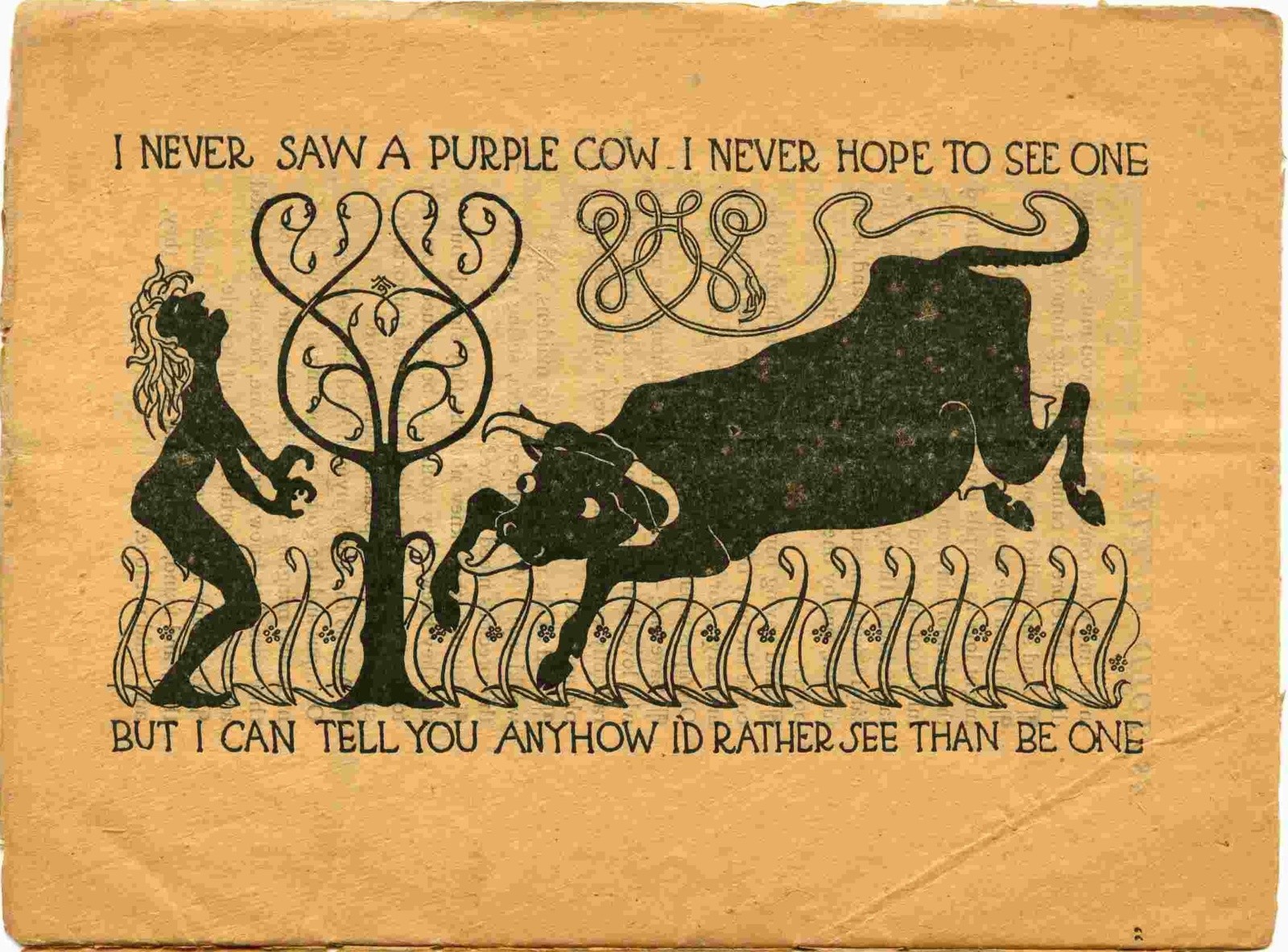



Walt Disney, Paramount Pictures and Doris Day intersect in a remarkable lost chapter of American art. Louis Grell—Disney’s former Chicago art teacher and the muralist behind numerous Paramount theatres—had never made a cartoon when he was asked in 1939 to create an entire world of Purple Cows. So the teacher became the student. Grell transformed Disney’s popular cow characters into something new: an episodic architectural cartoon world of recurring characters, visual jokes, jingles and local stories that spread through the Albert Pick hotel chain. Clarabelle became the model for his recurring heroine, Disney’s Ferdinand entered Grell’s world and married her, and individual cities were written into the story through locally themed murals and public jingle contests. The Purple Cow restaurants became popular enough to inspire Doris Day to sing “A Purple Cow.” Almost the entire painted world vanished. Today, 94 unique murals have been documented.
LOUIS GRELL AND ALBERT PICK HOTELS
A PAINTED WORLD ACROSS AMERICA · 1939–1960
By 1939, Louis Grell had entered one of the most unusual commissions of his long mural career. Albert Pick Hotels called it the Purple Cow. What followed was not one restaurant, one mural, or one decorative novelty. It became a geographically distributed painted program in which Grell created a distinctive comic universe of anthropomorphic cows, a bull and recurring characters for hotel restaurants across the Pick system.
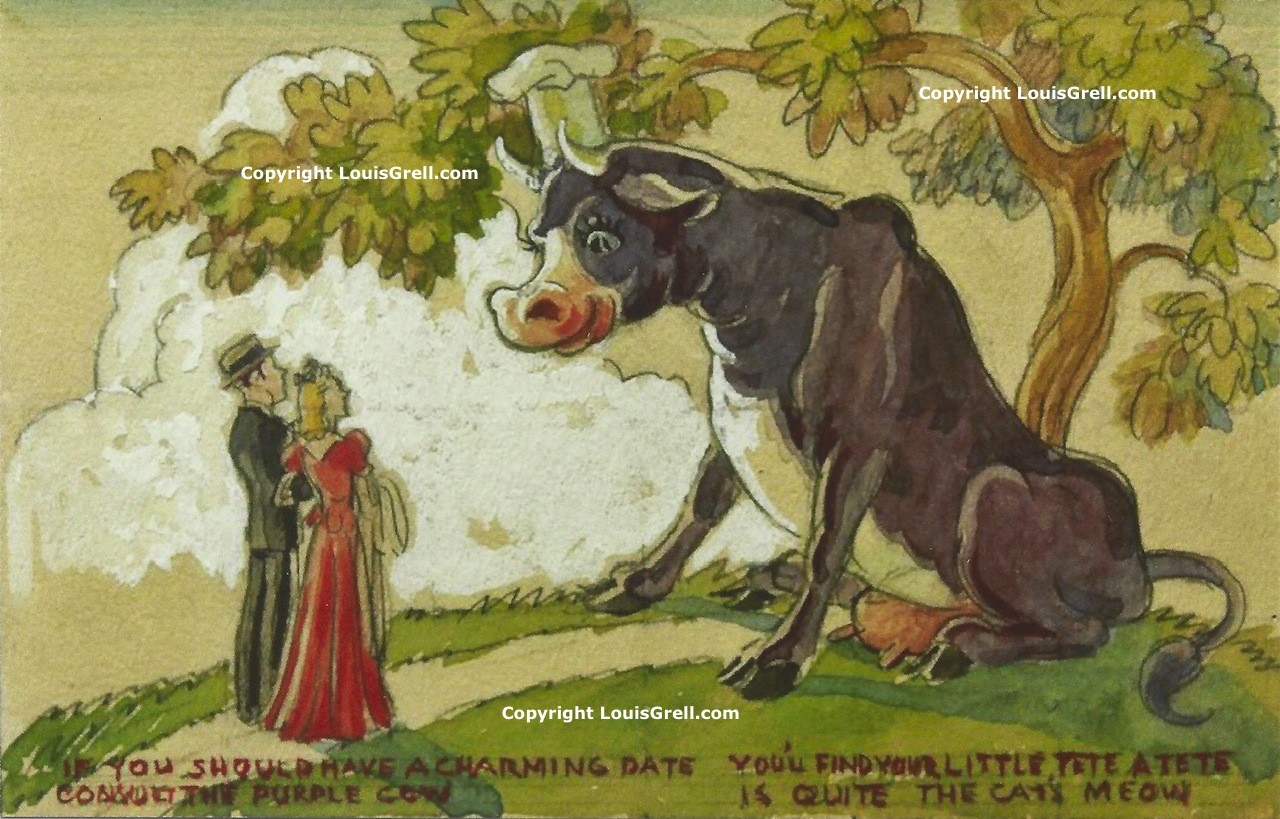
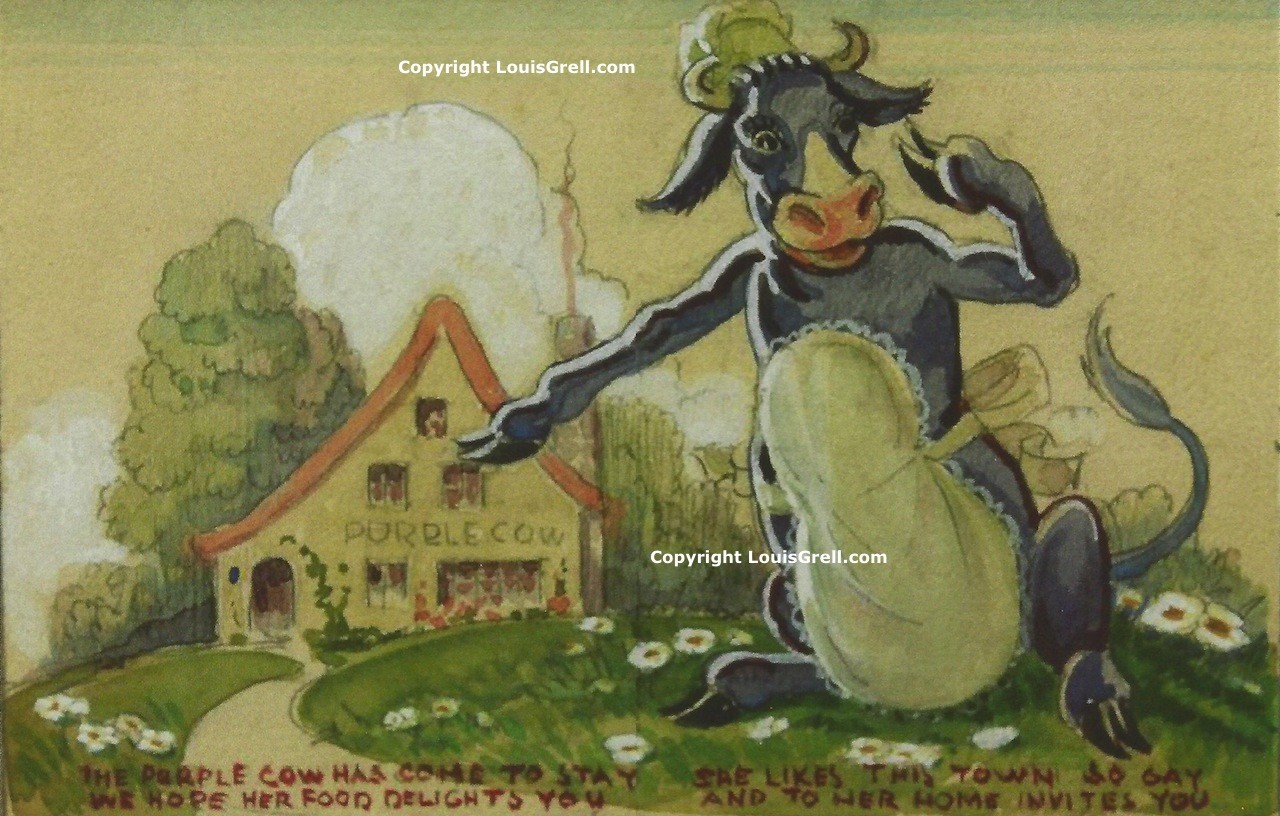
The Purple Cow restaurant itself predated Grell. Pick Hotels had used the name for years before his murals appeared. What Grell created was the painted world around it. Drawing upon the rapidly developing visual language of American animation and popular culture—and, as the surviving evidence increasingly demonstrates, character traditions closely associated with Walt Disney—Grell transformed the Purple Cow into an extraordinary cast of glamorous cows, gentle bulls and comic personalities who danced, sang, cooked, courted, worked, traveled and inhabited fantastic landscapes of flowers, improbable trees and restaurant humor.
This was not simply decoration. Grell’s characters became part of the identity of the Purple Cow restaurants themselves. They appeared on walls alongside rhyming jingles and migrated into menus, advertising, promotional cards, public contests and other Pick Hotels material. Individual compositions were repeated and transformed from city to city, while locally themed murals connected the imaginary Purple Cow world to the communities in which the restaurants operated.
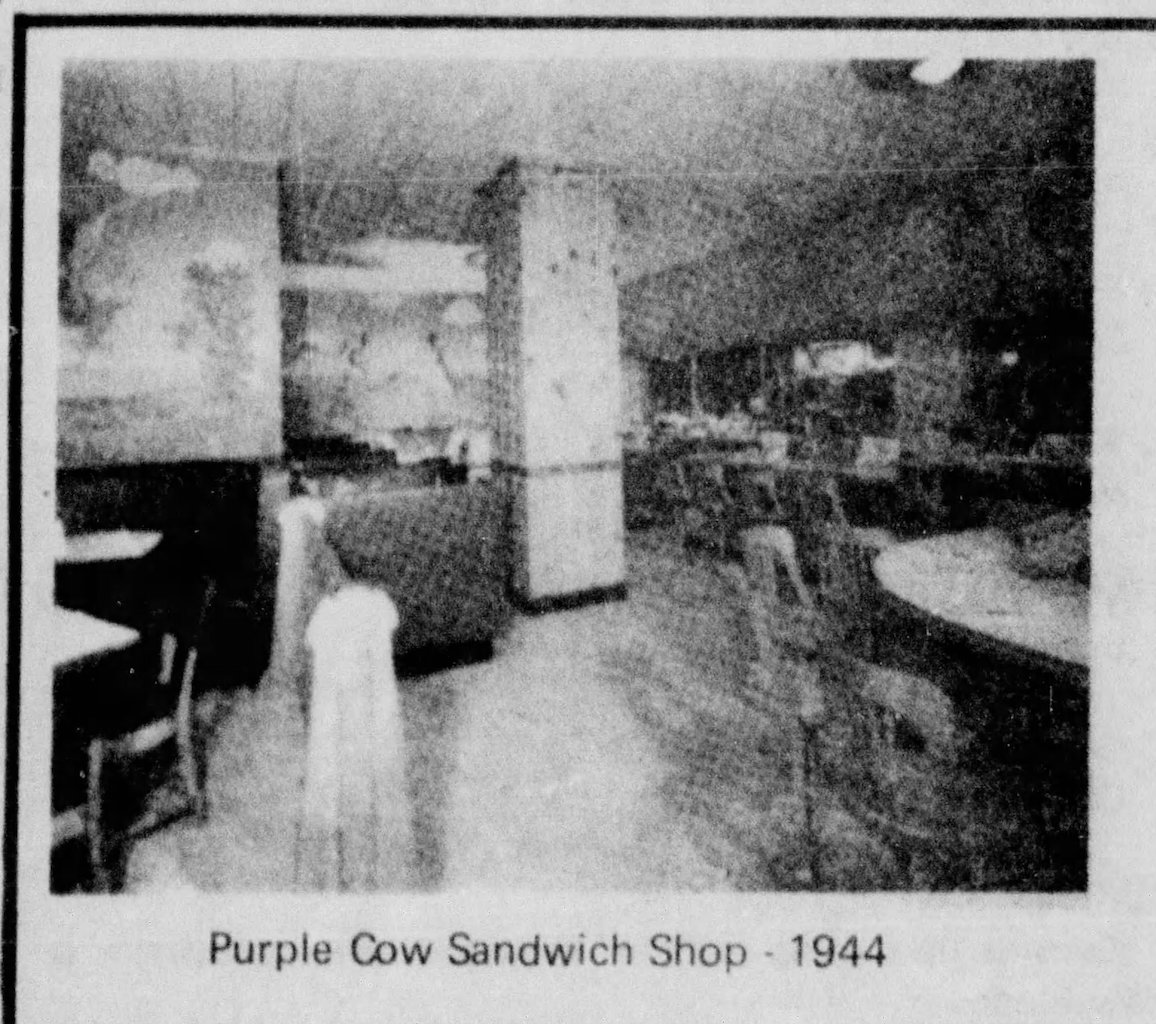
The surviving record can now be reconstructed from period photographs, Pick Hotels publications, newspaper advertisements, menus, public jingle contests, original Grell watercolors, surviving mural fragments and institutional survivors. The current photographic catalogue documents 94 individual Purple Cow mural images representing twelve hotel locations. That number is deliberately conservative: contemporary documentary evidence establishes additional Purple Cow mural installations for which no mural photographs are presently known.
94 DOCUMENTED MURAL IMAGES — THE HISTORICAL PROGRAM WAS LARGER.
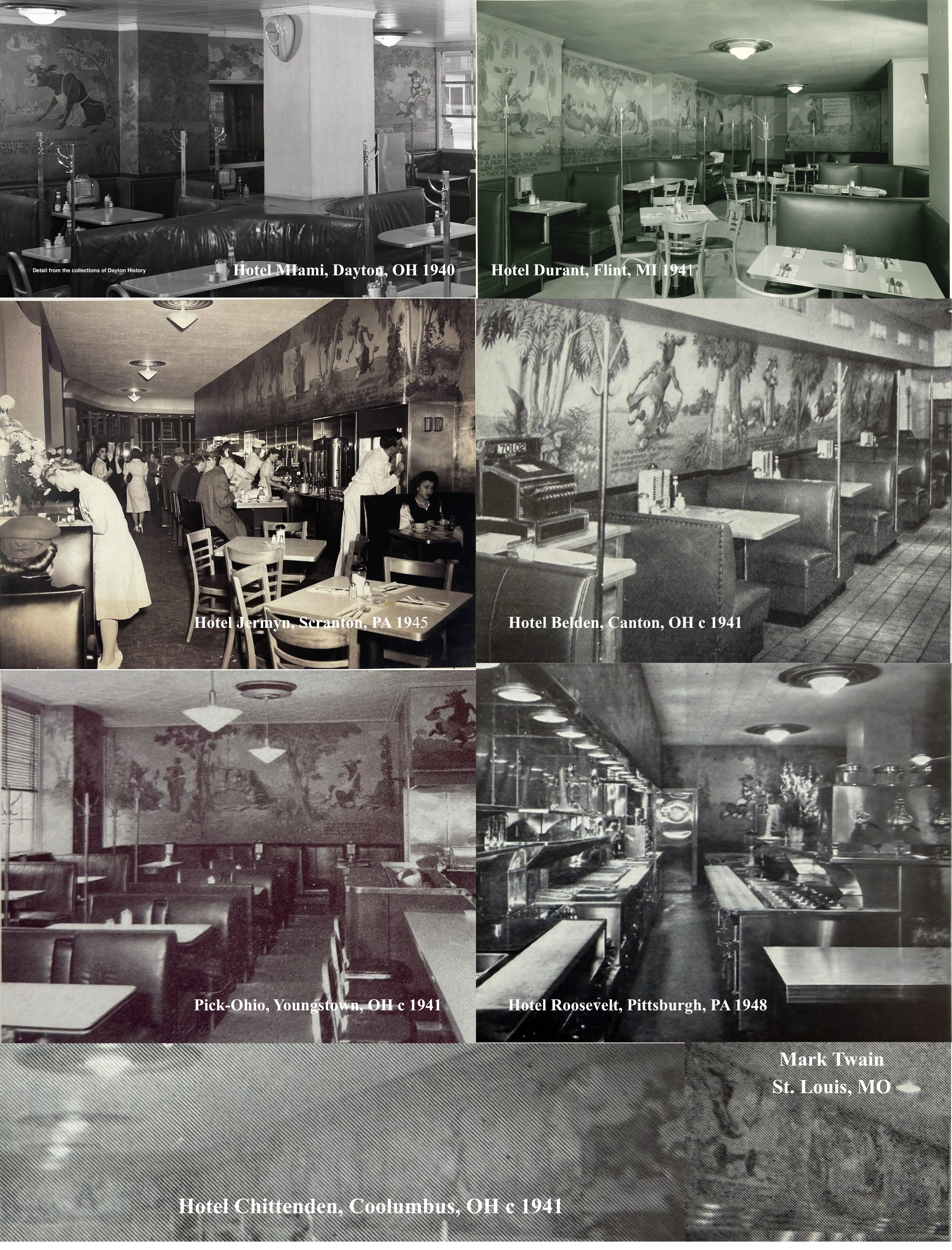
44 MURAL COLLAGE.
A portion of the reconstructed Purple Cow mural record. Grell’s recurring cast appears across geographically separated Pick Hotels properties, but the surrounding worlds continually change.
PICK HOTELS IDENTIFIED ITS OWN ARTIST
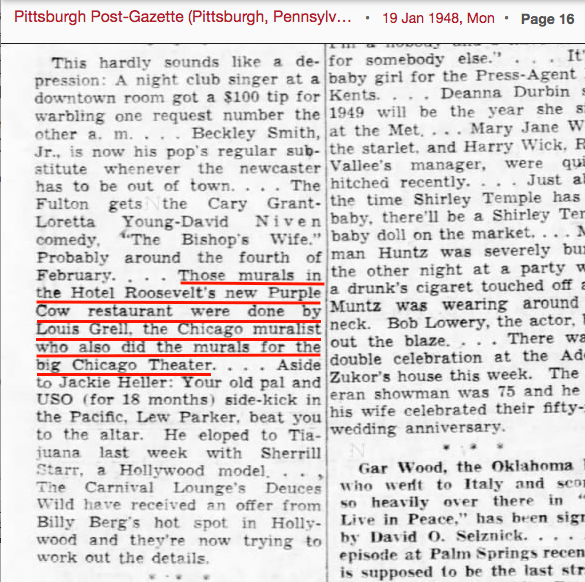
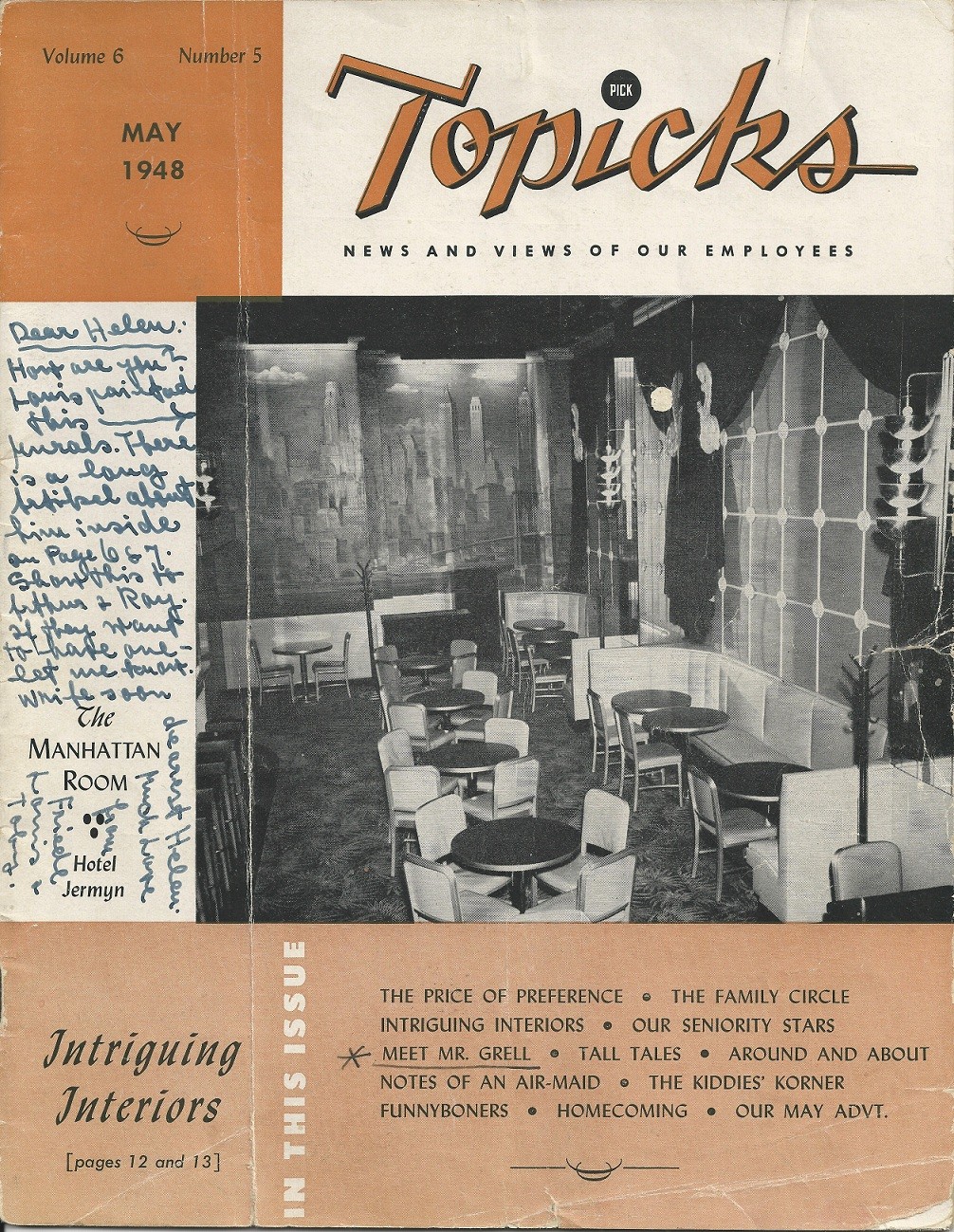
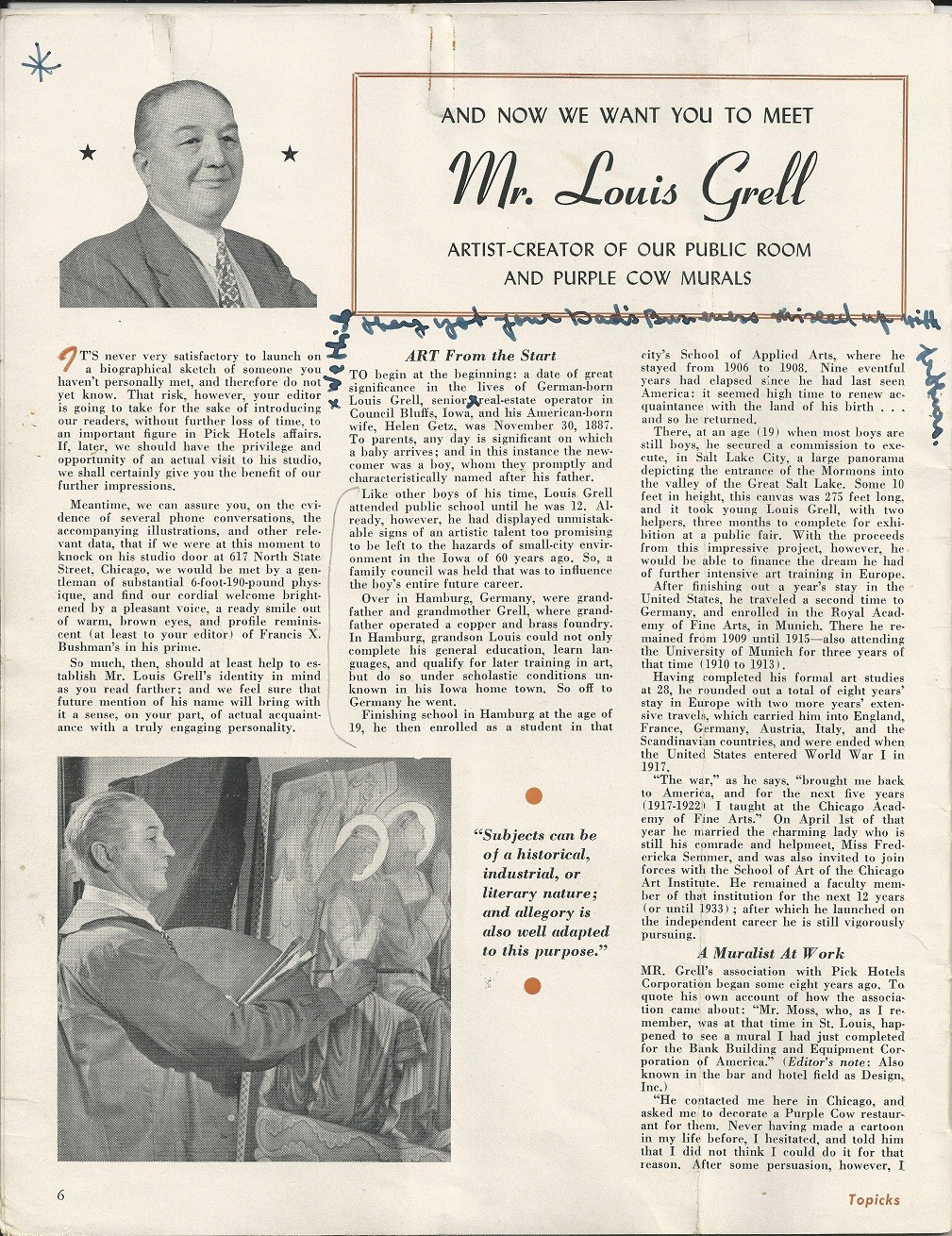
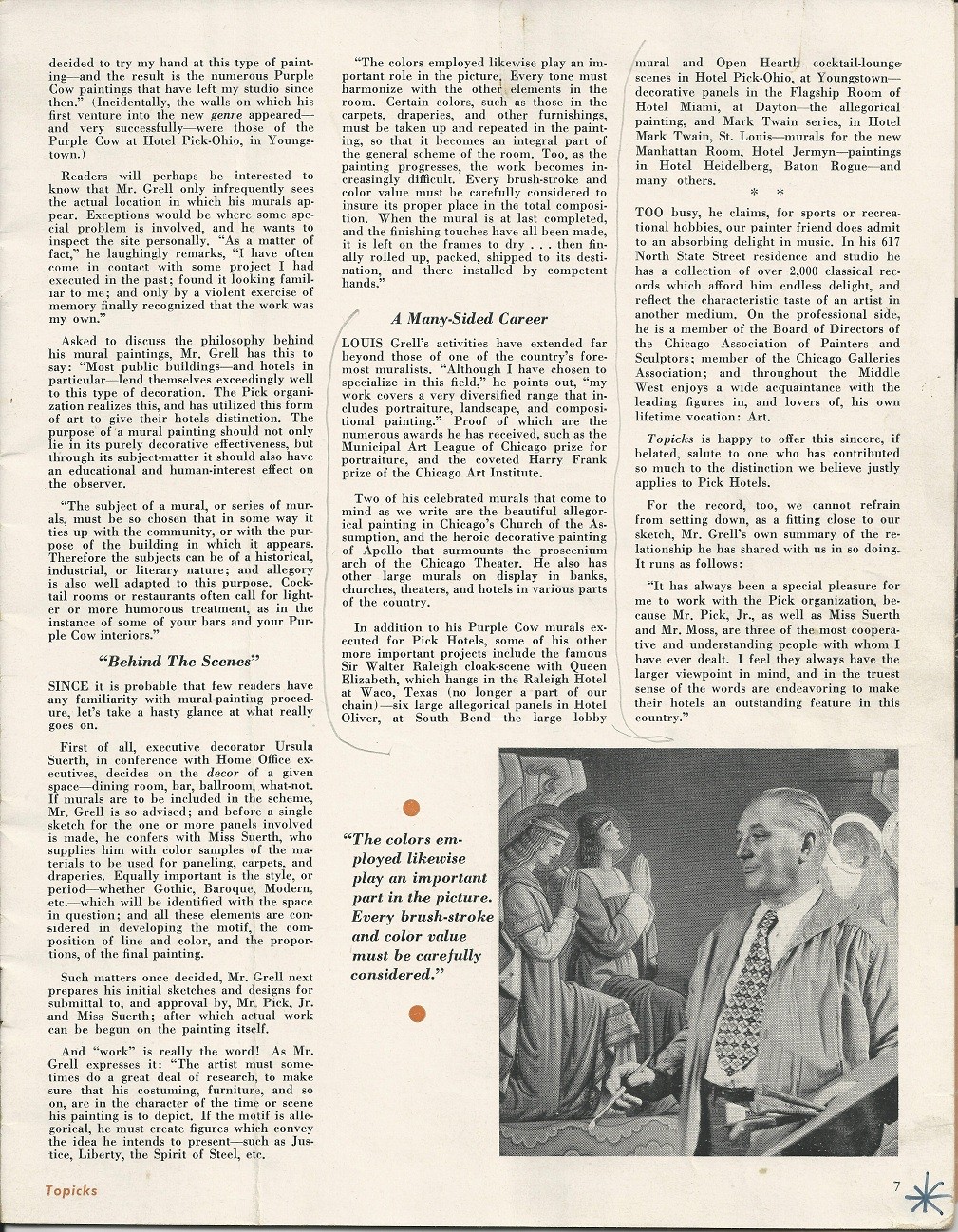
The attribution does not rest on a modern stylistic reconstruction. Pick Hotels identified Grell while the program was active. In May 1948, Topicks introduced him as the “Artist-Creator of Our Public Room and Purple Cow Murals.” In its March 1948 coverage of Pittsburgh’s Hotel Roosevelt, the company described “no less than 600 feet” of Purple Cow murals executed by the “famous Chicago mural artist, Louis Grell,” adding that his work “also adorns every other PC in the chain.”
Those statements establish both authorship and scale from the hotel organization itself. The photographs then allow the corporate record to be tested visually: exaggerated eyes and tongues, humanlike gestures, theatrical costumes, flowers, fantastic trees, food-bearing landscapes and comic narrative recur from property to property.
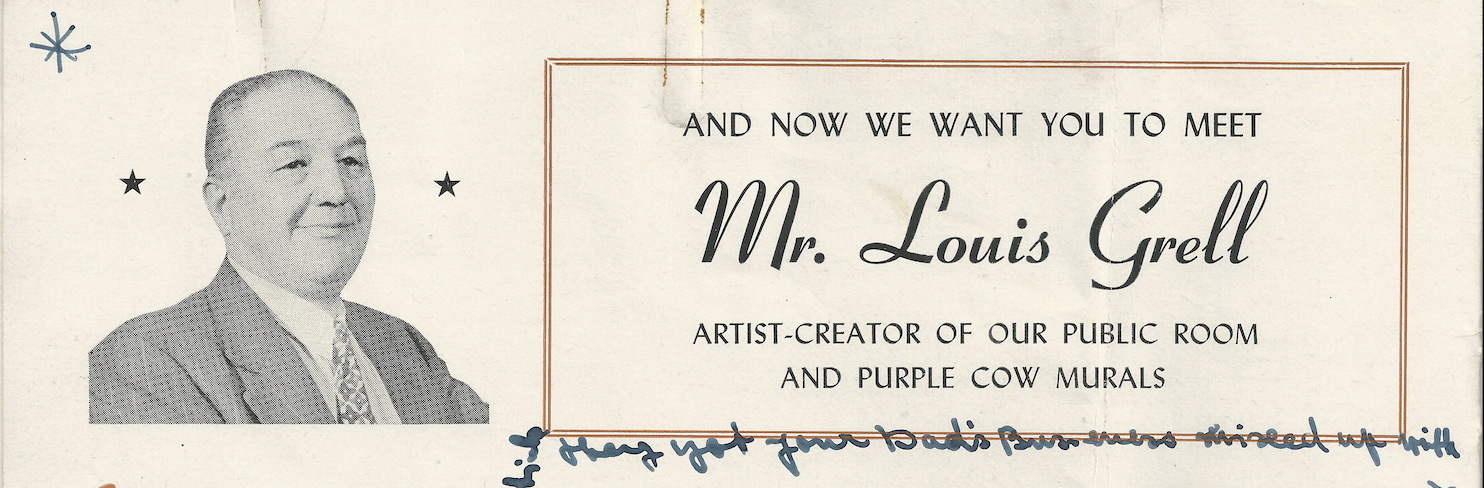
MEET MR. GRELL.
Pick Hotels’ own publication identifies Louis Grell as the artist-creator of its public-room and Purple Cow murals.
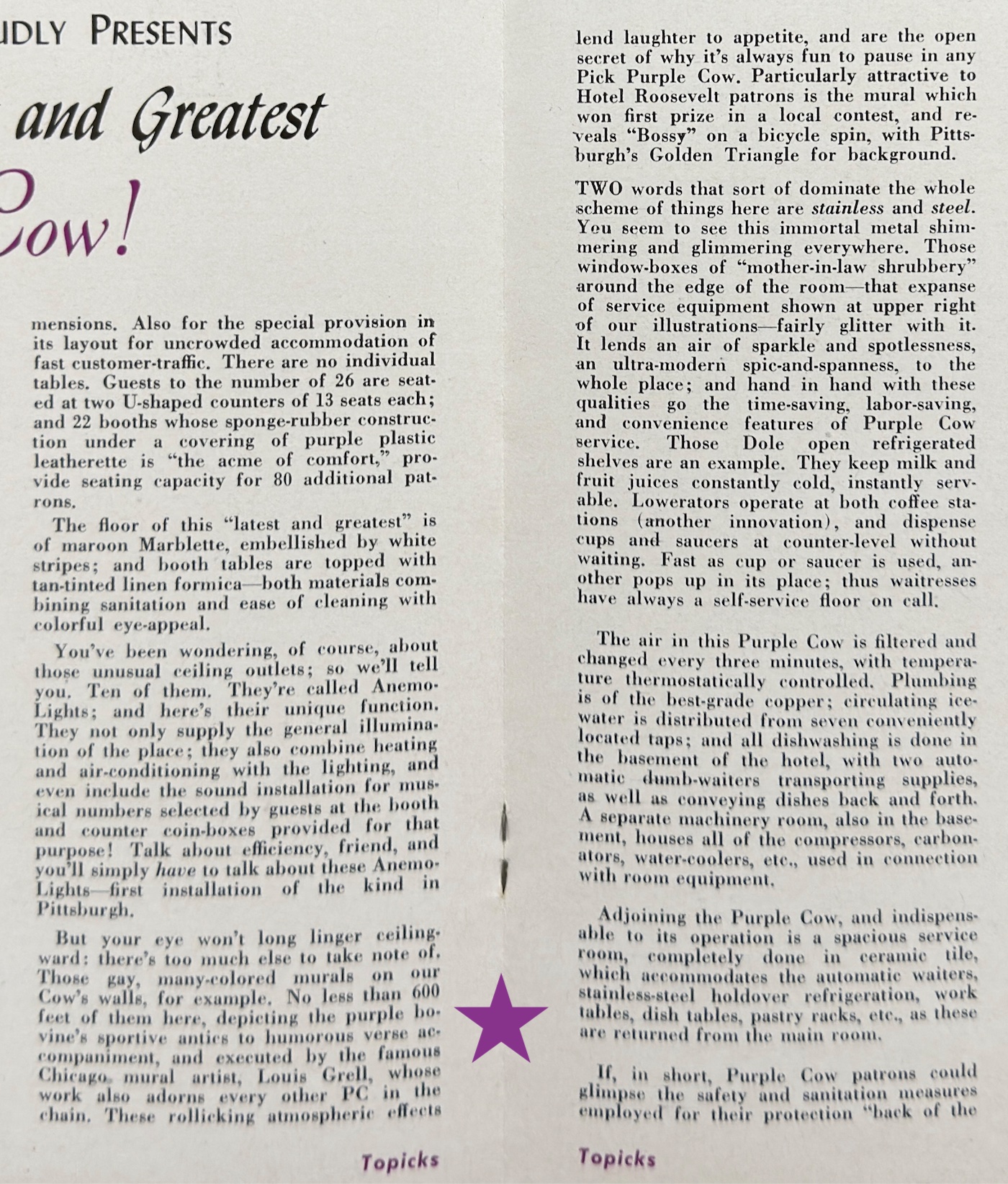
Hotel Roosevelt, Pittsburgh. Pick Hotels reported “no less than 600 feet” of Grell murals at this Purple Cow and stated that his work adorned every other Purple Cow in the chain.
SIX HUNDRED FEET OF GRELL
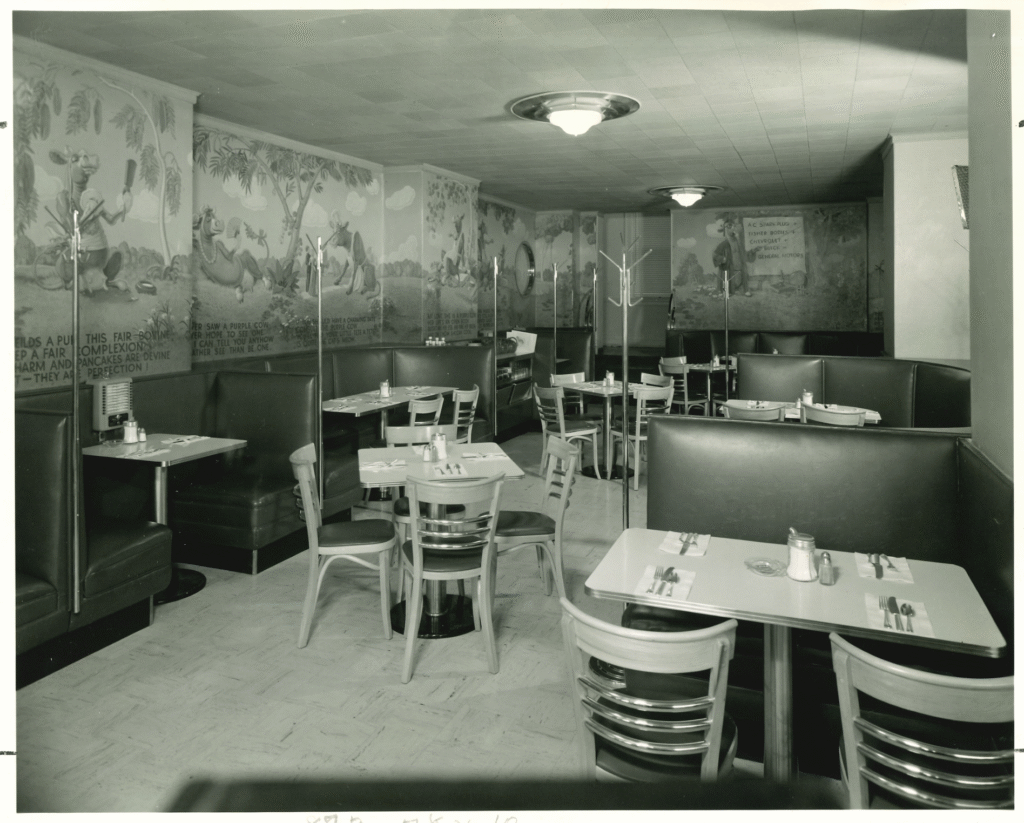
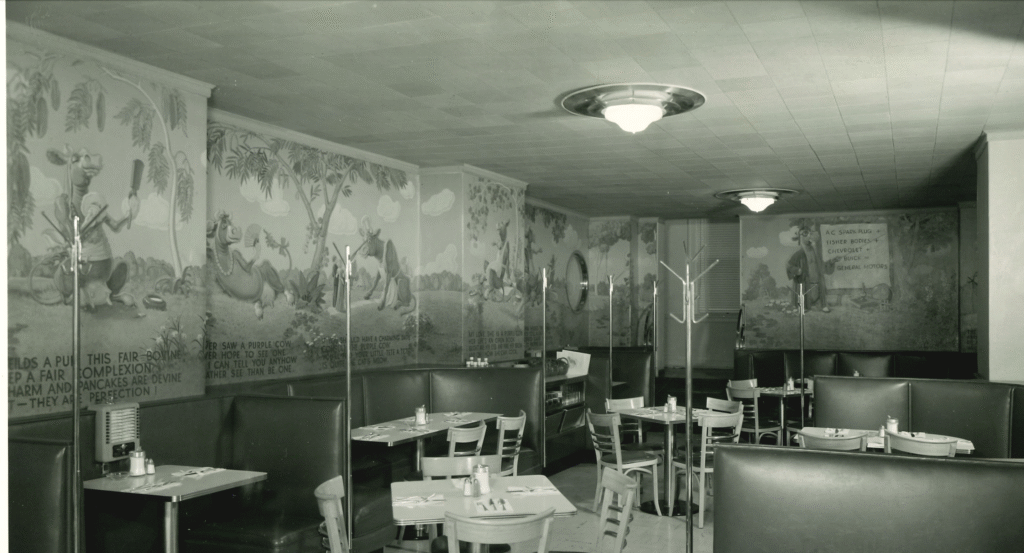
The Hotel Roosevelt provides the clearest surviving measure of the program’s architectural ambition. At least fifteen mural images have been identified in surviving Roosevelt documentation. The significance of the 600-foot statement is therefore not merely numerical. Guests were not looking at a few framed cartoons; they were seated within an environment whose imagery extended around the restaurant walls.
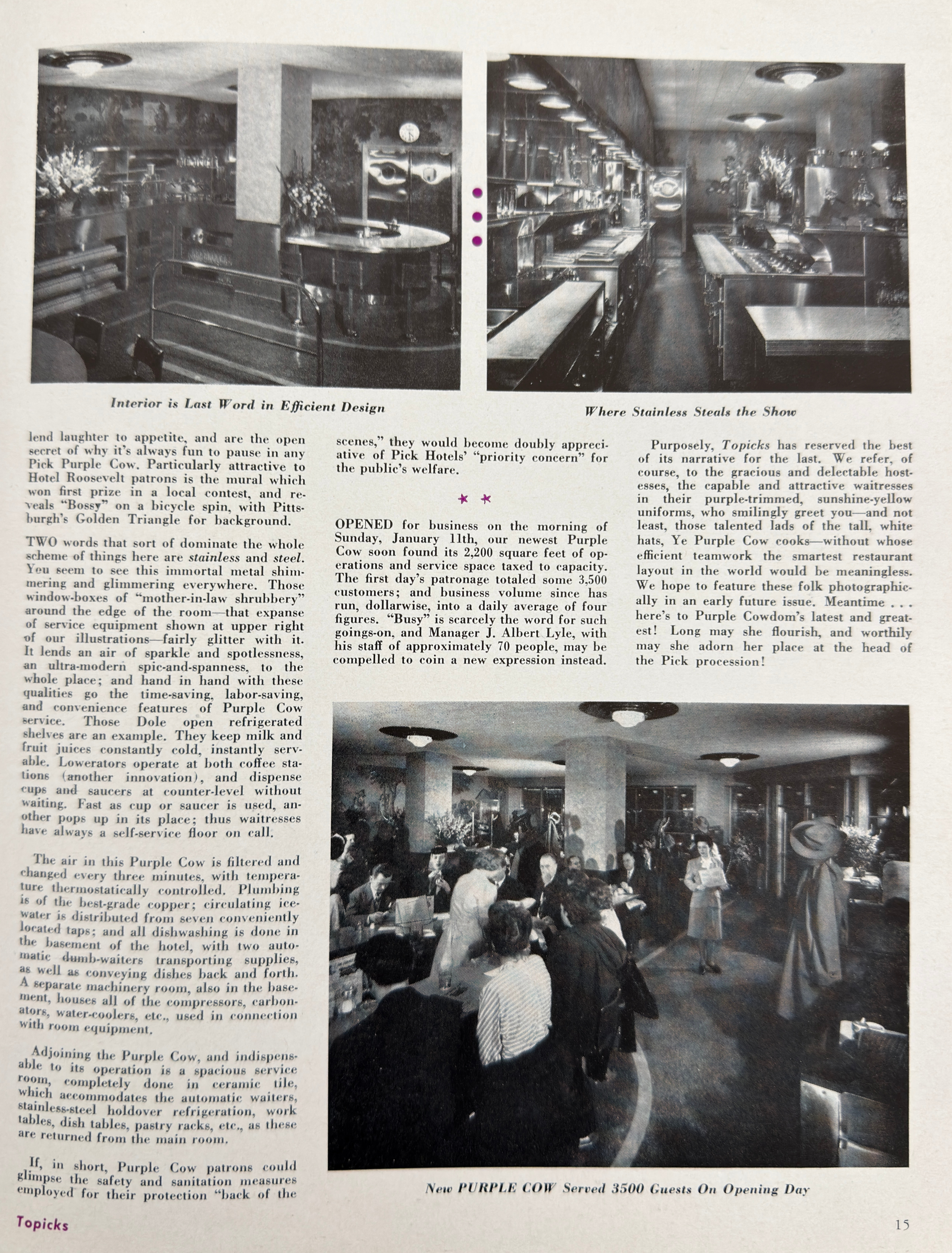
Purple Cow, Hotel Roosevelt, Pittsburgh. Period Pick Hotels documentation preserves the scale and variety of Grell’s painted environment.
A CAST OF CHARACTERS — NOT A SET OF DUPLICATES
Grell reused favorite characters, situations and visual jokes, but he did not simply transfer one identical mural from hotel to hotel. A familiar figure might return while the landscape changed; costumes, flowers, trees, props, architecture and surrounding characters could be reinvented. The result was continuity without mechanical sameness.
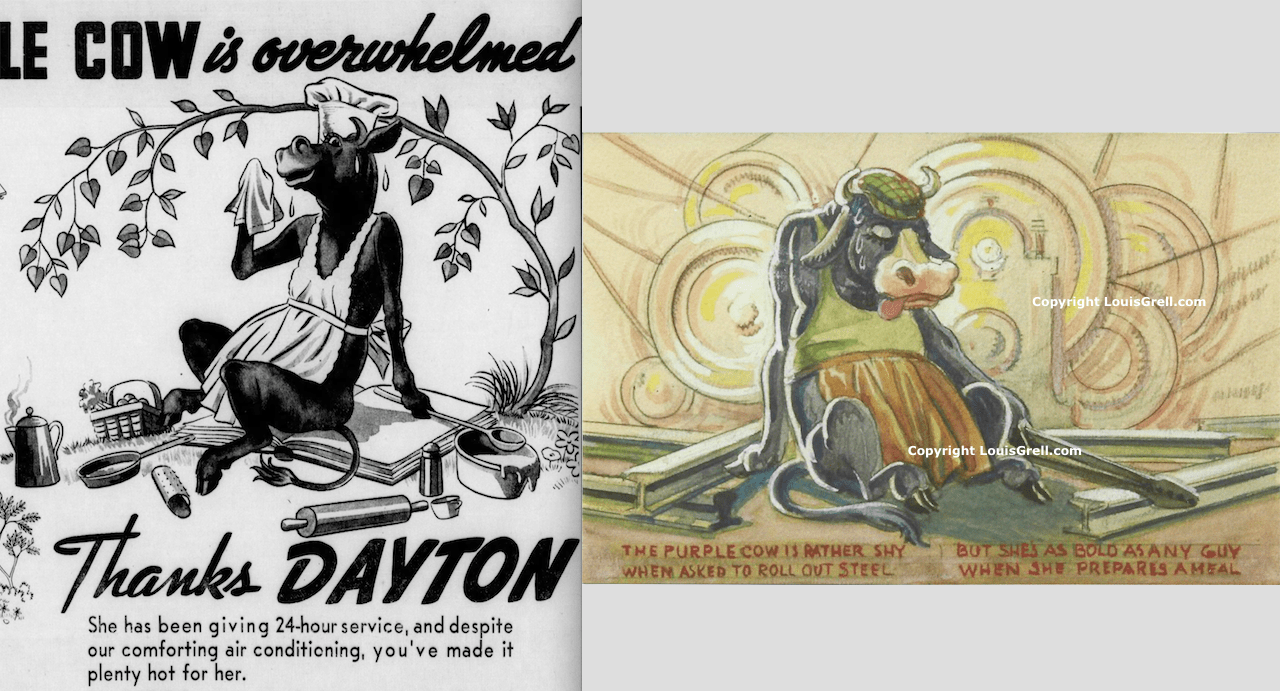
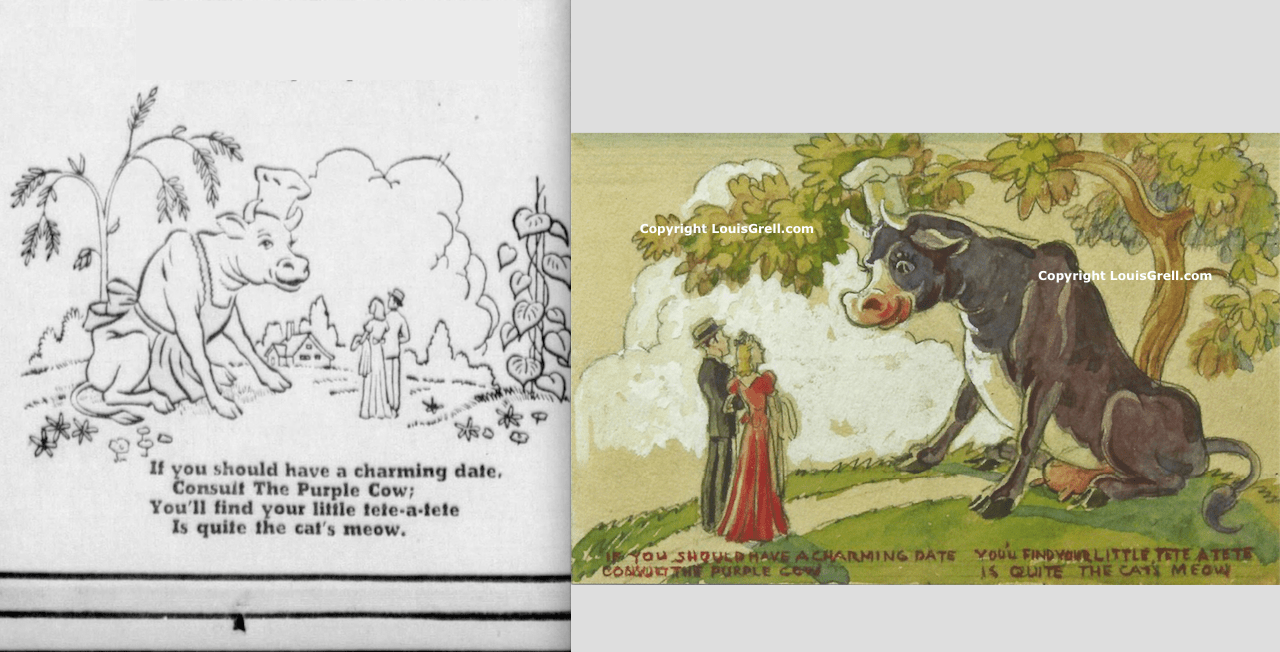
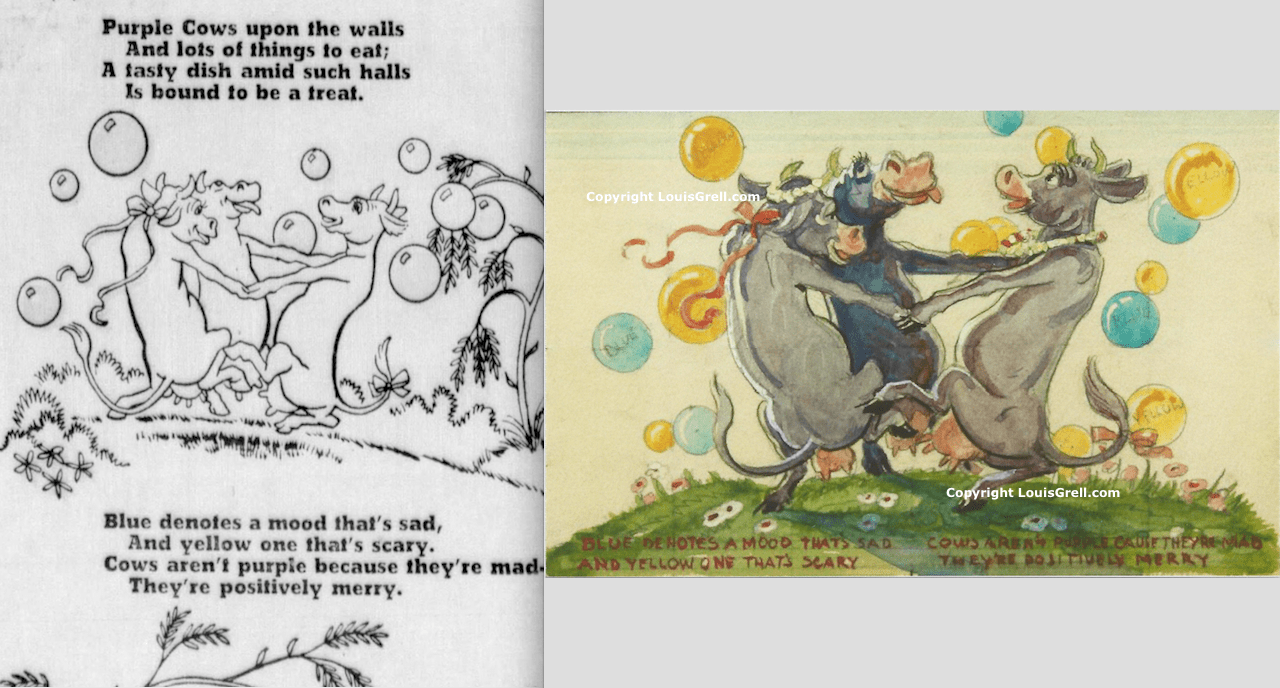
This is particularly clear when original watercolors are compared with hotel photographs. The small designs preserve central ideas, while the monumental murals place those figures within newly invented surroundings. Positively Merry is a strong example: its recognizable central character appears in several Purple Cow settings and in the June 25, 1940 Dayton advertisement, yet the surrounding wall compositions vary.
THE CHARACTER COULD RETURN. THE WORLD AROUND IT CHANGED.
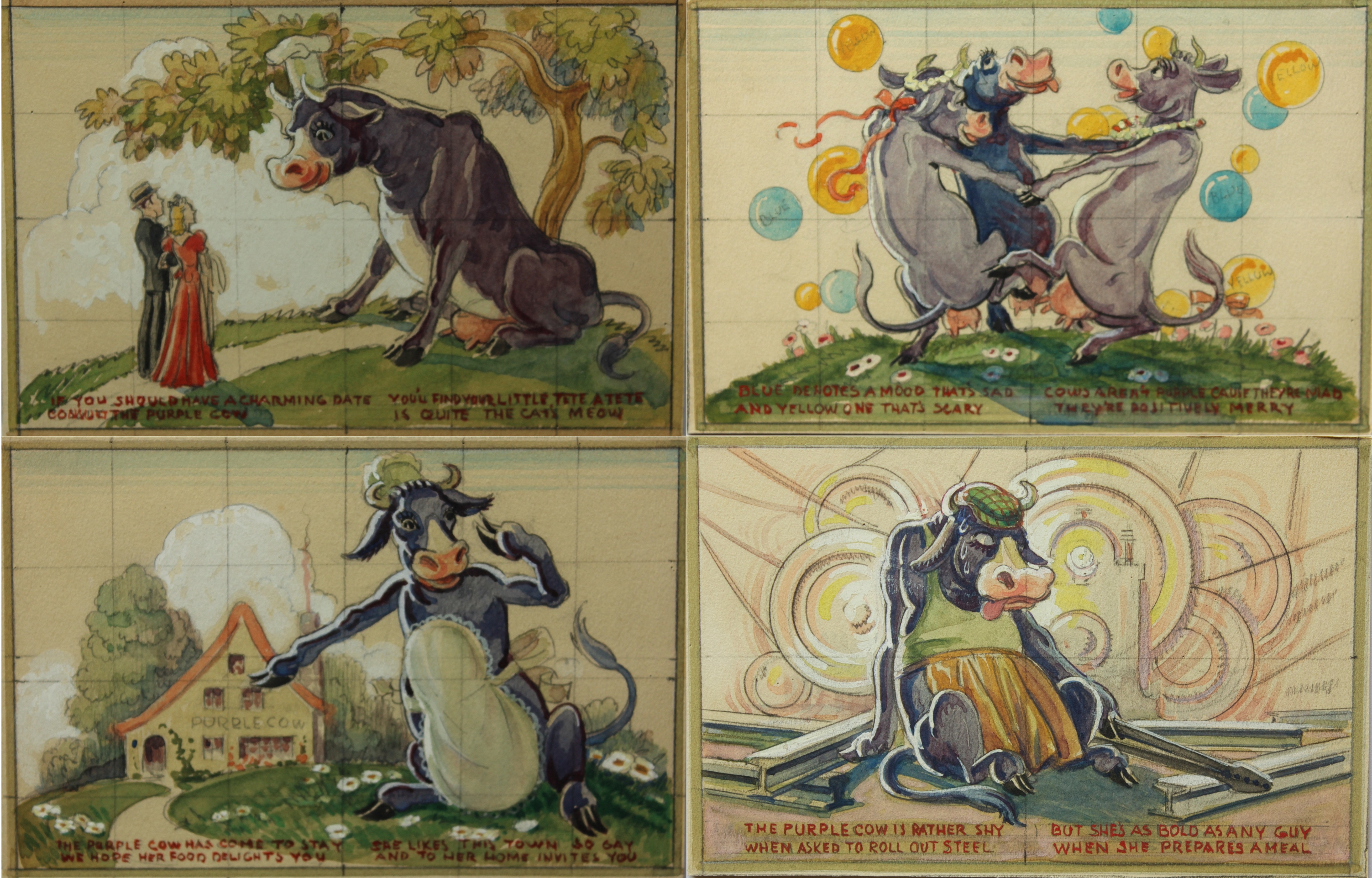
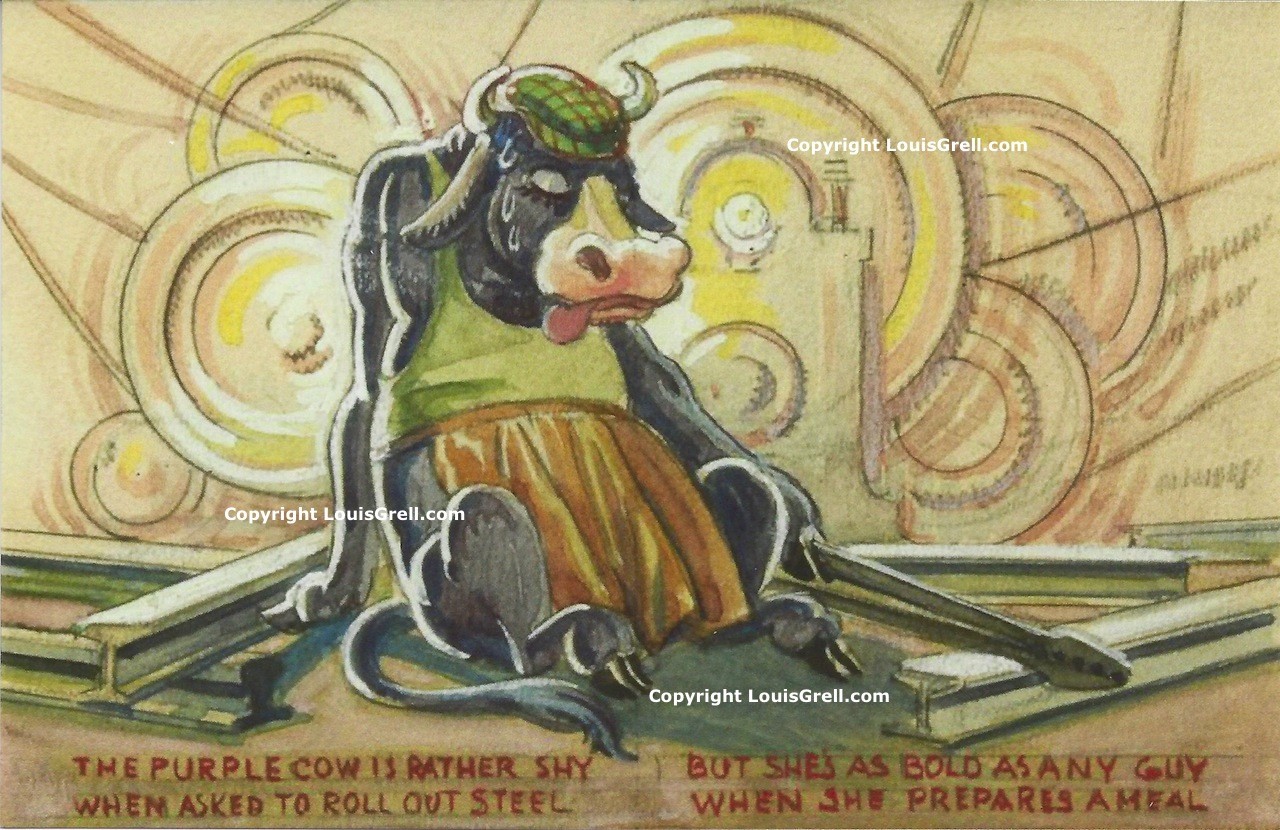
Four original Louis Grell Purple Cow watercolors preserved by members of the Grell family. Enlargement grids remain visible on the small designs, providing physical evidence of their working function. The colors of these cows may be an indication of how early these were created possibly indicating Grell and Executive Decorator Ursula Sierth had not yet settled on the exact purple hue of the female heroine.
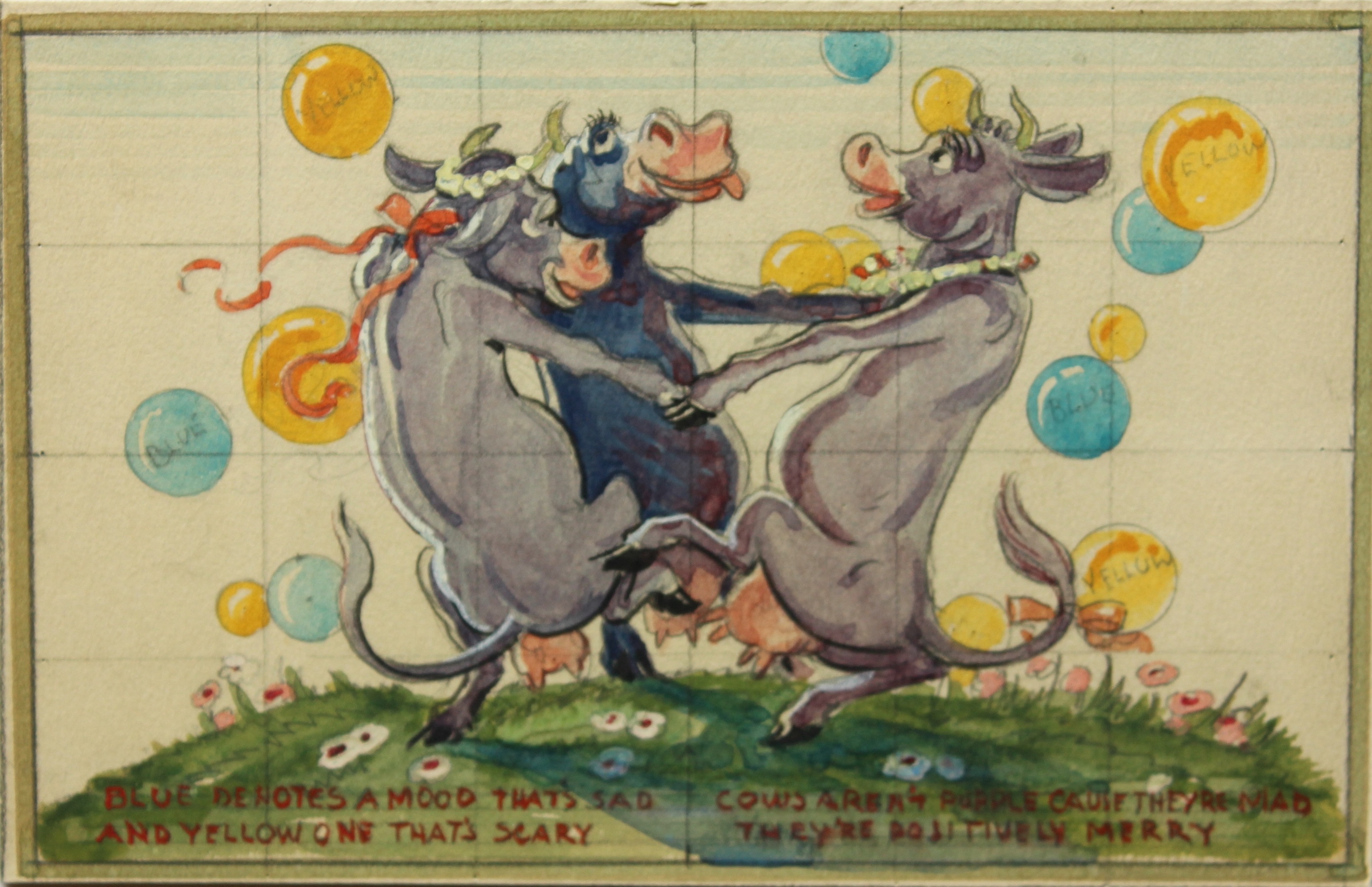
POSITIVELY MERRY. Grell’s small gridded watercolor preserves a recurring Purple Cow composition that can be followed into printed and monumental forms.
1940: THE PURPLE COW ALREADY HAD A VISUAL IDENTITY
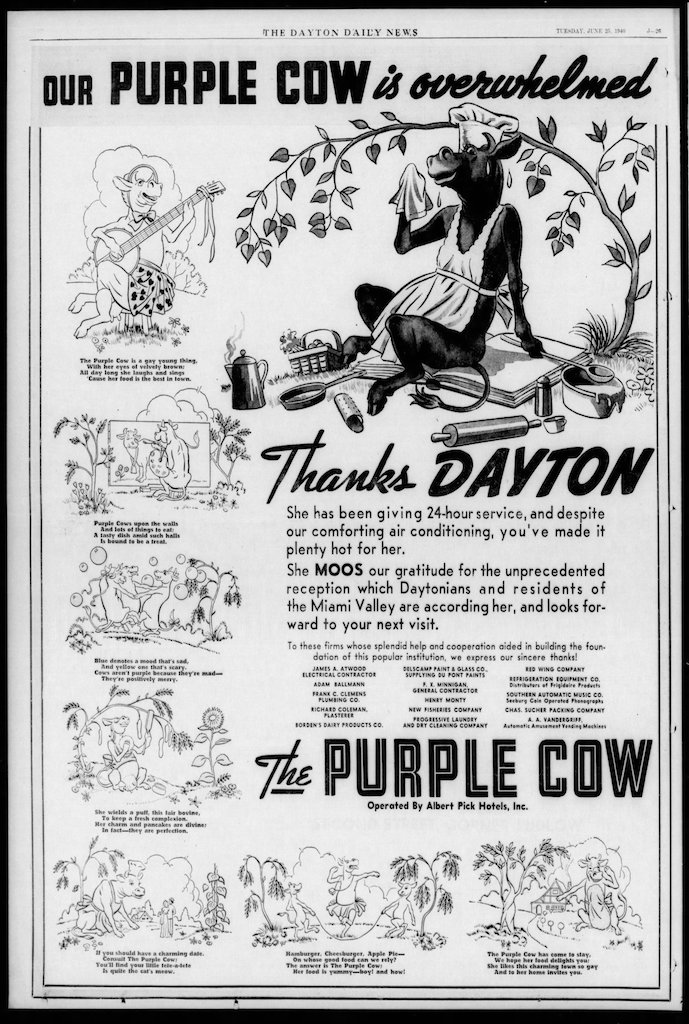
On June 25, 1940, the Dayton Daily News published a large Pick Hotels advertisement for the Hotel Miami Purple Cow. Eight Purple Cow compositions were reproduced in the advertisement; a ninth, Ferdinand, is documented in the restaurant photography. Three compositions in the advertisement correspond to original Grell Purple Cow watercolors preserved by members of the Grell family. Young Thing exists in private hands.
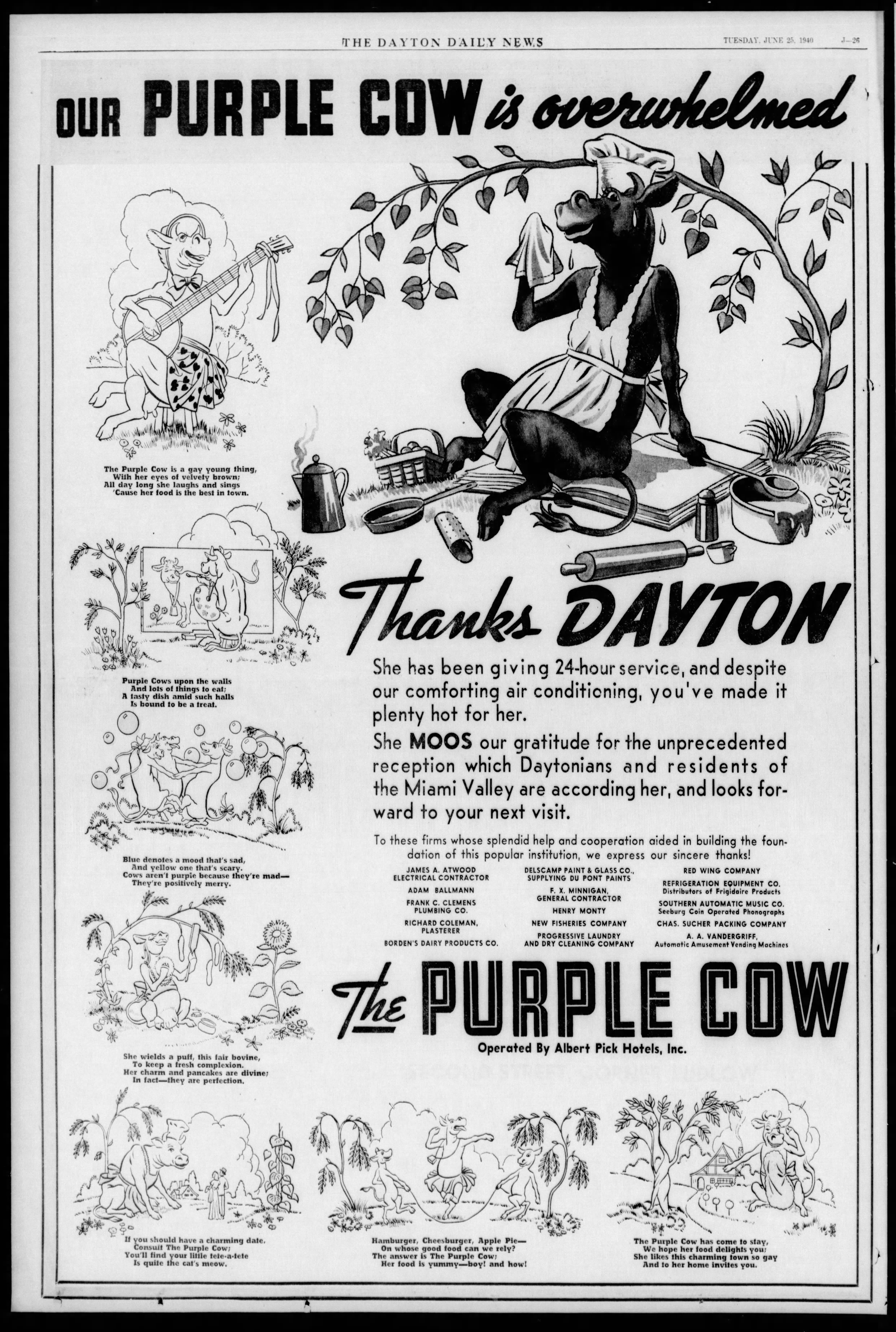
Dayton Daily News, June 25, 1940. Eight Purple Cow compositions are reproduced in this early Pick Hotels advertisement for the Hotel Miami. The advertisement provides a direct bridge between Grell’s small designs and the restaurant mural program.
FROM HOMAGE TO TRANSFORMATION
Disney and the Purple Cow World
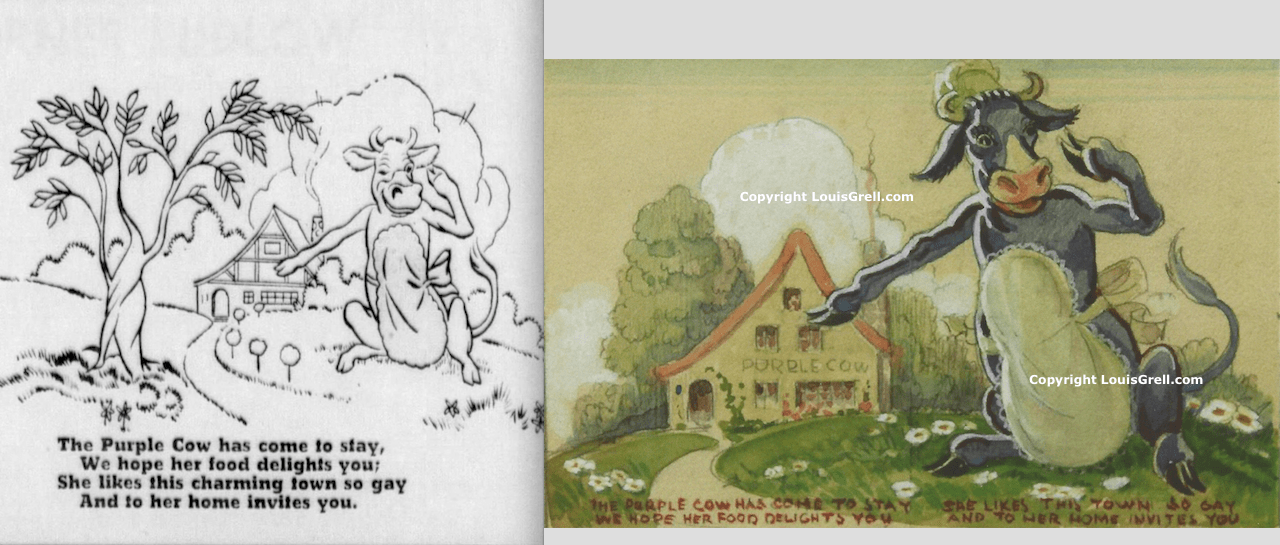
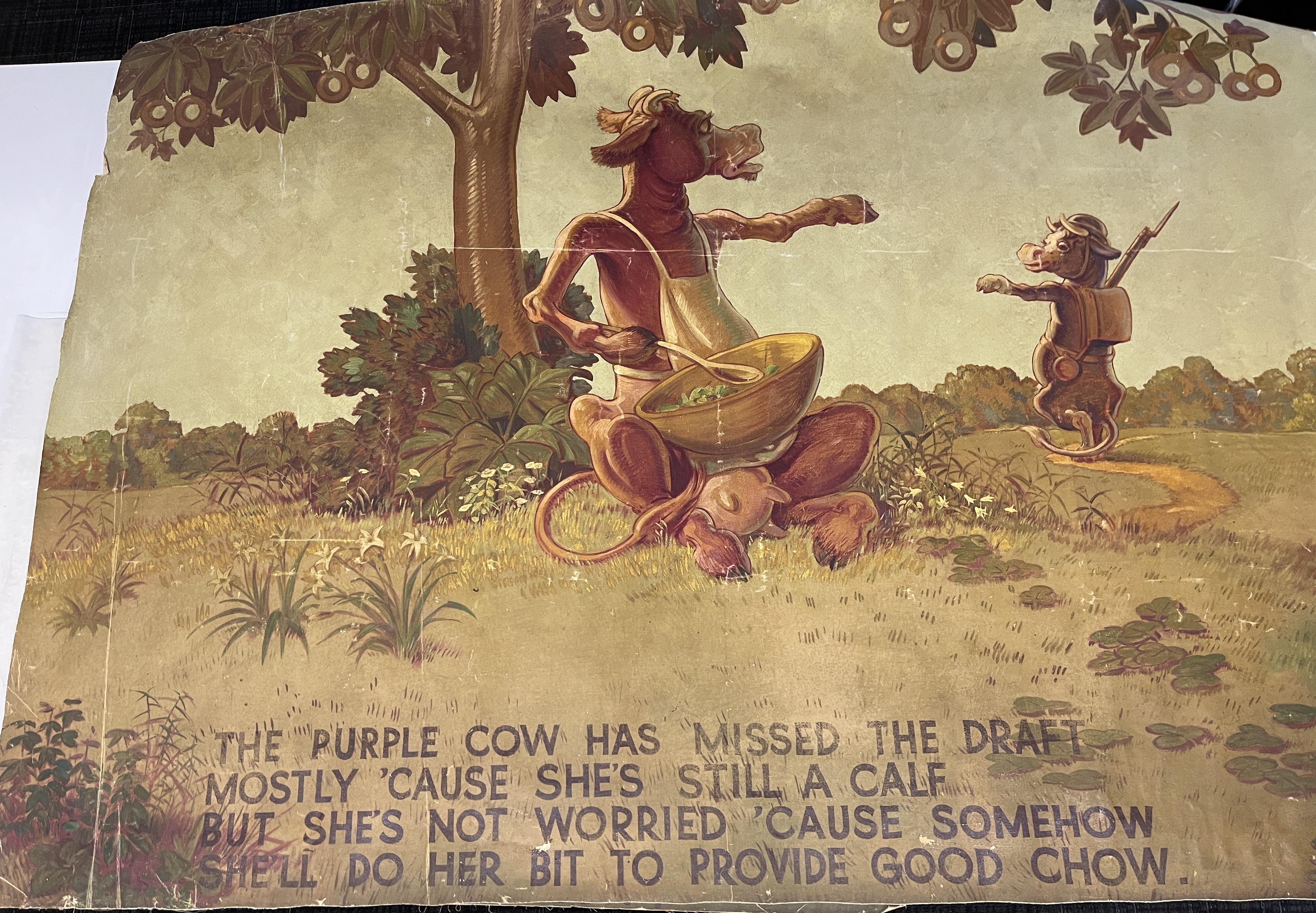
At first, the connection appeared to center on a single remarkable character: Ferdinand. Disney’s Ferdinand the Bull reached American theaters in November 1938 and won the Academy Award the following year, just as Grell’s Purple Cow world was beginning to take shape. By 1940, a bull named Ferdinand had entered Grell’s murals, retaining the gentle temperament, flowers and bullfighting narrative that defined Disney’s character. Grell then carried the story somewhere entirely new: his Ferdinand entered the Purple Cow world, encountered the matador without fighting—and married the Purple Cow.
Further study of the surviving murals, menus and promotional material now suggests that Ferdinand was not an isolated point of contact. During the decade immediately preceding Grell’s first Purple Cow murals, Disney had developed a recognizable world of anthropomorphic animal characters, including Clarabelle Cow—a highly feminized, socially human character who dressed, danced, performed music, cooked and participated in the comic and romantic life of Mickey’s animated world.
Grell did not reproduce Clarabelle’s physical design. His recurring female Purple Cow is unmistakably his own: reddish-purple, heavier and more naturally bovine in form, and lacking such familiar Clarabelle attributes as white gloves and her characteristic white neck treatment. Yet Grell repeatedly gave his Purple Cow heroine elements of the same character vocabulary—horns, exaggerated feminine eyes and lashes, makeup, bows and feminine clothing, occasional prominent cowbells, music, dancing, cooking, courtship and other distinctly human social behavior.
The distinction is important. The emerging evidence does not suggest simple copying. It suggests transformation.
Other surviving Pick material points toward Disney-era Mother Goose imagery, while Ferdinand provides the most explicit narrative connection. Taken together, these independent strands raise the possibility that Grell selectively absorbed elements of contemporary animated character culture and transformed them into a distinctive comic universe of his own—the Purple Cow world.
1. CLARABELLE COW — THE CHARACTER LANGUAGE
Throughout the decade before Grell’s first Purple Cow murals, Disney repeatedly presented Clarabelle as a recurring anthropomorphic female cow: horned and highly feminized, frequently wearing a skirt and her characteristic cowbell, and participating in music, dancing, cooking, romance, performance and other human activities.
Grell’s Purple Cow is physically different. Yet the surviving murals reveal that the same recognizable female Purple Cow type recurs throughout his program, changing costumes, activities and situations while retaining essentially the same color, substantial bovine form, facial construction, hair, horns, hooves and other physical characteristics.
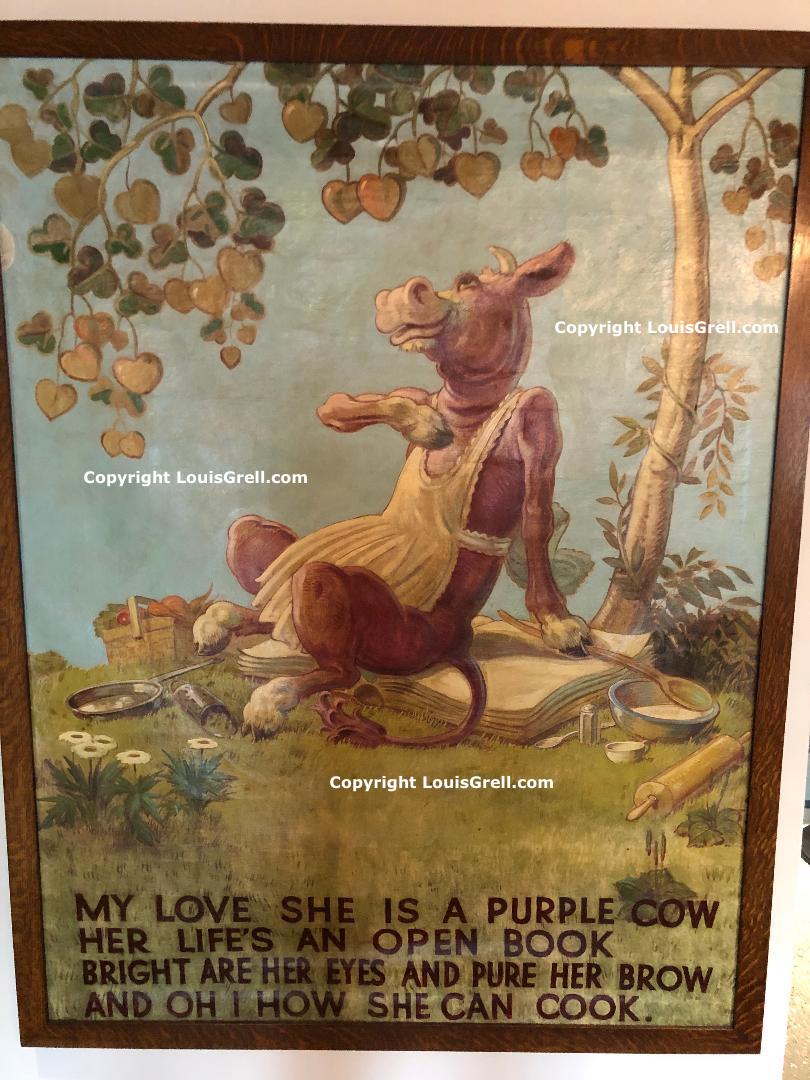
That recurring character was already present in the earliest documented Grell Purple Cow installation at the Hotel Pick-Ohio. Surviving images include FRESH COMPLEXION, with the Purple Cow engaged in feminine beauty and vanity; BE A TREAT, in which another cow being portrayed wears a conspicuous bell around her neck; and OH! HOW SHE CAN COOK, together with several presently unidentified mural scenes.
The significance is chronological. Grell’s female Purple Cow character existed independently of the known Ferdinand compositions.
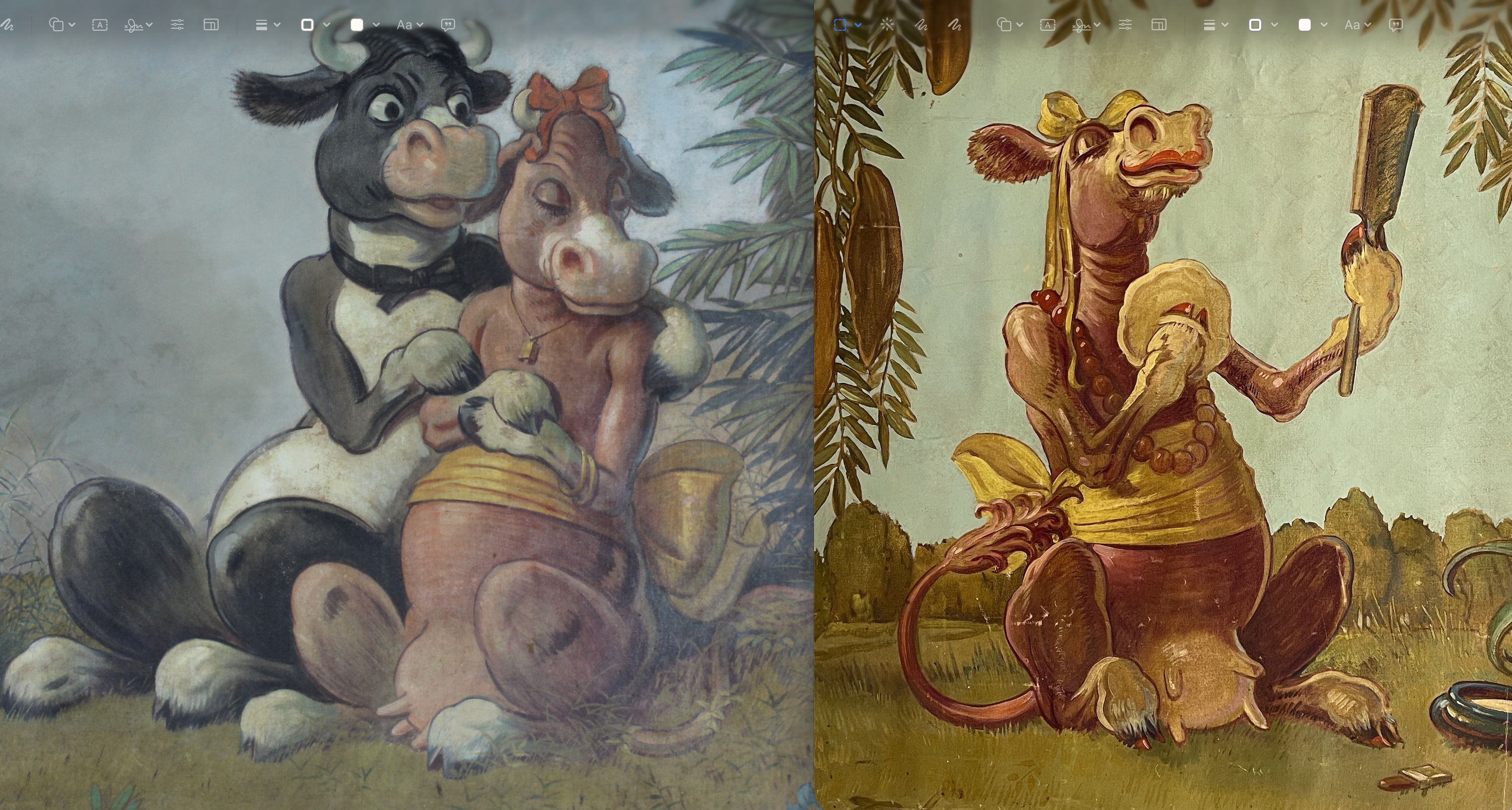
When Ferdinand subsequently enters the Purple Cow world, Grell does not replace his established heroine with a Disney-model Clarabelle. Ferdinand’s bride remains recognizably Grell’s Purple Cow. But Grell presents her with a particularly concentrated collection of feminine and Clarabelle-associated attributes: makeup, an elaborate hair bow, bracelets and a bell at her neck. Ferdinand wears a bow tie. The couple embraces beneath an exotic tree surrounded by flowers and foliage, while the accompanying verse explicitly announces that Ferdinand “HAS WED A SPLENDID SPOUSE.”
That creates a more intriguing question than simple physical resemblance:
WHY DID GRELL MARRY FERDINAND TO THIS PARTICULAR COW?
Was Grell merely marrying his newly introduced Ferdinand to the established heroine of the Purple Cow program? Or, in dressing and presenting that heroine for Ferdinand’s wedding, was he also playing upon the contemporary audience’s familiarity with Disney’s other famous anthropomorphic cow—Clarabelle?
The surviving evidence does not require Grell’s Purple Cow to be a copy of Clarabelle for that question to matter. Indeed, the physical differences may be part of the larger pattern: Grell repeatedly took recognizable elements of contemporary character culture and translated them into his own visual language.
NOT IMITATION. TRANSFORMATION.
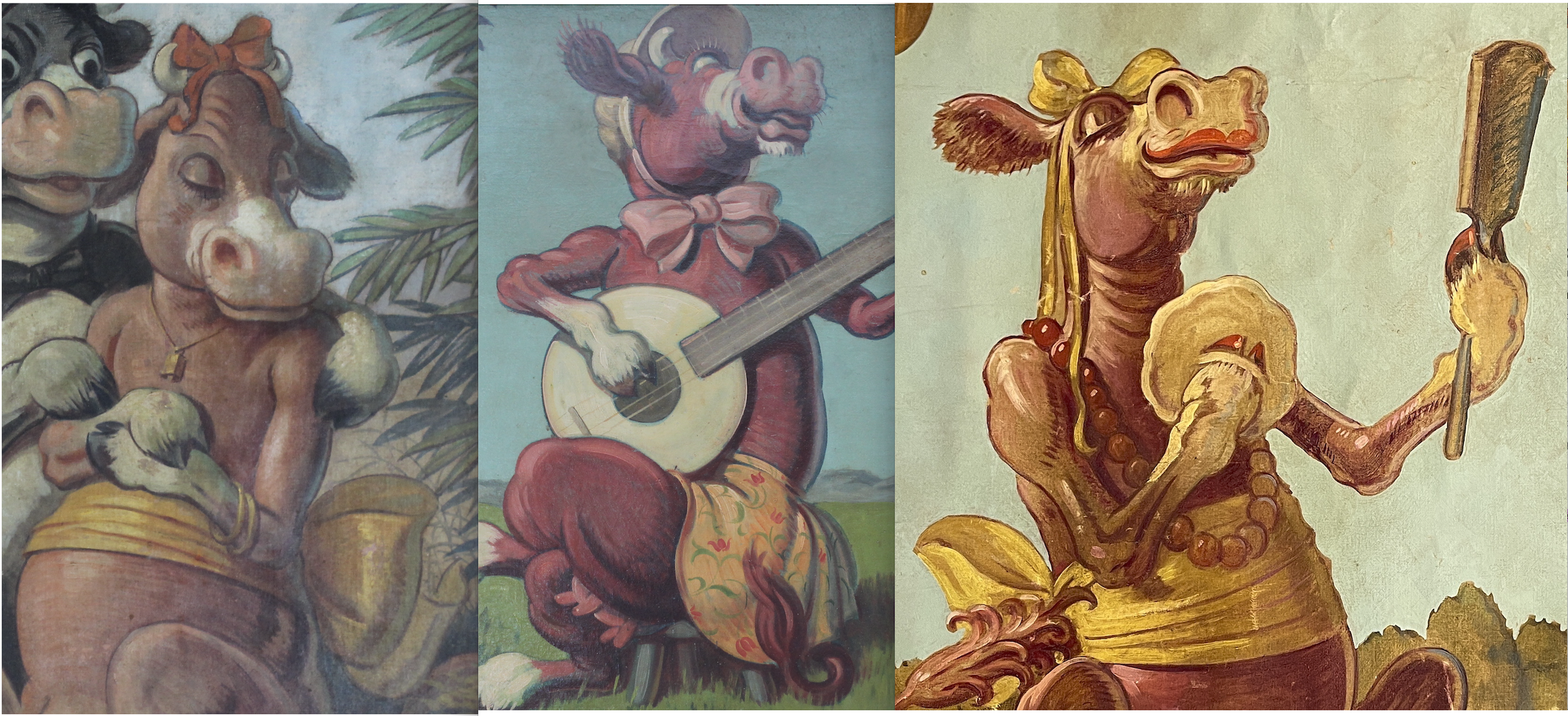
FRESH COMPLEXION at her vanity, YOUNG THING singing and playing an instrument, OH! HOW SHE CAN COOK/dancing imagery, and Ferdinand’s bride.
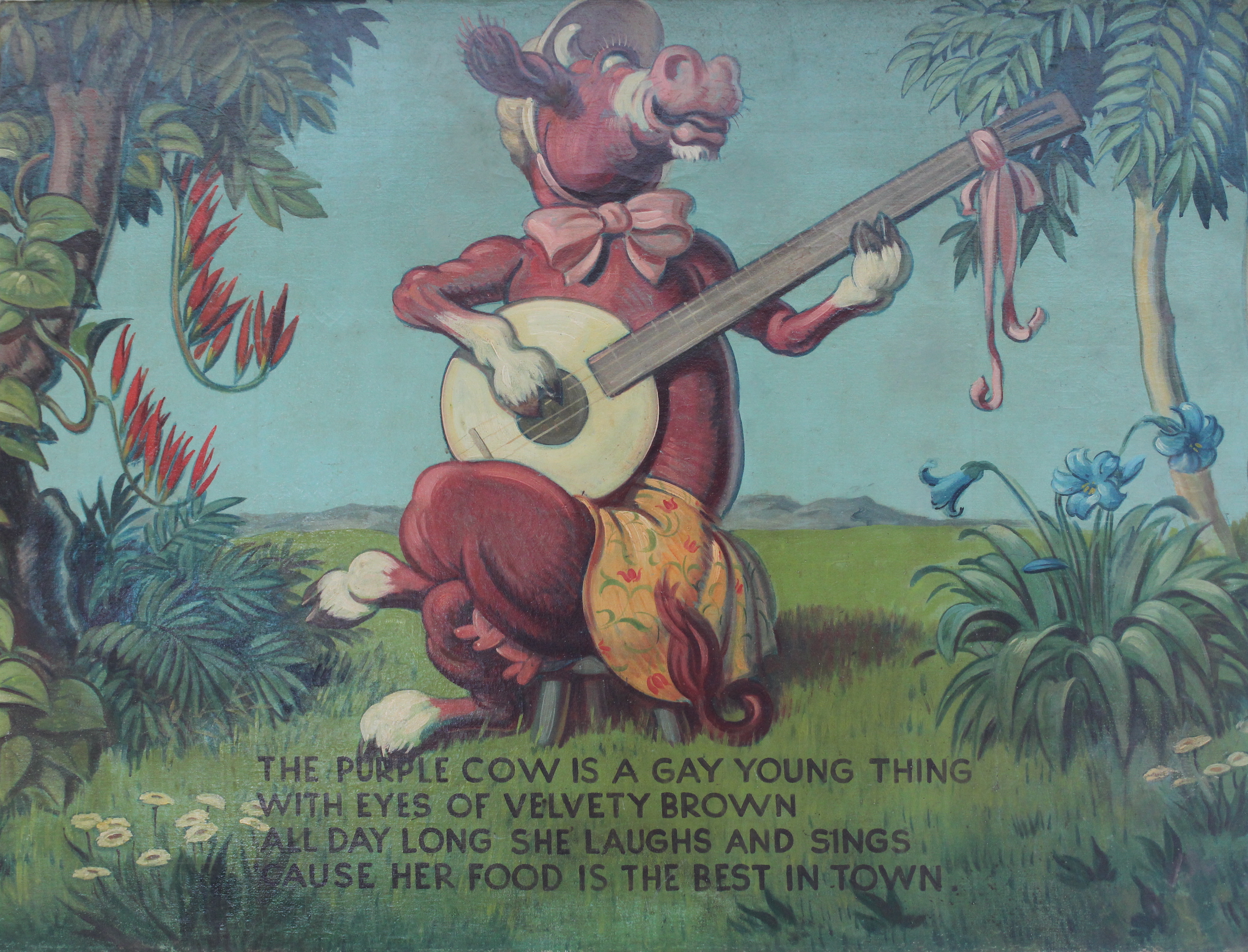
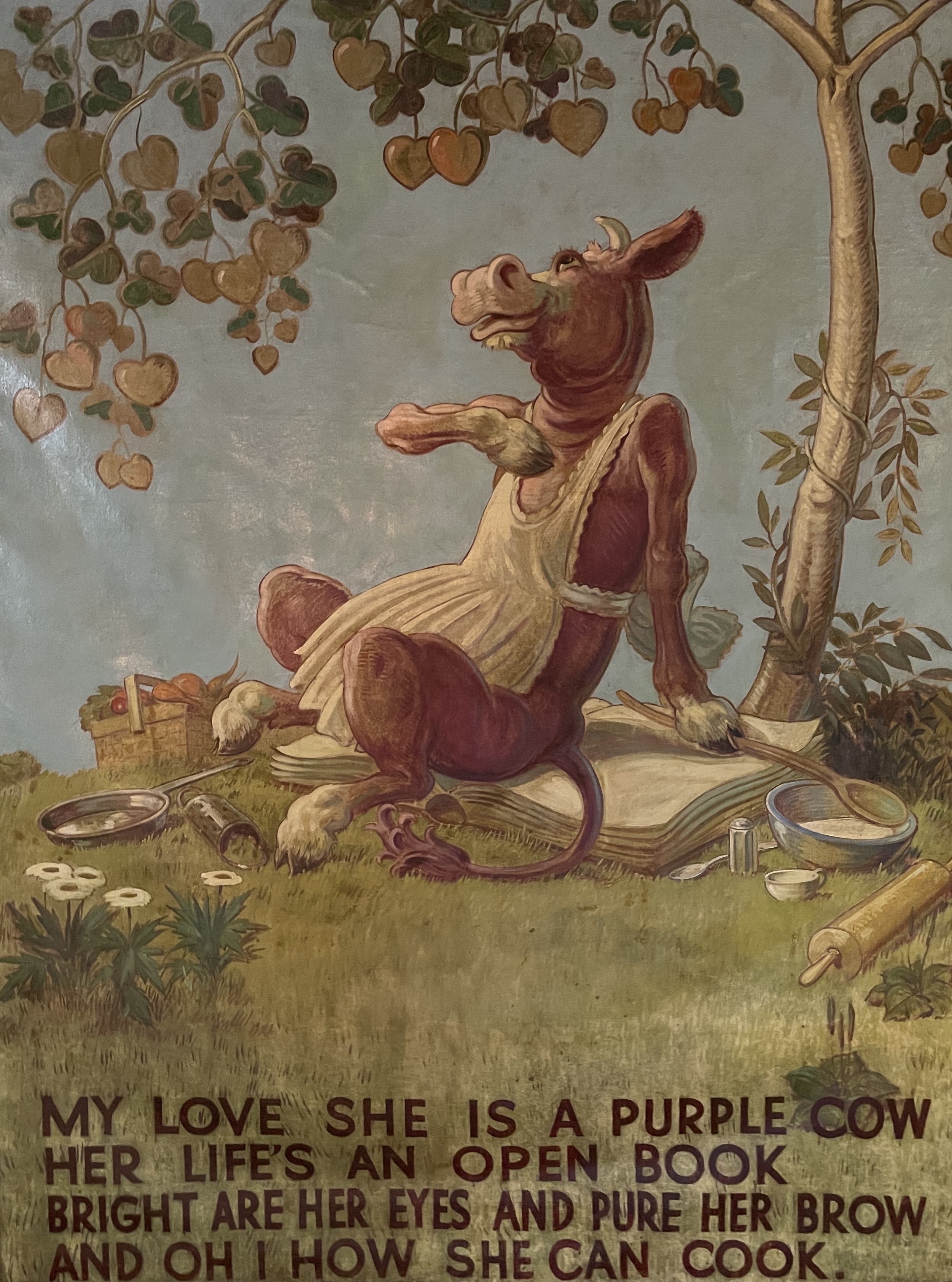
Camping Out (1934) is particularly relevent because it moves the comparison beyond appearance: Clarabelle, wearing a white cooking apron, prepares food for Mickey in a comic food sequence. Then, only five years later, Pick is advertising its Purple Cow with:
“Bright are her eyes and pure her brow,
And oh! how she can cook.”
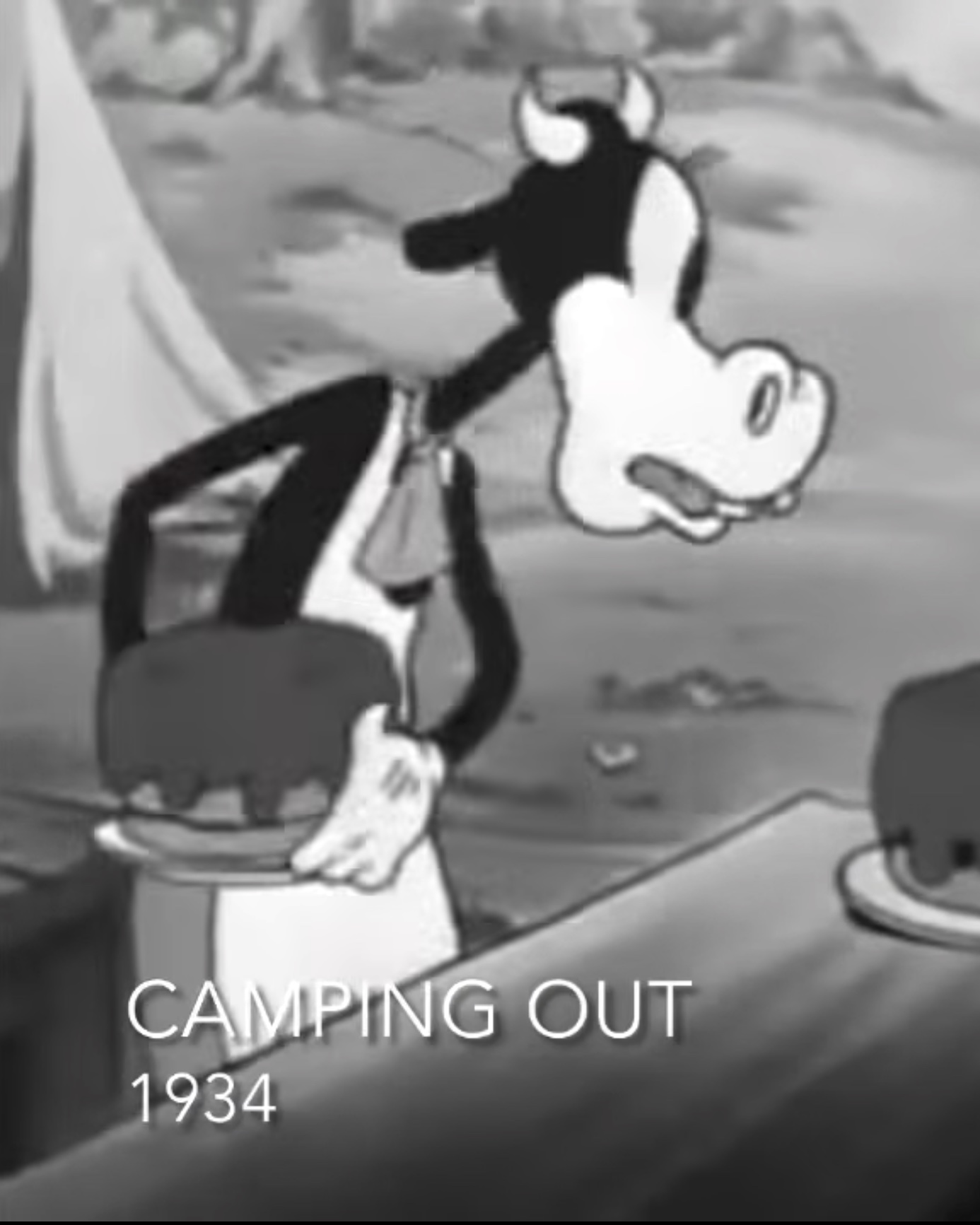
DISNEY’S CAMPING OUT
2. MOTHER GOOSE — THE CHARACTER LANGUAGE
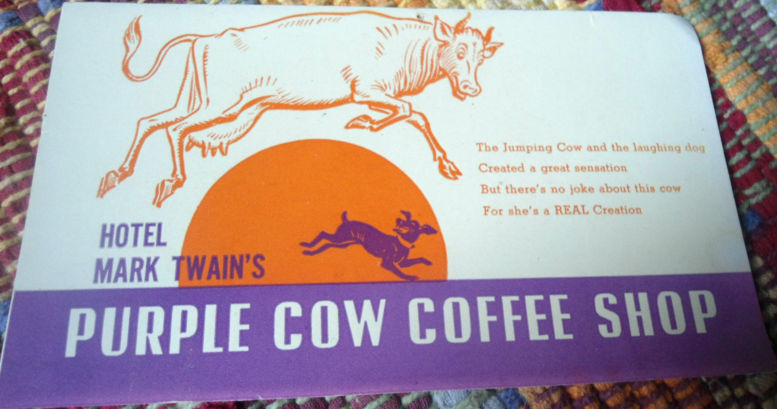
The Mark Twain Hotel card and its “Jumping Cow and the laughing dog / Created a great sensation” language, followed by the Purple Cow as a “REAL Creation.” The pre-Purple-Cow Disney Mother Goose animation chronology is a completely different evidentiary route from Clarabelle.
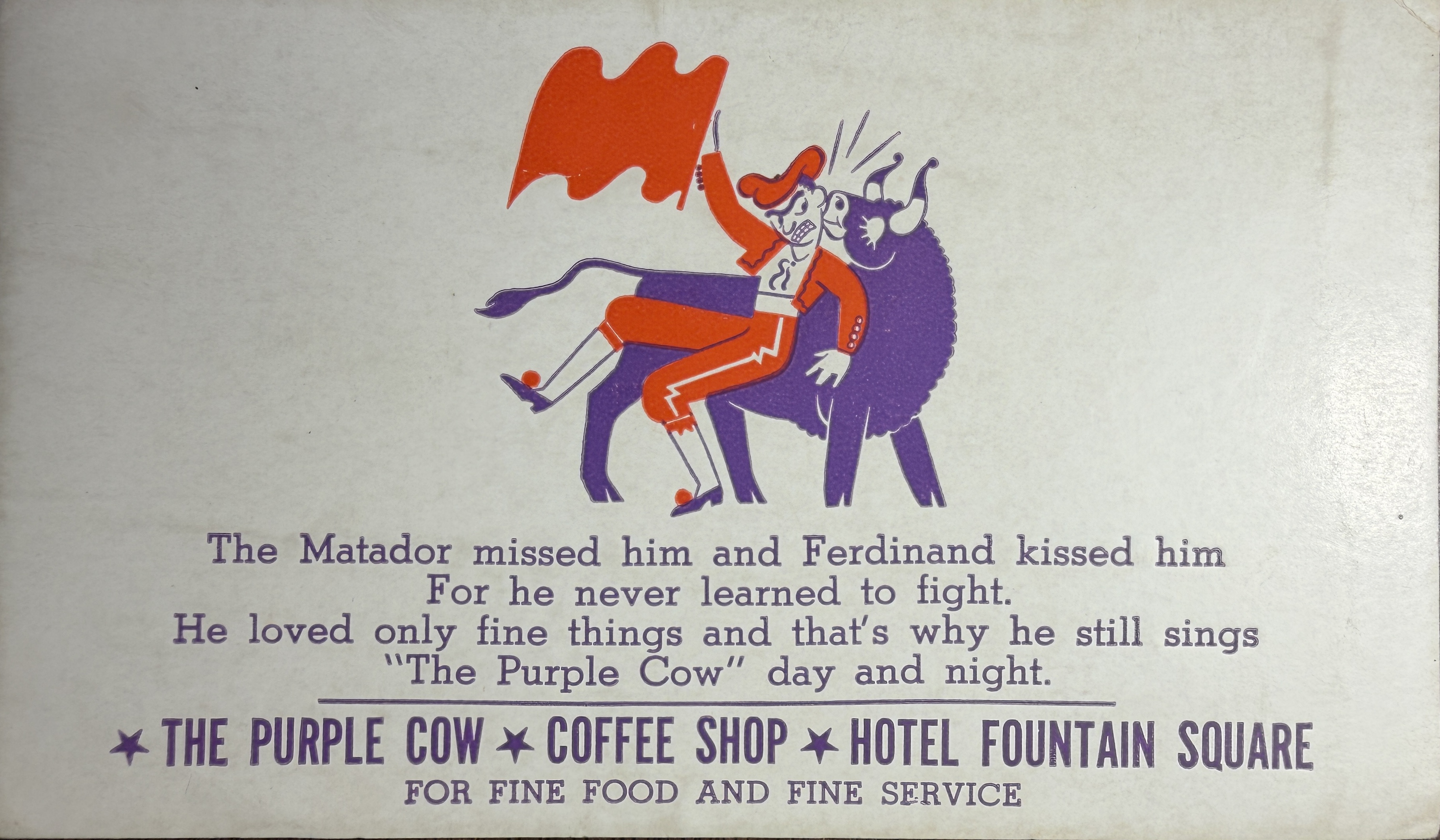
3. FERDINAND — THE CHARACTER AND NARRATIVE. Name, chronology, visual character, flowers, peaceful disposition, matador, refusal to fight, kiss—and finally marriage to the Purple Cow.
Taken together, these surviving images and texts reveal something broader than an isolated homage. Grell appears to have creatively transformed the character language of Disney-era animation into a distinctive comic universe of his own—the Purple Cow world.
Ferdinand marries the Purple Cow.
Taken together, these surviving images and texts suggest something more substantial than an isolated visual homage. Grell appears to have creatively transformed elements of Disney-era animated character culture into a distinctive comic universe of his own: the Purple Cow world.
The bull is Ferdinand. The bride is Grell’s recurring Purple Cow (Young Thing and Fresh Complexion).
FERDINAND — A RECURRING GRELL CHARACTER
Ferdinand deserves to be treated as one of the best-documented recurring characters in Grell’s Purple Cow world. He is not known from one isolated surviving fragment. Photographic and archival evidence records the character in multiple Purple Cow settings. The bull remains recognizable while Grell changes landscapes, props, vegetation and surrounding figures.
The earliest securely documented example in the present record is at the Hotel Miami in Dayton installed by June 1940. A period interior photograph places Ferdinand on the rear wall among multiple Grell compositions. An enlargement from the original negative held by Dayton History made the figure and accompanying verse sufficiently clear to confirm the identification.
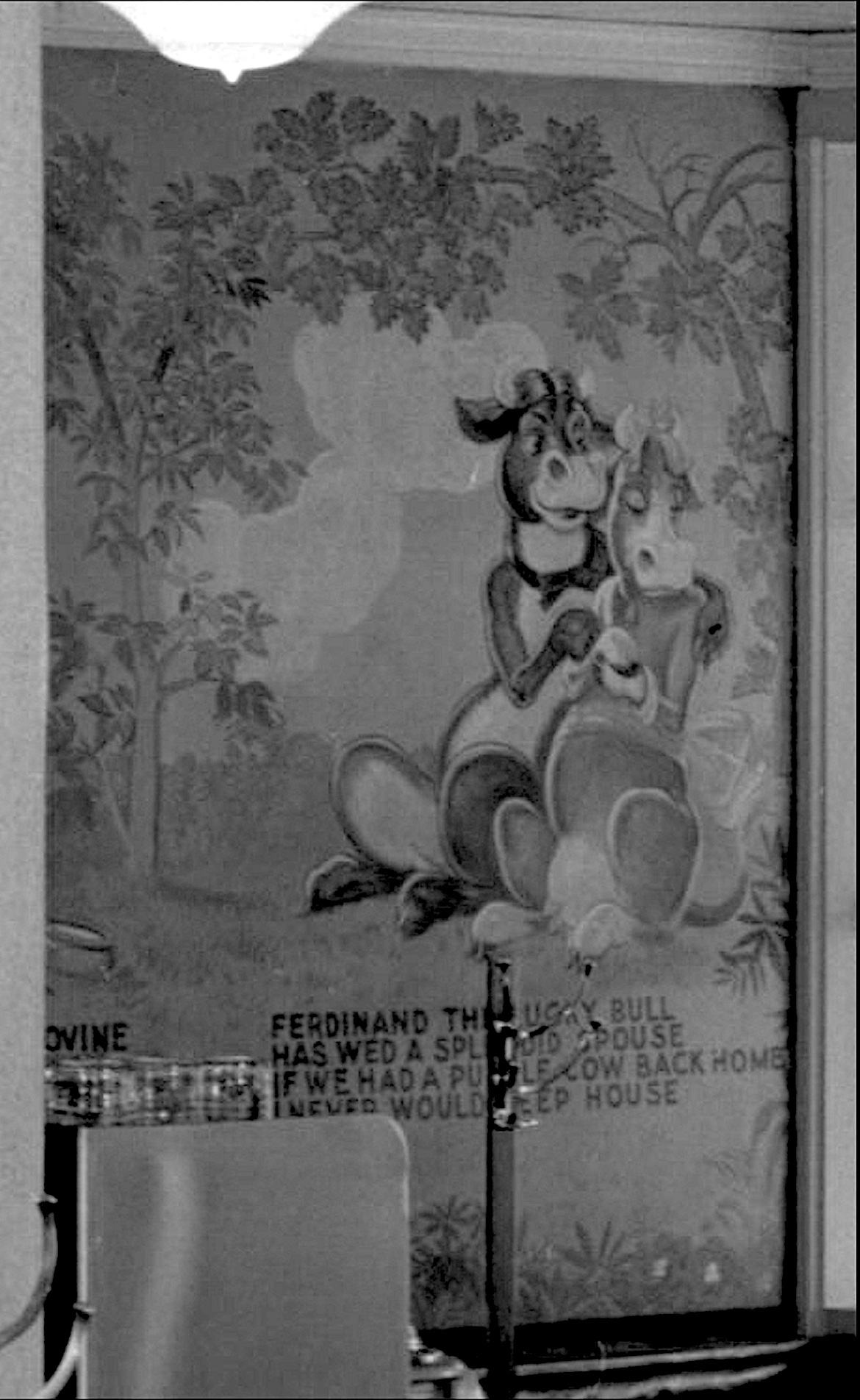
FERDINAND · Purple Cow · Hotel Miami · Dayton, Ohio. Enlargement from the period hotel photograph showing Grell’s dark bull and Purple Cow companion on the restaurant wall. This is an early documented Ferdinand within the Purple Cow program (Dayton History).
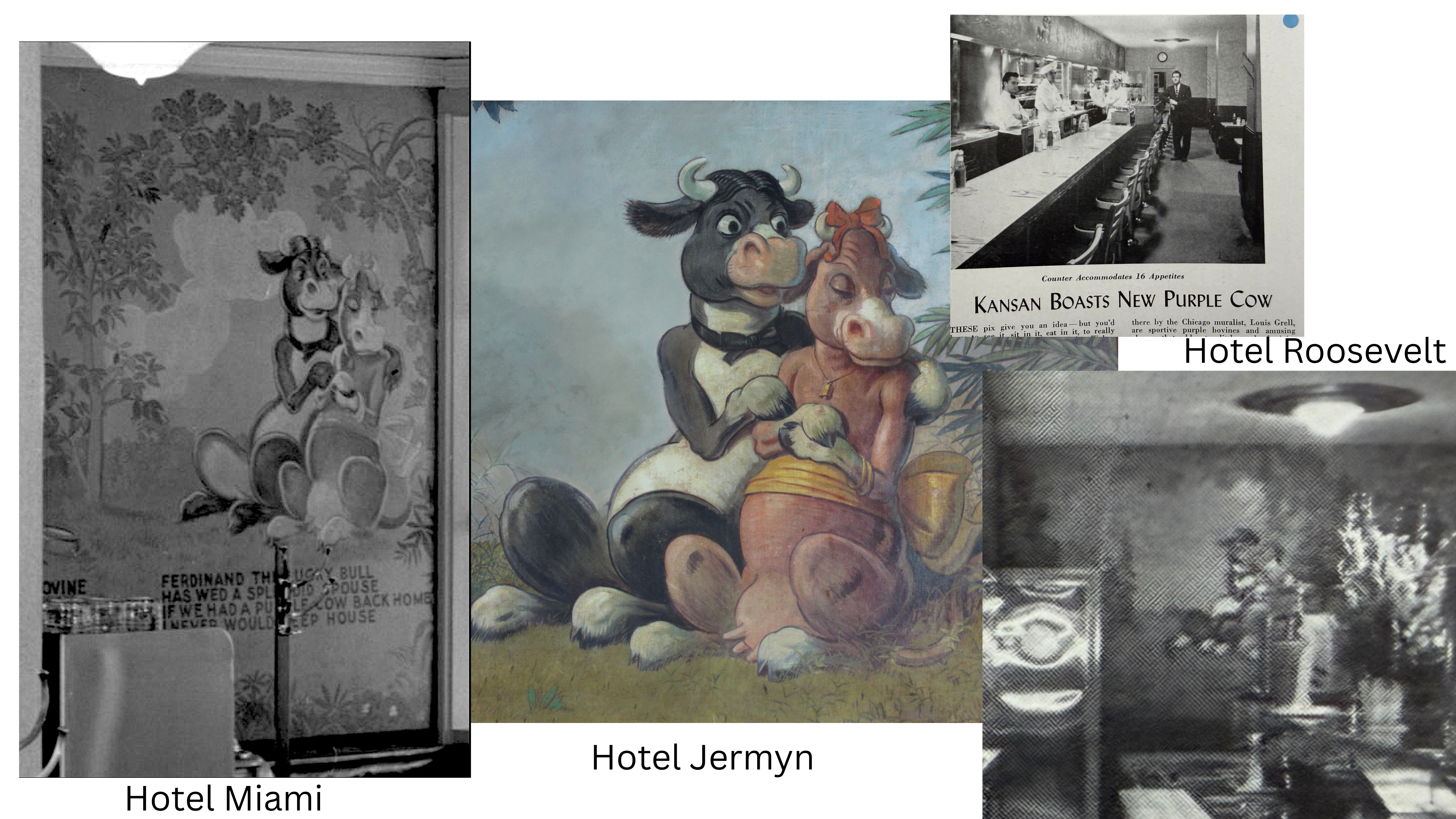
FERDINAND ACROSS THE PICK HOTELS SYSTEM. Four documented Grell Ferdinand appearances/variations demonstrate a recurring character rather than a one-time mural. Grell preserves Ferdinand’s identity while reinventing the painted world around him.
The bull who would not fight
A surviving Hotel Fountain Square Purple Cow card carries another Ferdinand episode. The matador misses him, and Ferdinand responds not with aggression but affection. The card explicitly says that he “never learned to fight.” This peaceful characterization is important to the Grell Ferdinand story.
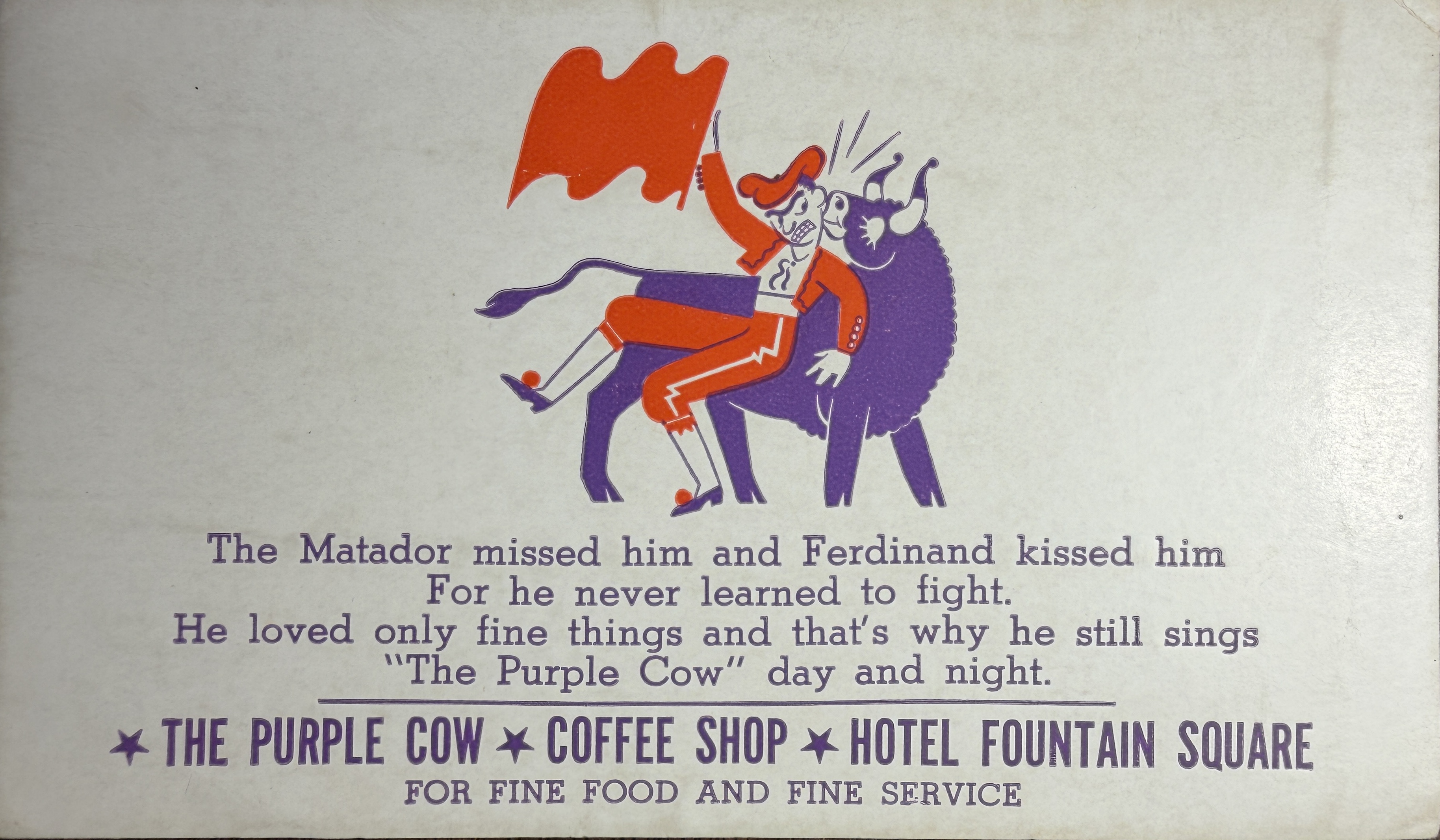
FERDINAND · Hotel Fountain Square · original Purple Cow card. Grell’s Ferdinand encounters a matador but “never learned to fight.” The surviving card preserves a distinct Ferdinand episode within the Pick Hotels world.
CLARABELLE COW AND GRELL’S PURPLE COW
Ferdinand may not be the first Disney-associated character to emerge from Louis Grell’s Purple Cow world.
As the surviving murals have been assembled and compared, another pattern has become increasingly difficult to overlook: Grell repeatedly painted a highly anthropomorphic female Purple Cow whose appearance and personality invite comparison with Clarabelle Cow, one of Walt Disney’s established characters of the 1930s and actually beginning with Plane Crazy (1928), Disney’s very first Mickey Mouse production. The opening scene and very first sounds are of a bovine.
Clarabelle was not simply a cartoon cow. She was a female character given distinctly human personality and behavior. She dressed, socialized, danced, performed and participated in romantic and comic situations. Among her familiar visual attributes were exaggerated feminine eyes and eyelashes, bows and other feminine accessories—and the cowbell worn around her neck.
Grell’s Purple Cow heroine was constructed from a remarkably similar vocabulary.
Across the surviving Purple Cow compositions, she appears with enormous expressive eyes and long eyelashes, pronounced lips and makeup, bows and elaborate headwear, jewelry and other accessories. She wears clothing, dances, sings, plays musical instruments, powders her complexion, cooks, flirts and participates in romantic situations. In several Grell compositions she also wears a conspicuous cowbell around her neck.
The recurrence of these characteristics matters. This is not a comparison based upon one cartoon cow resembling another. Grell appears to have created a continuing female character, recognizable through repeated physical attributes, accessories, behavior and personality as she moves from one Purple Cow situation to another.
THE COWBELL
One detail deserves particular attention.
The cowbell is one of Clarabelle Cow’s characteristic accessories in Disney imagery. Grell repeatedly gives his female Purple Cow a prominent bell as well.
In some Purple Cow compositions the bell is large and unmistakable. In the surviving FERDINAND mural, however, the bride wears a considerably smaller, more delicate bell suspended from a thin necklace.
The difference makes sense within the scene Grell has painted.
This is her wedding day.
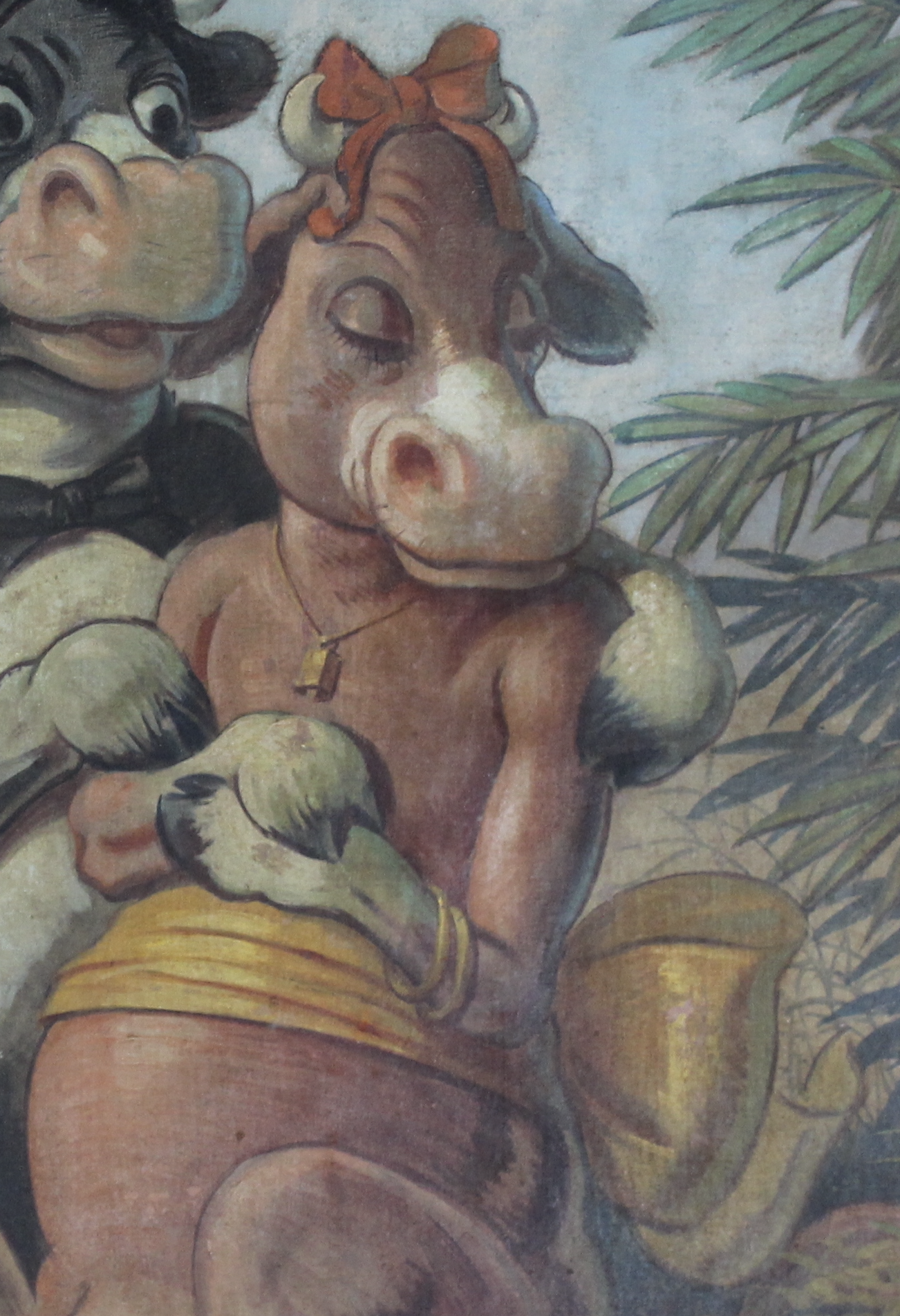
She is not presented in her usual comic costume. Grell has dressed the character for the occasion.
The bride wears a large red hair bow, makeup, gold bracelets and the small formal gold bell at her throat. A broad gold bonnet appears around her waist. Her eyes are closed as she leans affectionately toward Ferdinand. Ferdinand himself has been dressed for the occasion with a bow tie.
They embrace beneath a tree surrounded by luxuriant, exotic foliage. In the Hotel Miami version of the composition, flowers can also be seen at the couple’s feet beneath the large exotic tree.
This is not simply a picture of two cattle standing together.
Grell has staged a wedding portrait.
THE BRIDE WAS ALREADY PART OF THE PURPLE COW WORLD
That distinction changes the interpretation of FERDINAND.
The female cow beside Ferdinand does not appear to have been created merely because Grell needed a bride for a joke. Her characteristic feminine treatment belongs to the larger Purple Cow vocabulary visible elsewhere in the mural program.
In FAIR COMPLEXION, Grell presents the Purple Cow as a glamorous female personality concerned with her appearance. She wears feminine accessories and uses a powder puff and mirror while the accompanying jingle celebrates her complexion and charm.
In YOUNG THING, the Purple Cow becomes a performer. With exaggerated eyelashes, feminine clothing and accessories, she sits beneath a tree playing a stringed instrument while her verse describes a character who “laughs and sings.”
Other surviving Purple Cow images continue the pattern through dancing, courtship, fashion, cooking and other human activities.
Taken together, these compositions reveal something that was difficult to recognize when the murals were studied individually:
Grell’s female Purple Cow was a recurring character.
And that character existed before she became Ferdinand’s bride.
FERDINAND MARRIES CLARABELLE COW?
This brings the investigation to its most provocative possibility.
Disney’s Clarabelle Cow was already an established anthropomorphic cow character when Grell began developing the Purple Cow mural world around 1939–1940. Grell’s recurring heroine shares not simply her species, but an unusual constellation of character traits: exaggerated feminine features, prominent eyelashes, bows and clothing, jewelry and accessories, a recurring cowbell, musical and dancing roles, romantic behavior and participation in a thoroughly humanized comic world.
Then Grell introduced Ferdinand.
And Ferdinand married her.
The surviving mural makes the event explicit. Grell paints the couple embracing beneath a tree, dressed for the occasion, while the accompanying verse announces:
FERDINAND, THE LUCKY BULL
HAS WED A SPLENDID SPOUSE
IF WE HAD A PURPLE COW BACK HOME
I NEVER WOULD KEEP HOUSE.
The significance is difficult to miss.
If Grell’s Ferdinand represents an intentional adaptation or continuation of Disney’s celebrated Ferdinand—and the evidence examined elsewhere in this article strongly supports that interpretation—then Grell did something considerably more imaginative than reproduce a popular cartoon character.
He brought Ferdinand into the Purple Cow world and married him to its established heroine.
And if that heroine was herself constructed in conscious dialogue with Disney’s Clarabelle Cow, Grell’s joke becomes considerably more sophisticated:
FERDINAND MARRIES CLARABELLE COW.
WHOSE “EXCLUSIVE RIGHTS”?
One surviving Pick Hotels statement may ultimately prove especially important to understanding the larger Purple Cow program.
Pick asserted “exclusive rights” in connection with its Purple Cow operation.
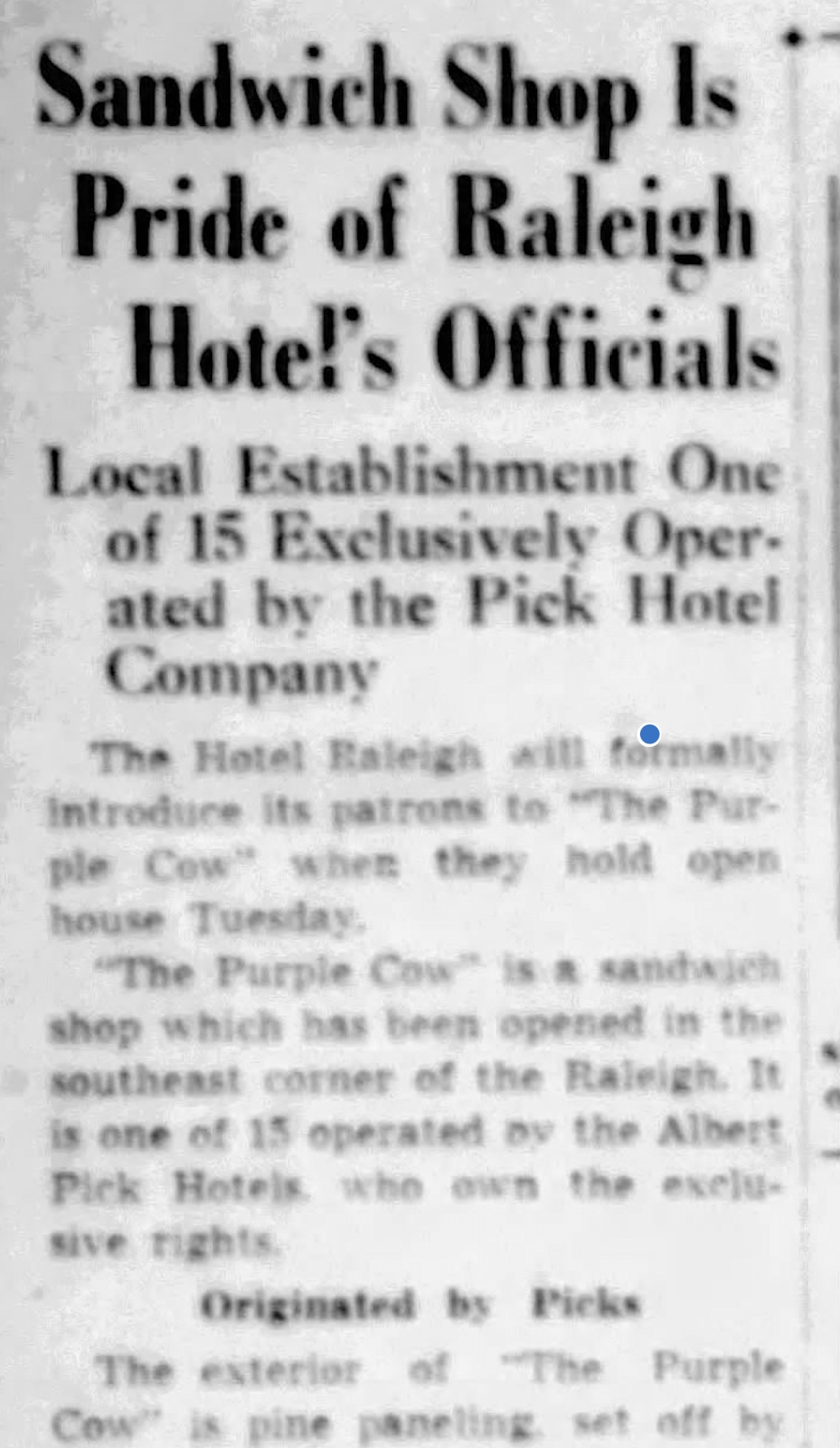
“exclusive rights”

When this statement was first encountered, the most obvious explanation appeared to be the literary history of the Purple Cow itself and the famous verse associated with Gelett Burgess.
The reconstruction of Grell’s mural program now makes the wording worth reconsidering.
The Purple Cow was not merely a restaurant name. It developed into an extensive character environment incorporating recurring anthropomorphic cows, mural narratives, jingles, menus, advertising and promotional material. Within that world, Grell created a recurring female Purple Cow whose character vocabulary invites comparison with Disney’s Clarabelle Cow; Pick material invoked the jumping cow and laughing dog of Mother Goose after Disney had repeatedly animated Mother Goose subjects; and Grell introduced a character explicitly named FERDINAND, whose appearance, temperament and matador narrative closely parallel Disney’s Academy Award-winning Ferdinand.
This raises a question that could not reasonably have been asked when the “exclusive rights” statement was first discovered:
WHAT, EXACTLY, DID PICK HOTELS HAVE EXCLUSIVE RIGHTS TO?
At present, the surviving wording should not be interpreted as evidence of Disney authorization unless additional documentation establishes that connection. But neither should the statement be dismissed as routine promotional language. Determining the nature, source and scope of Pick’s claimed rights has become an important part of reconstructing the Purple Cow program.
The surviving Ferdinand
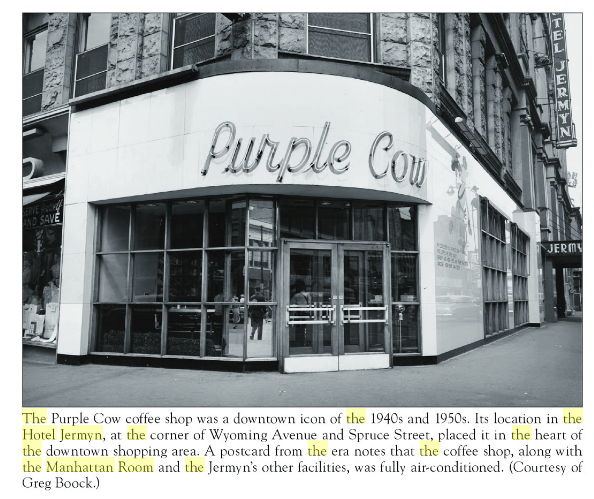
At the Hotel Jermyn in Scranton, Grell again painted the dark bull with his Purple Cow companion. A substantial mural fragment from that installation survived. Originally catalogued under another title, the work was later reidentified as Ferdinand after the photographic mural record, menu evidence and the Dayton enlargement converged.
That matters because the Jermyn fragment is not merely an attractive Purple Cow survivor. It is a surviving physical example of a recurring Grell character whose story can be followed across the larger program.
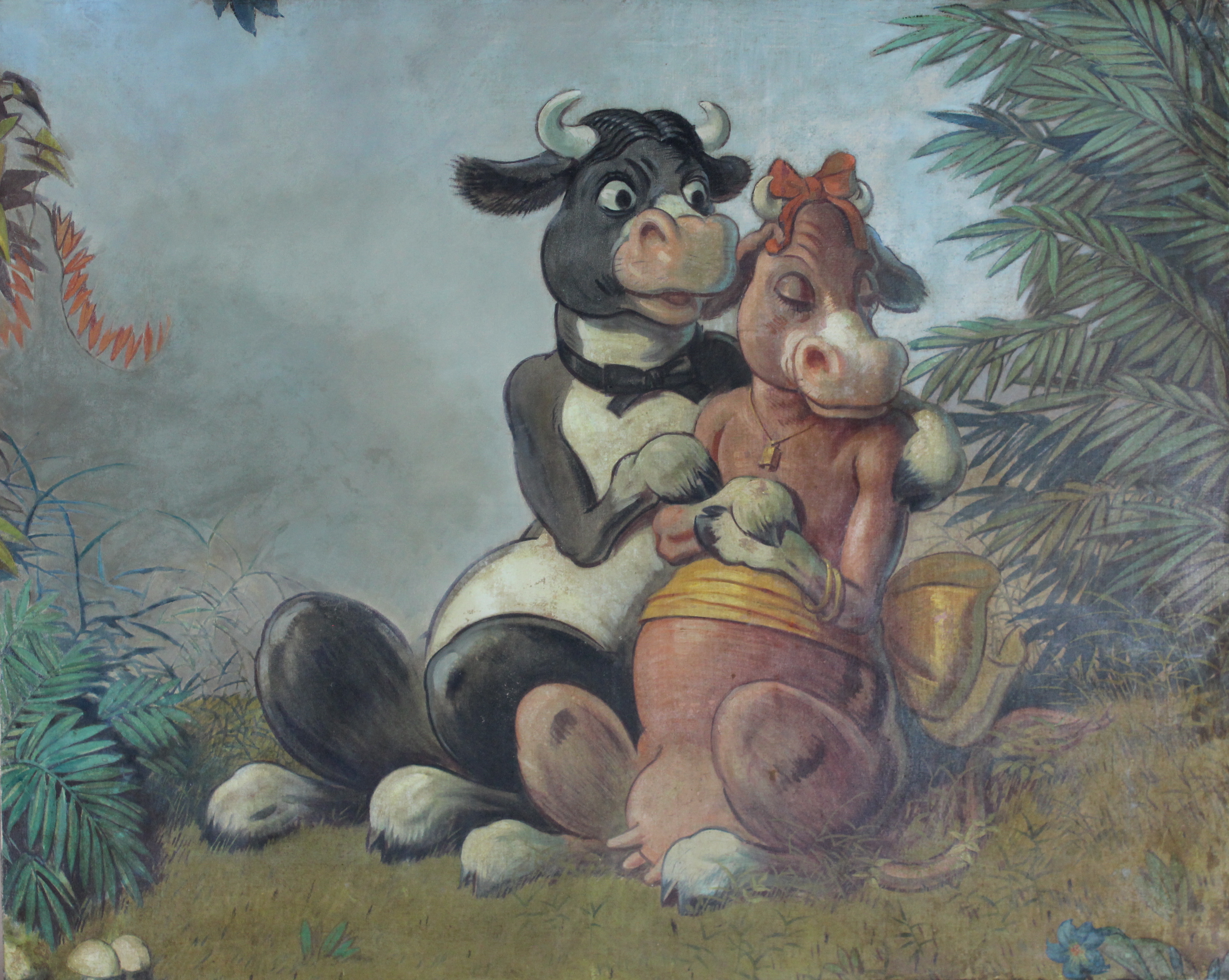
FERDINAND · Hotel Jermyn · Scranton, Pennsylvania · 1945. Surviving Louis Grell Purple Cow mural fragment, conserved after acquisition. Archival and photographic evidence reconnected the dark bull with the recurring Ferdinand character documented elsewhere in the Pick Hotels system.
THE HOTEL JERMYN RECONNECTS THE SURVIVING WORKS
The Jermyn photographic record is unusually valuable because recurring Purple Cow compositions can be seen in their architectural context. Young Thing and Positively Merry appear within the restaurant world, reconnecting surviving works and working designs with the environments for which Grell developed them. Exterior evidence also shows Purple Cow imagery adapted to street-facing promotion, demonstrating that the murals helped identify the restaurant itself.
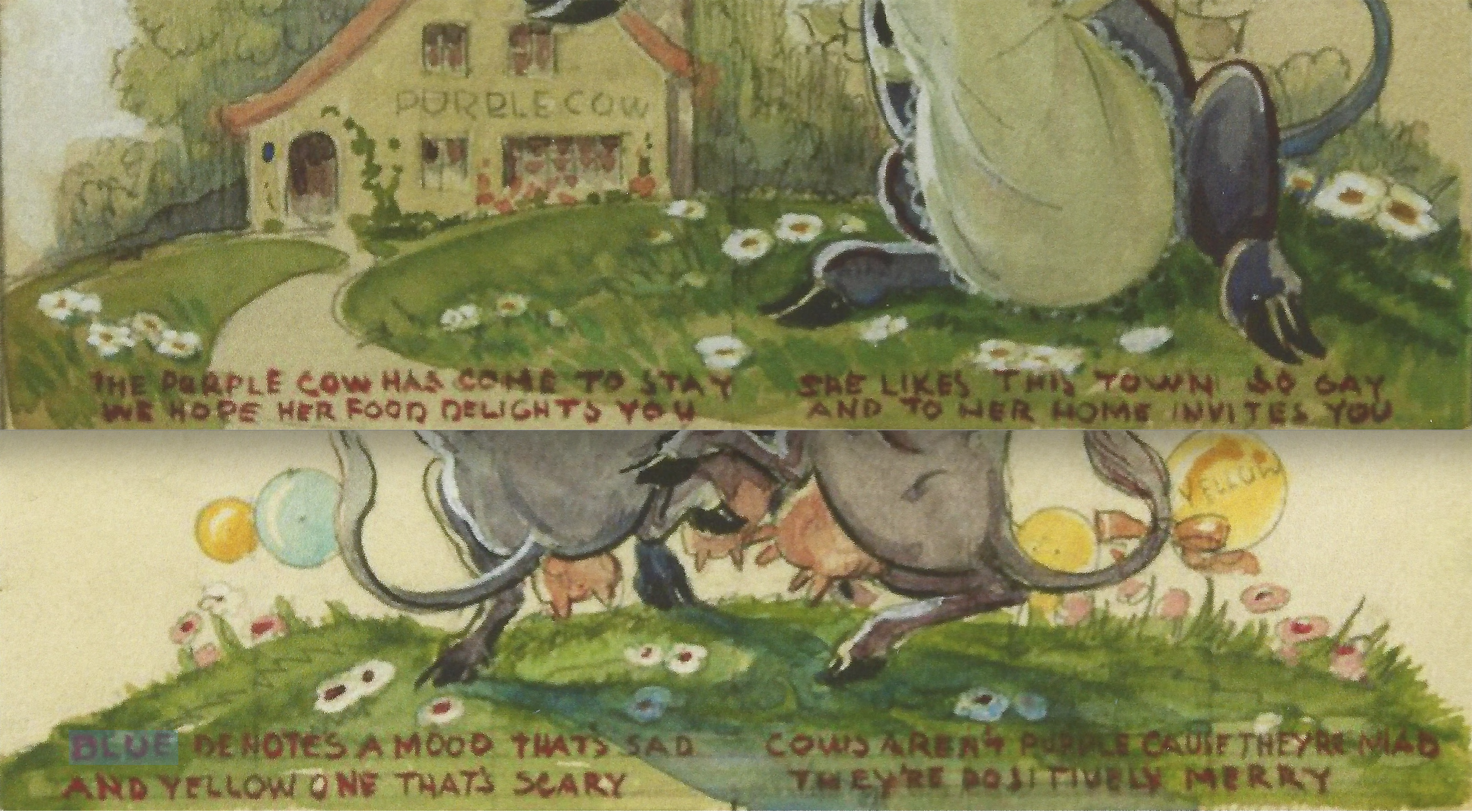
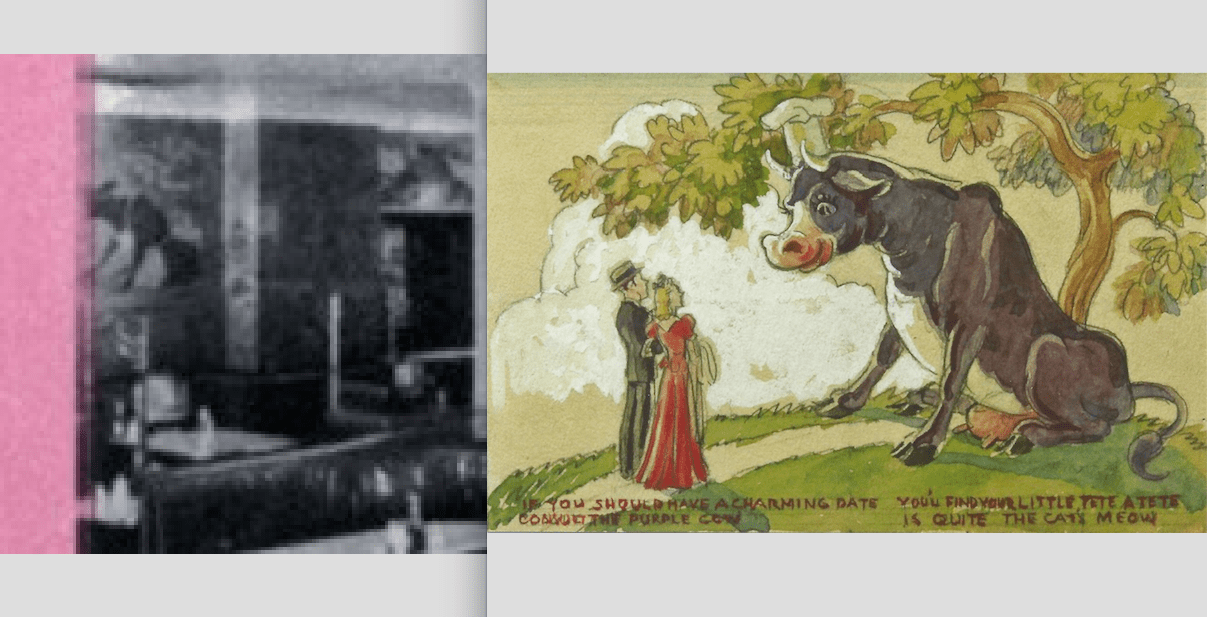
The poem and trees surrounding this mural fragment (above left) were cut off when this mural was removed from the walls of the Hotel Jermyn Purple Cow shop during a 1970’s renovation. Notice Ferdinand’s parted hair in Grell’s creation, some mushrooms and one blue flower that weren’t cut out during removal. There is also a partial tree remaining and some odd bushes surrounding them. The two partial views of watercolors (above right) show the many daisies Grell added.
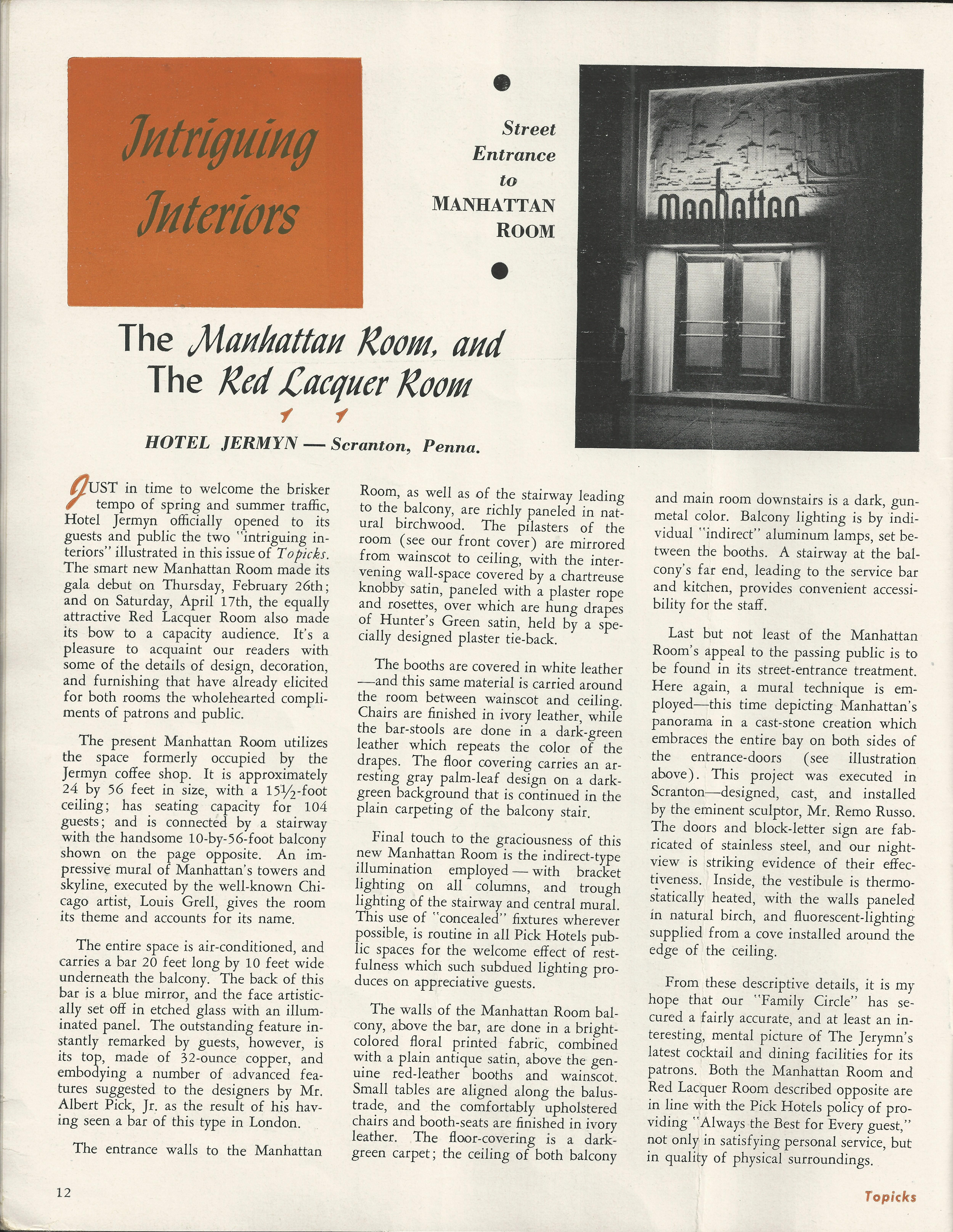
Hotel Jermyn, Scranton. Pick Hotels’ period coverage preserves Grell’s Purple Cow environment and helps reconnect surviving works with their original architectural setting.
THE PUBLIC WAS INVITED INTO THE PAINTING
One of the most distinctive features of the Purple Cow program was the public jingle competition. The evidence supports a precise description of the mechanism. The public did not design Grell’s murals and was not invited to write verses for the mural program generally. At participating properties, one locally themed Grell mural was selected to receive a missing verse. The image was already Grell’s. The public supplied the words that completed that particular local story.
GRELL CREATED THE LOCAL IMAGE. PICK LEFT ITS STORY UNFINISHED. THE PUBLIC SUPPLIED THE WORDS.
Four independently documented contests
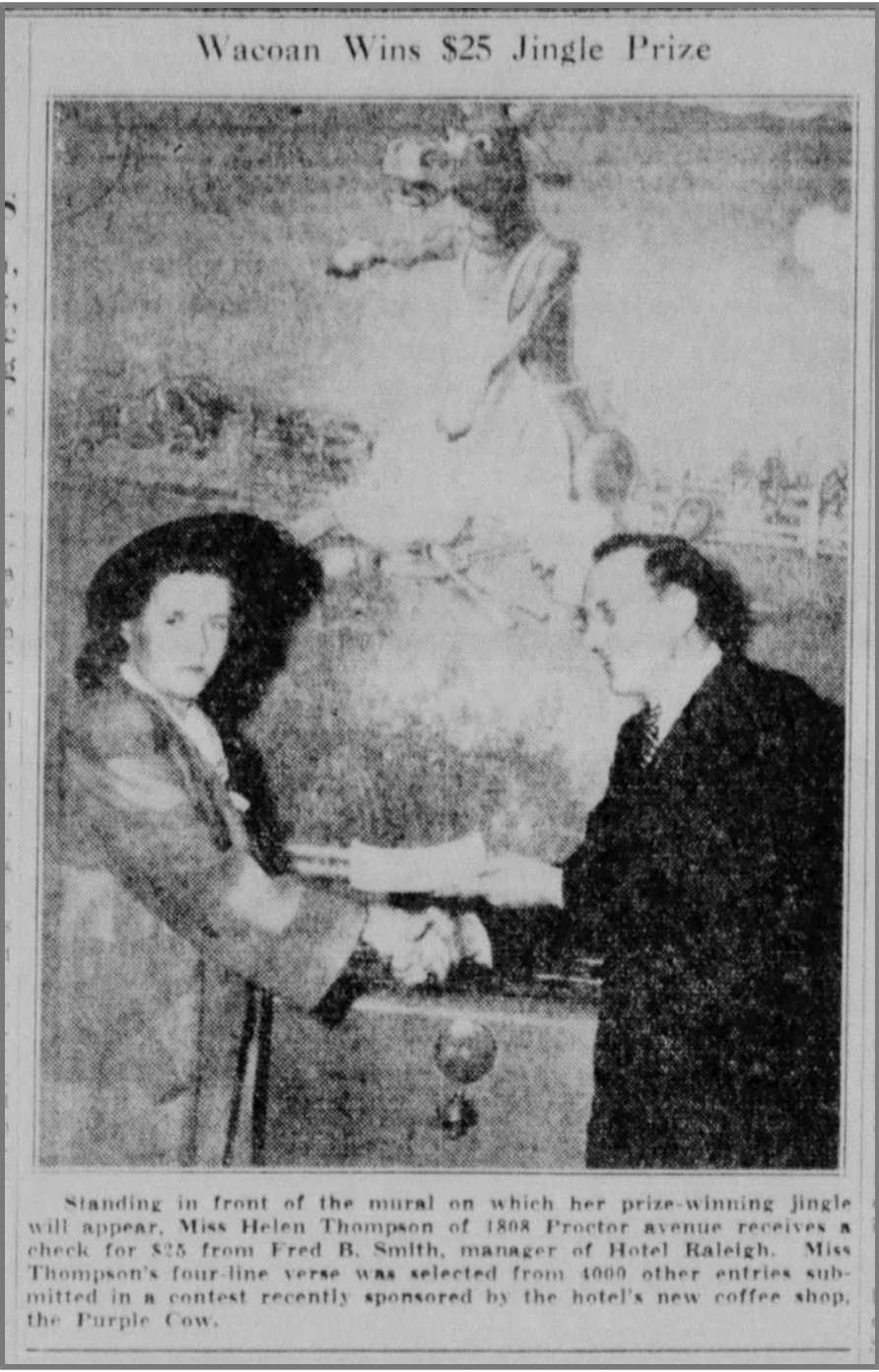
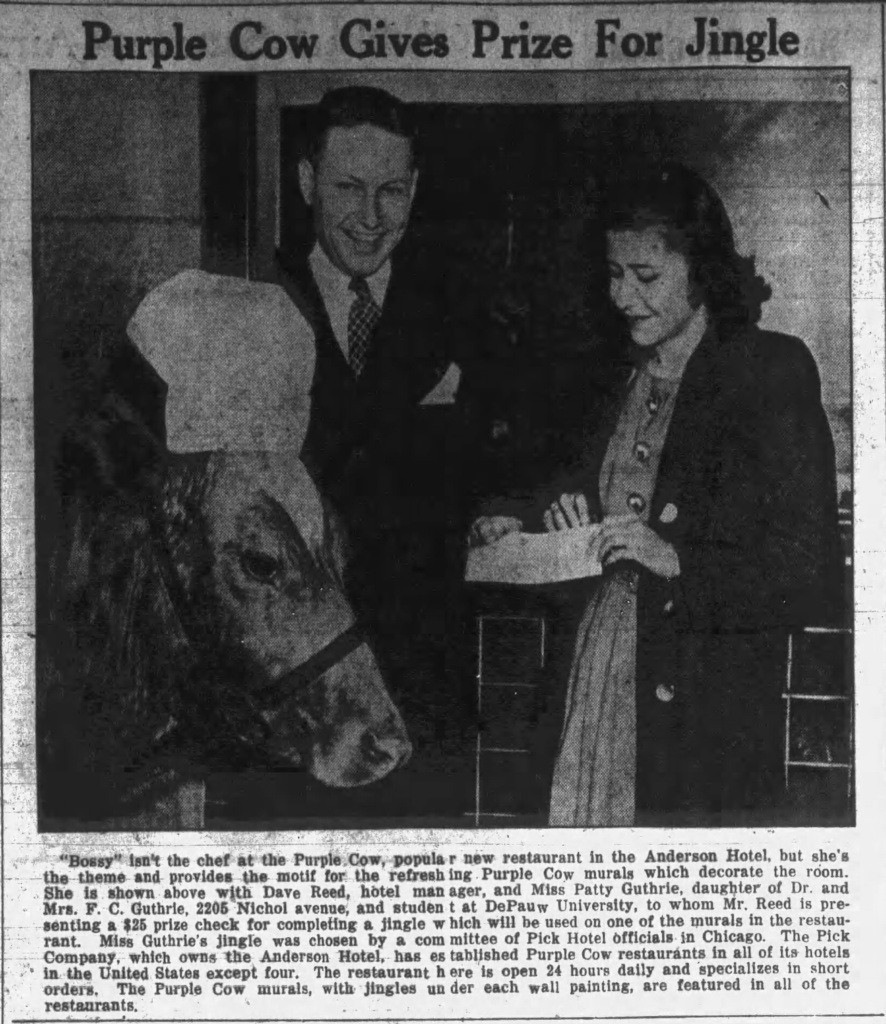
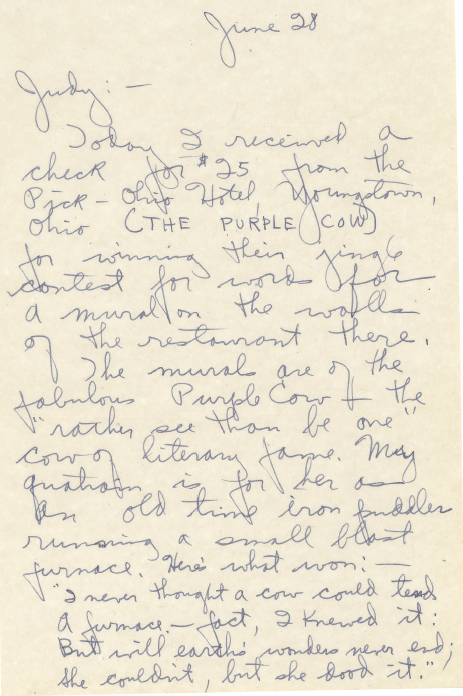
At the Hotel Raleigh in Waco, Helen Thompson received a $25 award while standing before the mural on which her winning verse was to appear; the newspaper reported that her entry had been selected from approximately 4,000 submissions. At Pittsburgh’s Hotel Roosevelt, Rosalie Bond’s four-line verse was chosen for Grell’s locally themed bicycling Purple Cow after roughly 1,500 entries. At the Anderson Hotel, Patty Guthrie received $25 for a jingle that the newspaper said would be used on one of the restaurant murals; the same report explained that Purple Cow murals with jingles beneath the wall paintings were featured in the restaurants.
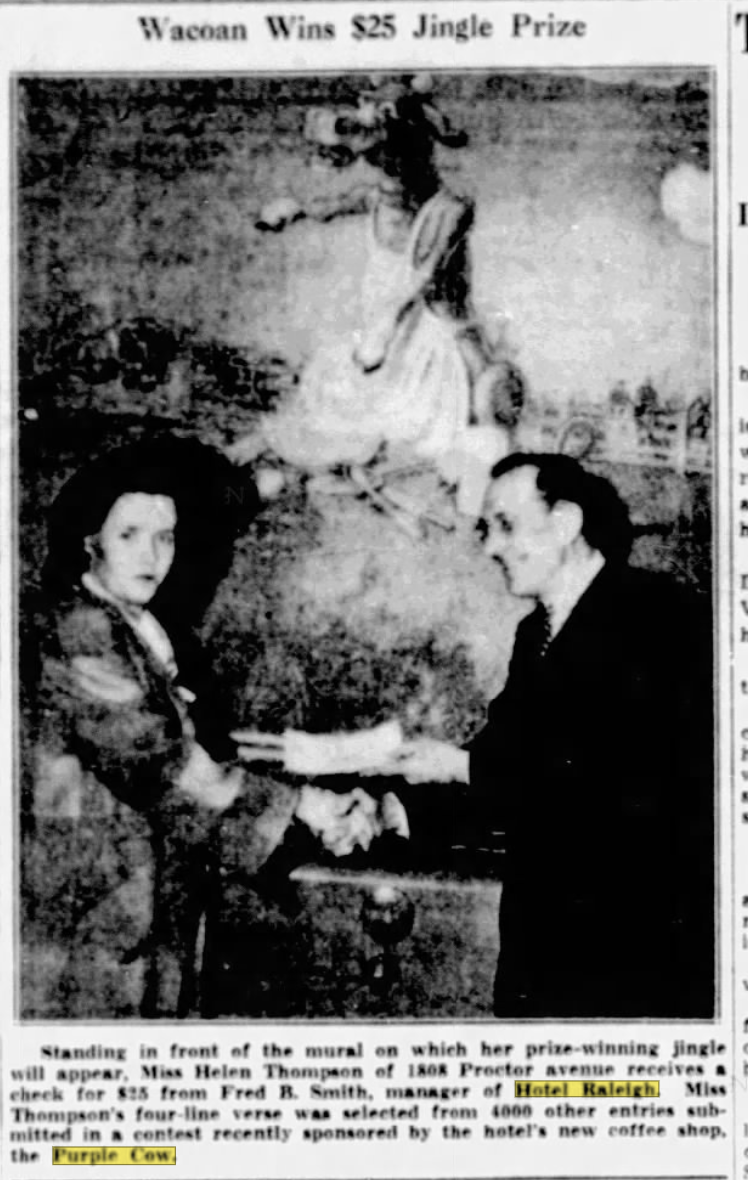
WACOAN WINS $25 JINGLE PRIZE. Hotel Raleigh, Waco, Texas. Winner Helen Thompson stands before the locally themed Grell mural on which her prize-winning verse was to appear. The newspaper reported approximately 4,000 entries.
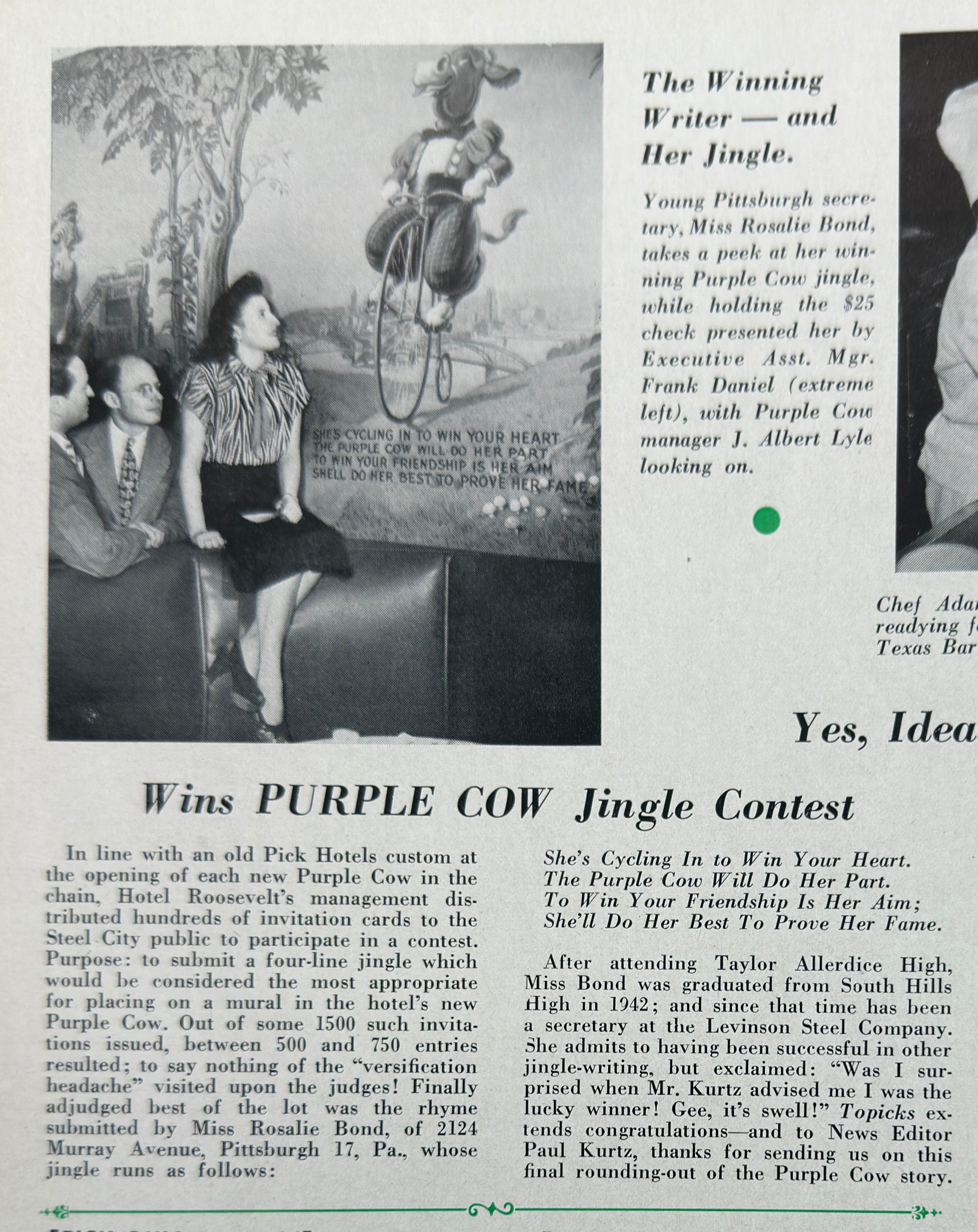
THE WINNING WRITER — AND HER JINGLE. Hotel Roosevelt, Pittsburgh. Rosalie Bond stands before Grell’s locally themed bicycling Purple Cow mural after winning the public contest for its verse.
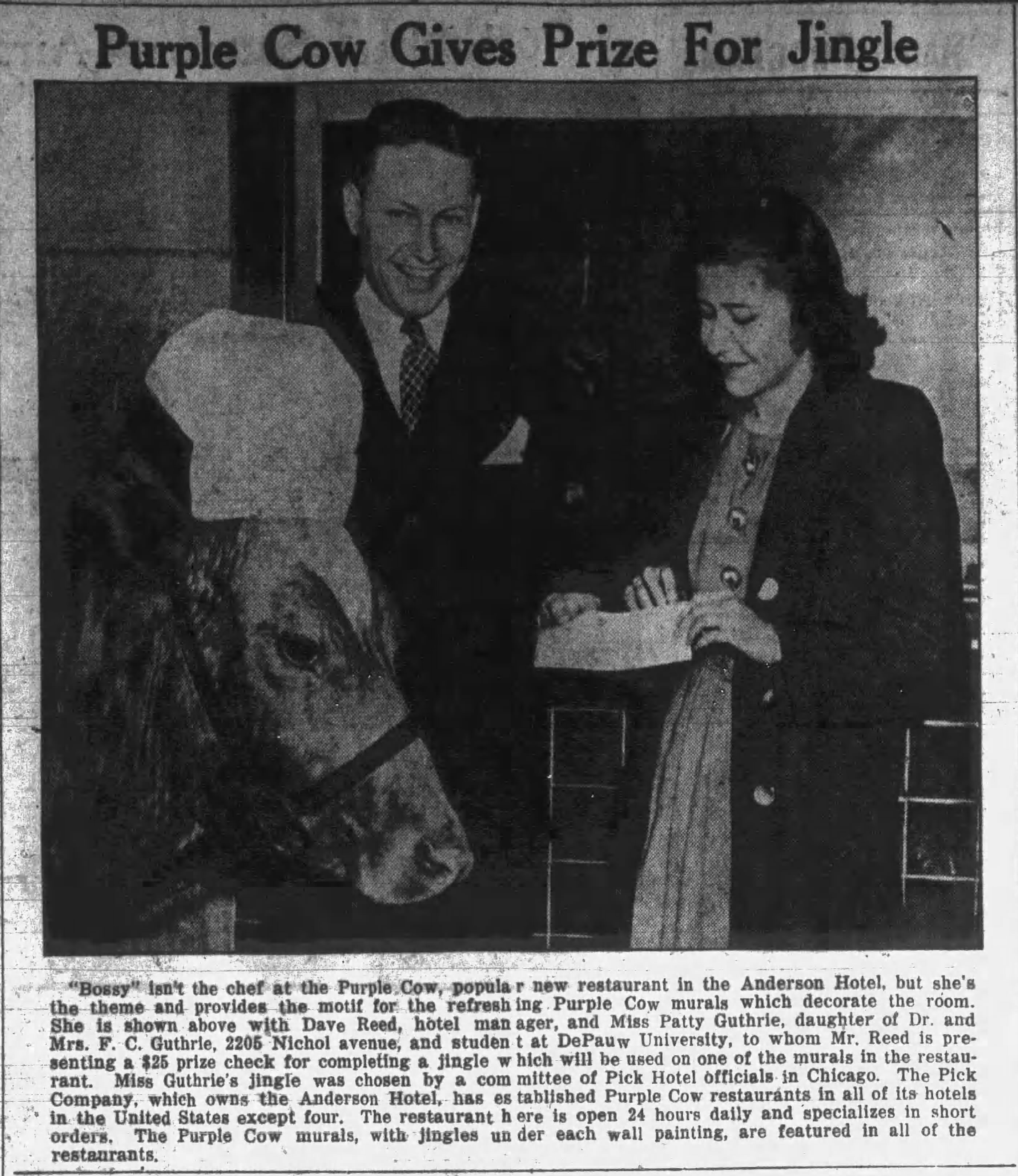
PURPLE COW GIVES PRIZE FOR JINGLE. Anderson Hotel, Anderson, Indiana, 1943. Patty Guthrie receives the $25 prize. The article documents the restaurant’s murals even though no Anderson mural photograph is presently counted among the 94 documented images.
GM TECH — THE PROCESS PRESERVED BEFORE AND AFTER
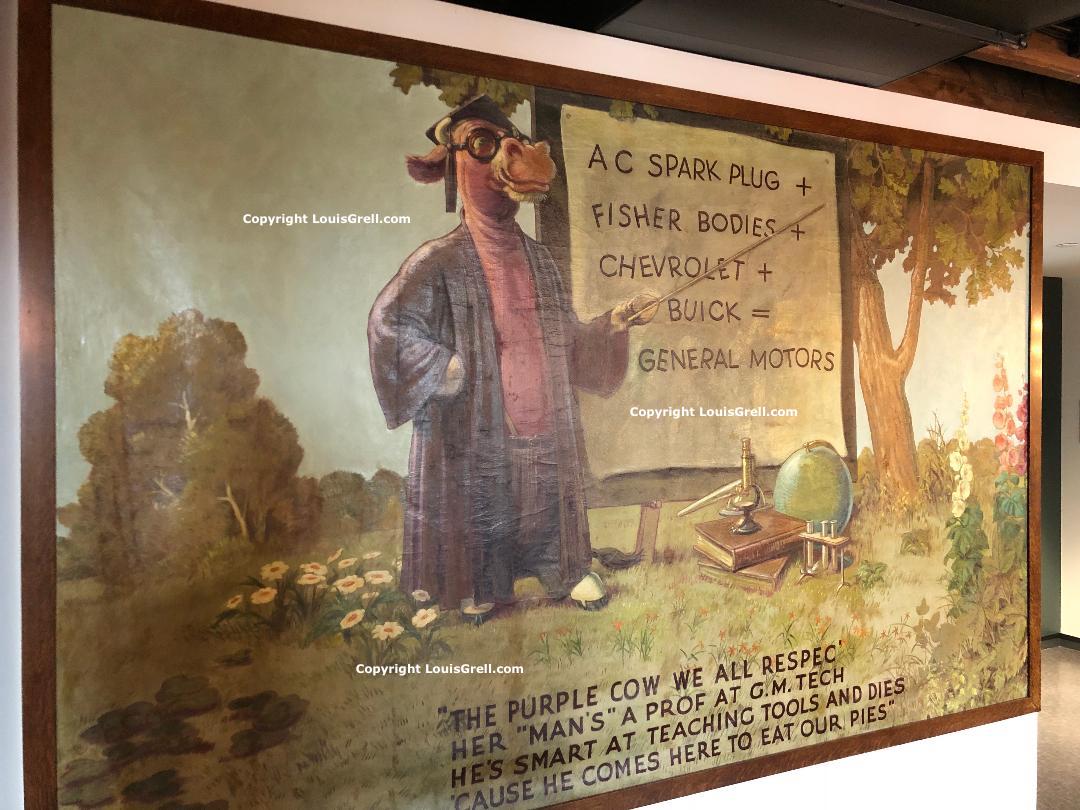
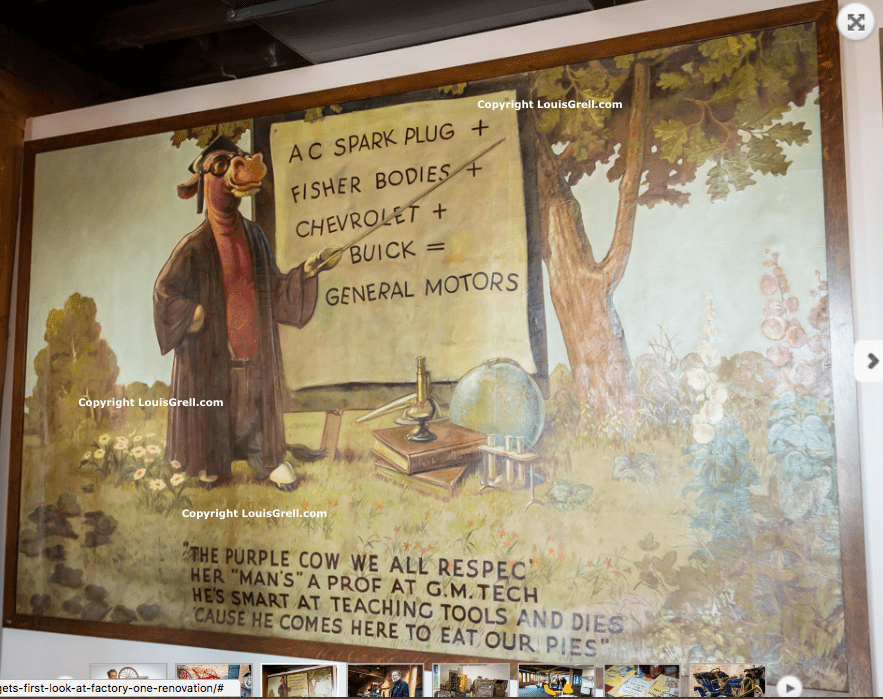
The Hotel Durant in Flint supplies rare visual evidence of the sequence itself. A 1941 opening-period photograph records Grell’s locally themed GM TECH mural fully painted: the Purple Cow professor stands before a blackboard linking AC Spark Plug, Fisher Bodies, Chevrolet and Buick to General Motors. Yet the lower portion contains no jingle.
The same mural survives today at Kettering University with its completed four-line verse painted beneath the composition. The before-and-after evidence demonstrates that a local mural could exist first and receive its text afterward.
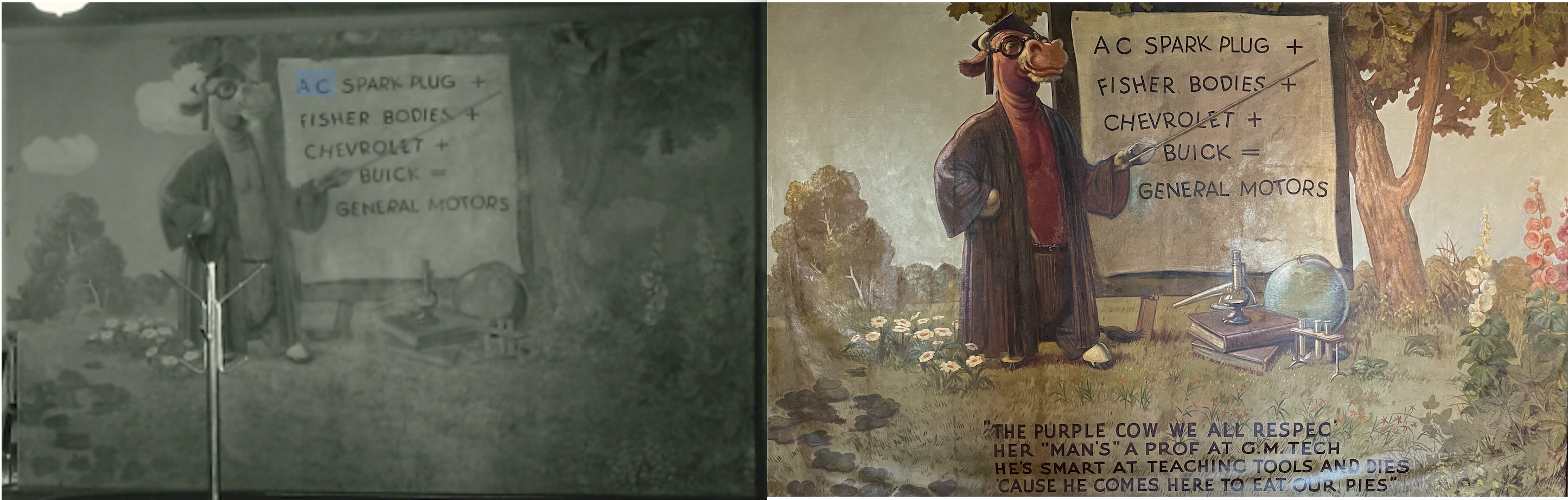
Grell’s G.M. Tech Purple Cow mural, Hotel Durant, Flint, Michigan. Left: the mural photographed at the restaurant’s 1941 opening before a jingle appears beneath the composition. Right: the surviving mural photographed at Kettering University in 2022 with its four-line verse in place. The comparison helps document how a locally themed Purple Cow composition could exist first as an image and subsequently acquire its accompanying jingle (MLIVE, Kettering University).
LOCAL IDENTITY INSIDE A NATIONAL PROGRAM
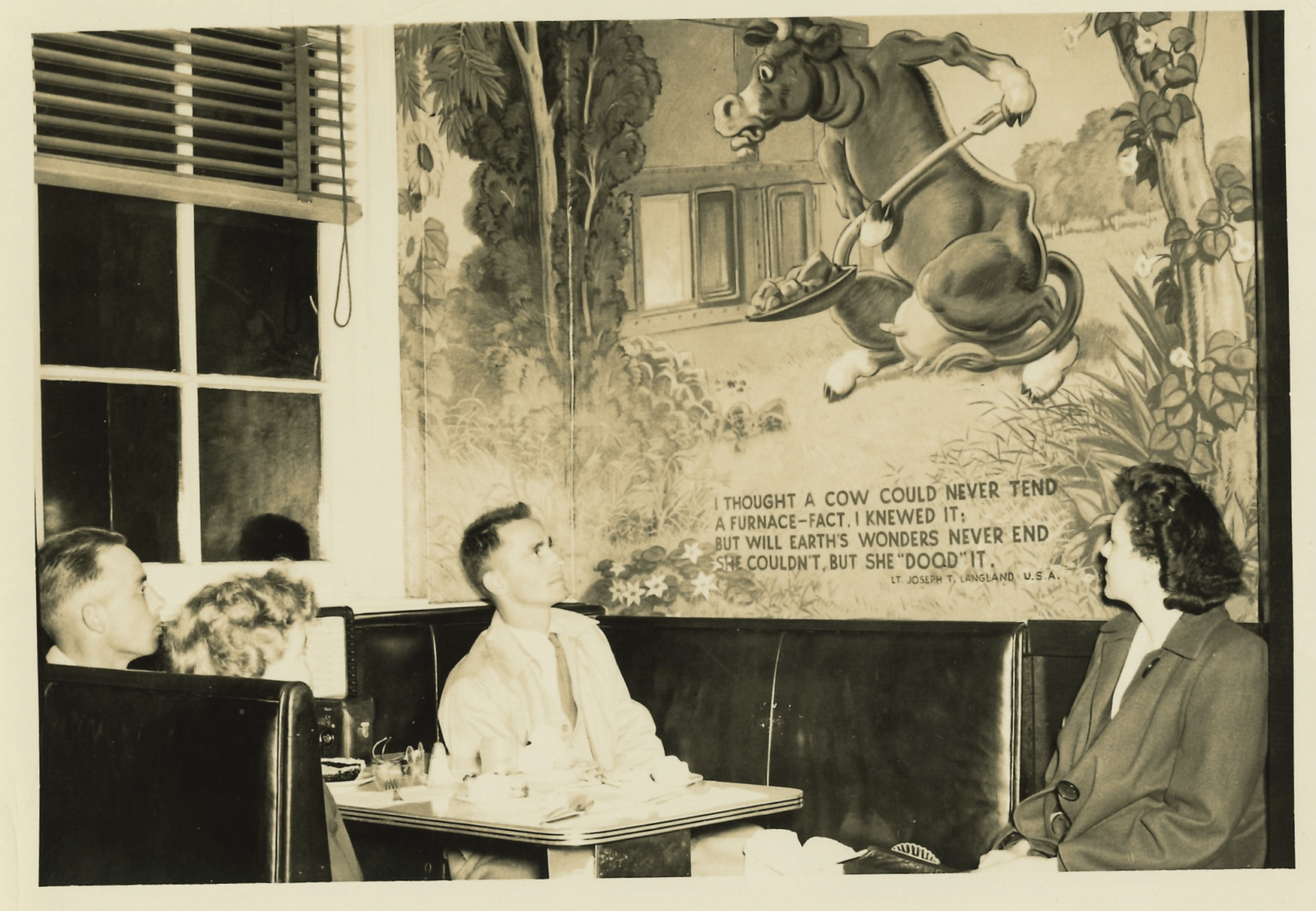
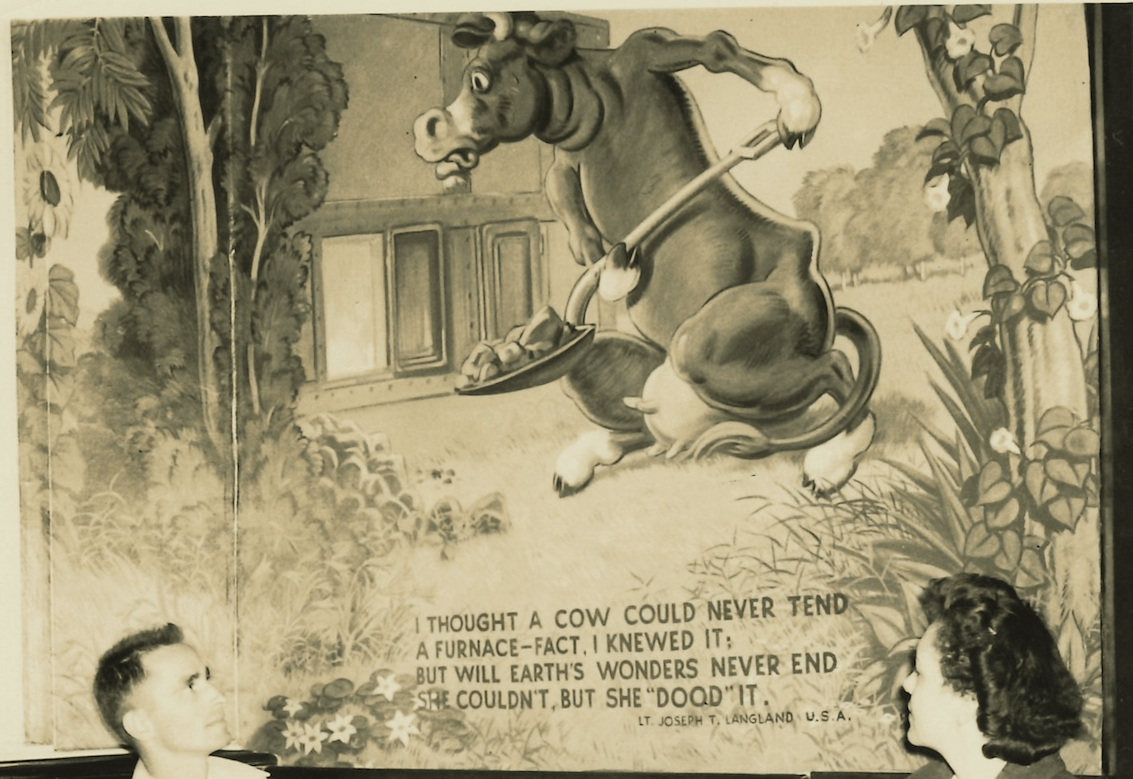
The local mural was not an exception to the Purple Cow identity; it was one way the national concept became local. Flint received General Motors. Pittsburgh received a bicycling Purple Cow with the Golden Triangle in the background. Youngstown received a furnace subject tied to its steel identity. Waco’s selected mural became the focus of thousands of local entries.
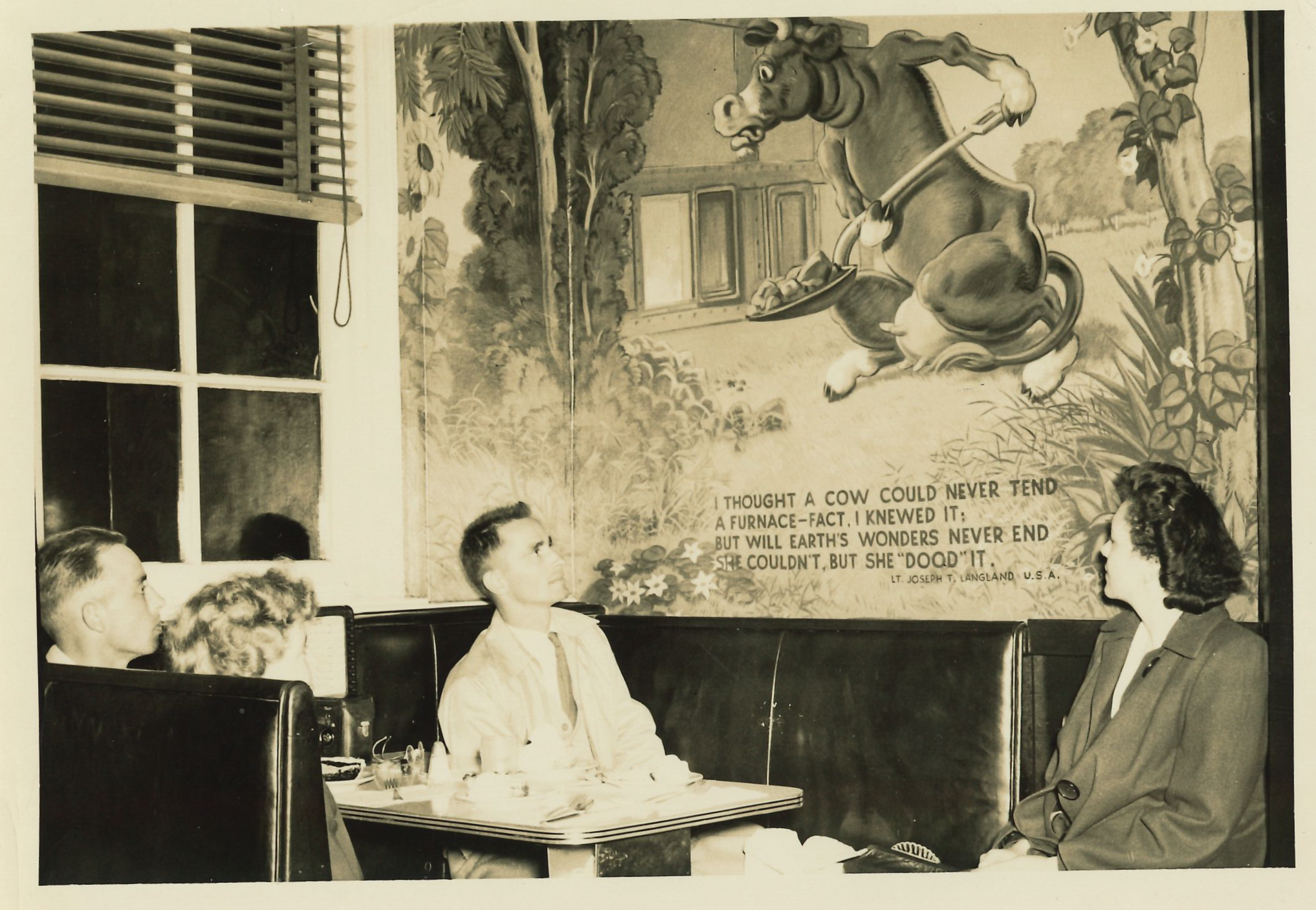
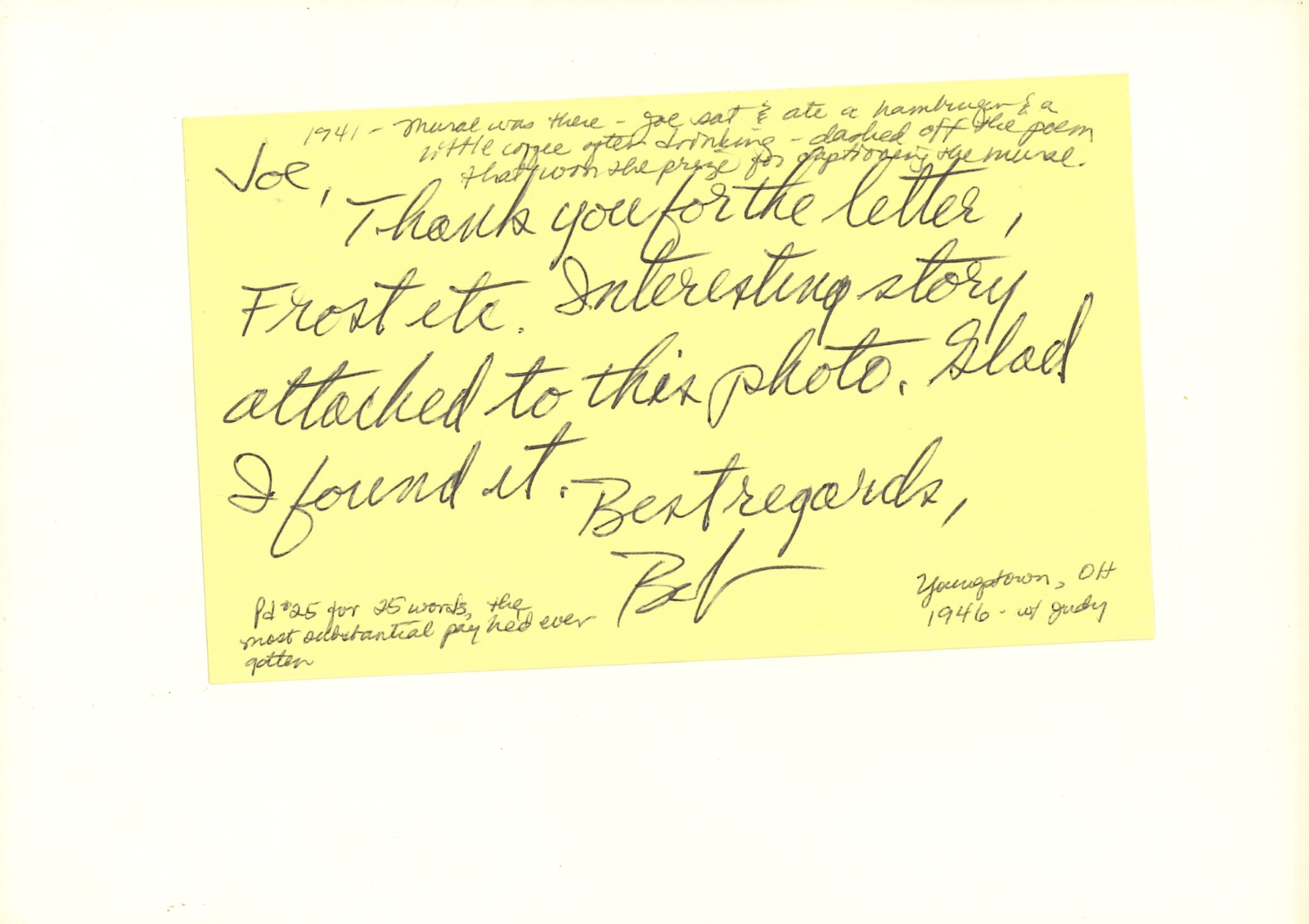
Pick-Ohio, Youngstown. American Poet Joseph Langland’s jingle was selected for Grell’s TEND A FURNACE mural. A locally themed Grell Purple Cow furnace subject became part of the hotel’s public jingle history, connecting the national restaurant concept to Youngstown’s steel identity.
THE ANDERSON LESSON — DOCUMENTED WITHOUT A MURAL PHOTOGRAPH
Anderson explains why the catalogue must distinguish between documented murals and documented images. No known Anderson mural photograph is included in the 94-image count. Yet the 1943 newspaper report independently states that Purple Cow murals decorated the room and that the winning jingle would be used on one of them. Anderson therefore belongs securely in the documentary history while contributing zero mural images to the present photographic catalogue.
94 IS A DOCUMENTED-IMAGE COUNT — NOT AN ESTIMATE OF TOTAL PRODUCTION.
FROM GRELL’S WALL TO DORIS DAY
By 1953 the Purple Cow had moved beyond the hotel wall and into a broader promotional culture. Doris Day recorded “A Purple Cow,” and the connection between the song and Albert Pick Hotels’ Purple Cow restaurants was documented in two separate contemporary publications.
Pick Hotels’ own Topicks described the relationship with Columbia Records as a “timely and widely-publicized liaison” expected to increase reputation and revenue on both sides. During Day’s five-day stay at Chicago’s Congress Hotel, Albert Pick Jr. was photographed presenting her with a Purple Cow menu while Day offered him her Columbia recording. The Flint Journal independently published the exchange on August 6, 1953 and directly connected Day’s new recording with the Purple Cow restaurants of the Pick Hotels chain.
RECORD FOR MENU. COLUMBIA FOR PICK. DORIS DAY FOR THE PURPLE COW.
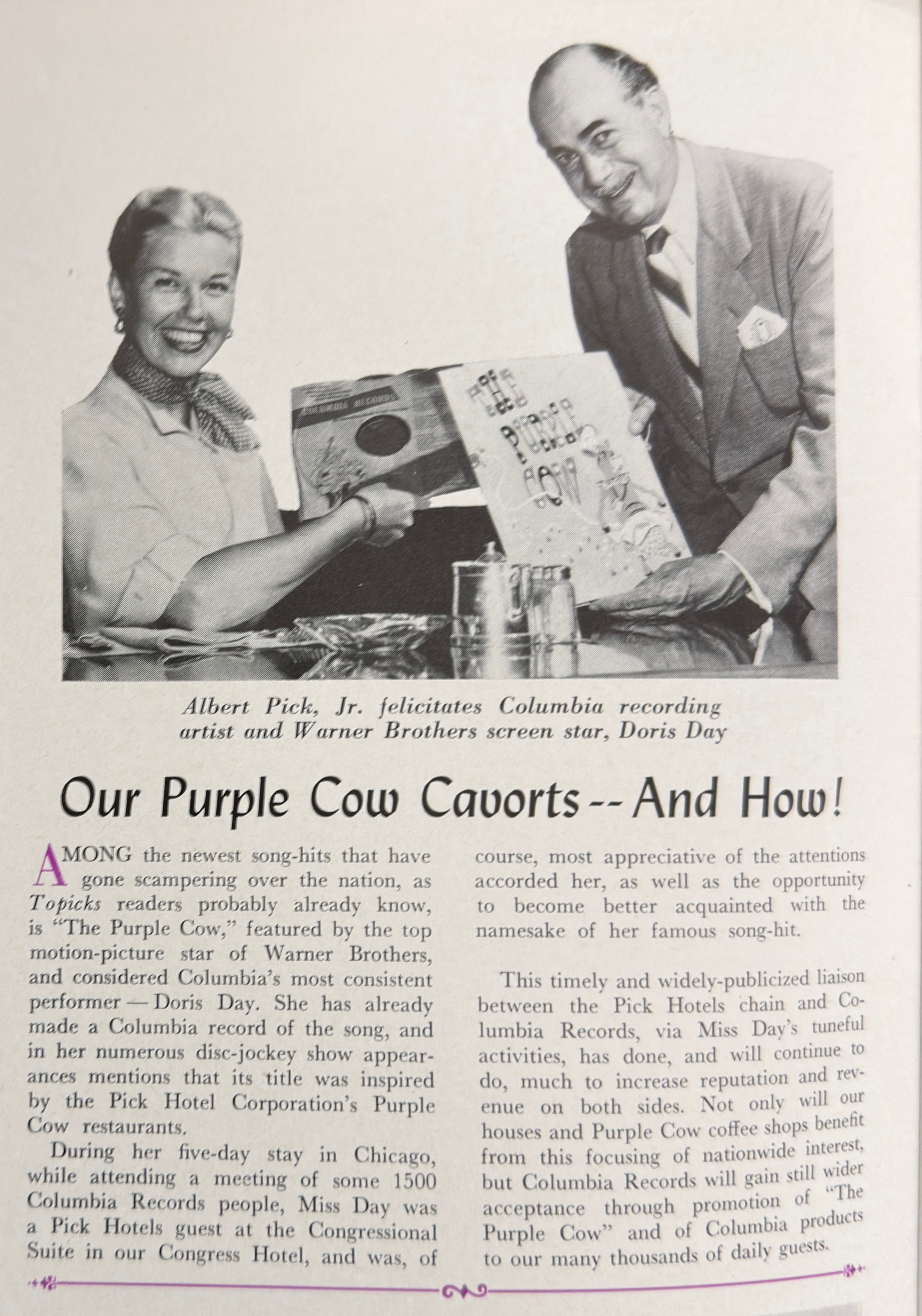
THE EVEN TRADE · Congress Hotel · Chicago · 1953. Doris Day offers Albert Pick Jr. her Columbia recording of “A Purple Cow” while Pick presents a Purple Cow menu. The promotion was documented by Pick Hotels and independently by the Flint Journal.
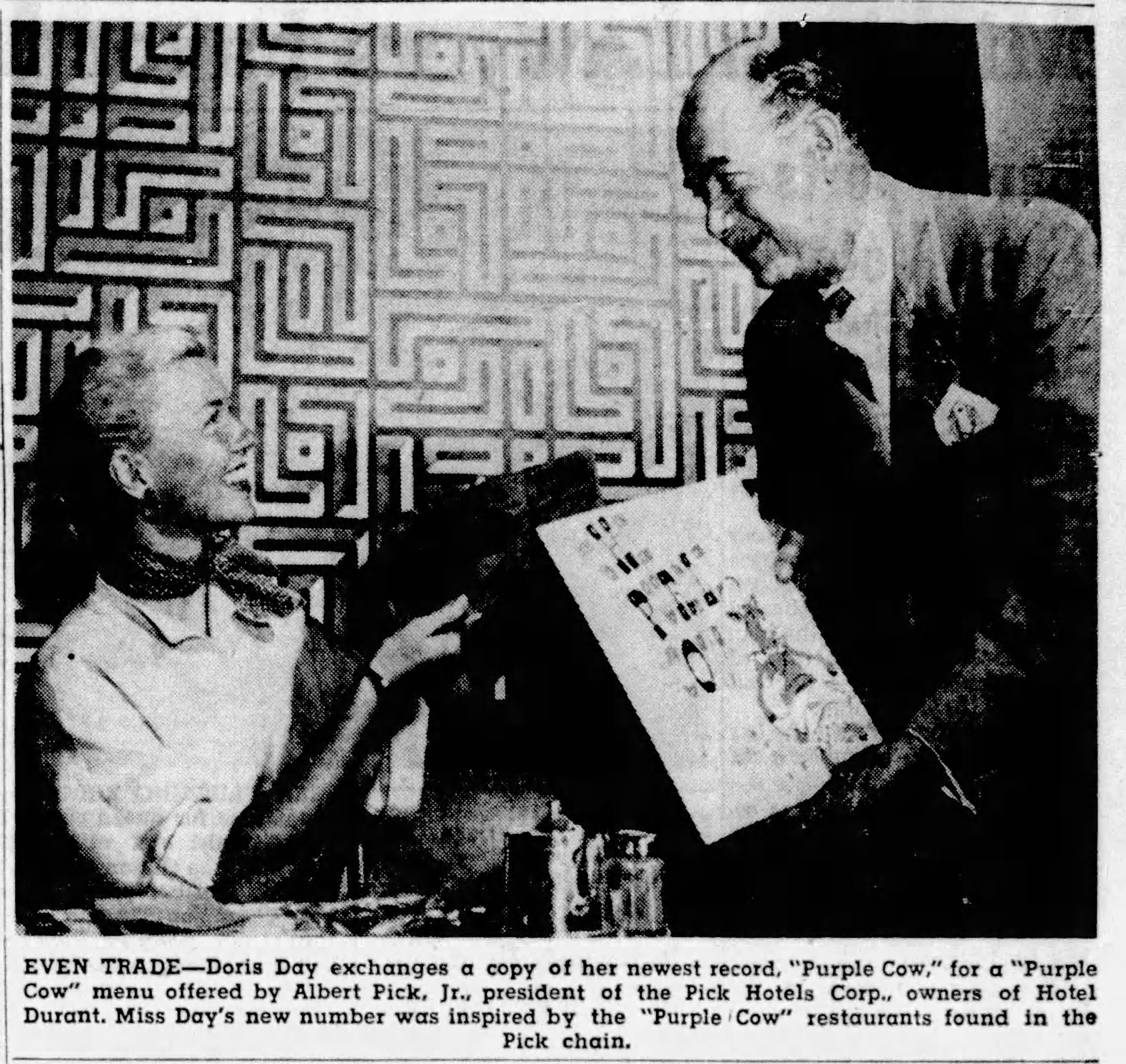
Flint Journal · August 6, 1953. Independent contemporary coverage connected Doris Day’s new recording directly with the Purple Cow restaurants of the Albert Pick Hotels chain.
The menu itself belonged to Grell’s painted world
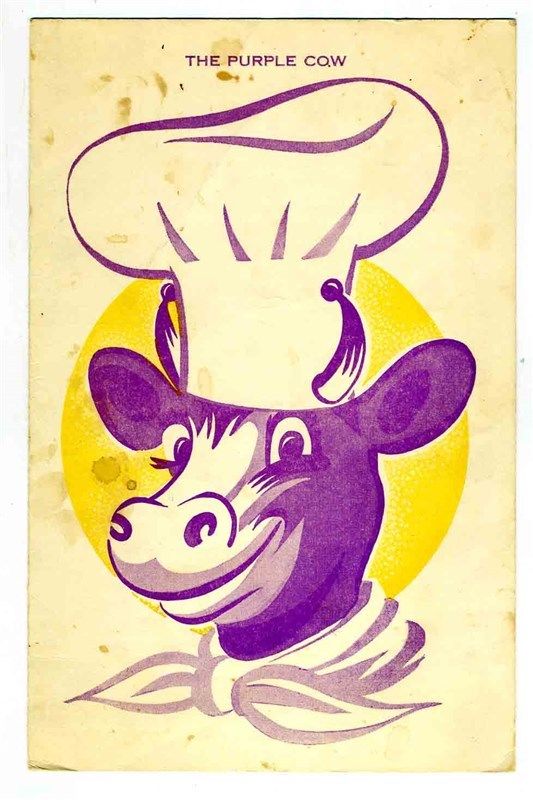
The exchange becomes more significant when the menu is compared with Grell’s surviving mural record. The central Purple Cow imagery on the menu derives from the composition documented as IN THE MOOD at the Hotel Belden in Canton, Ohio. What had appeared at monumental scale on a hotel wall had become something a guest could hold.
Another example of the same menu design survives through the Grell family archive. The two examples therefore followed strikingly different paths: one passed from Albert Pick Jr. to Doris Day during the EVEN TRADE; another remained connected to Grell’s family and archive.
GRELL MURAL → PURPLE COW MENU → ALBERT PICK JR. → DORIS DAY
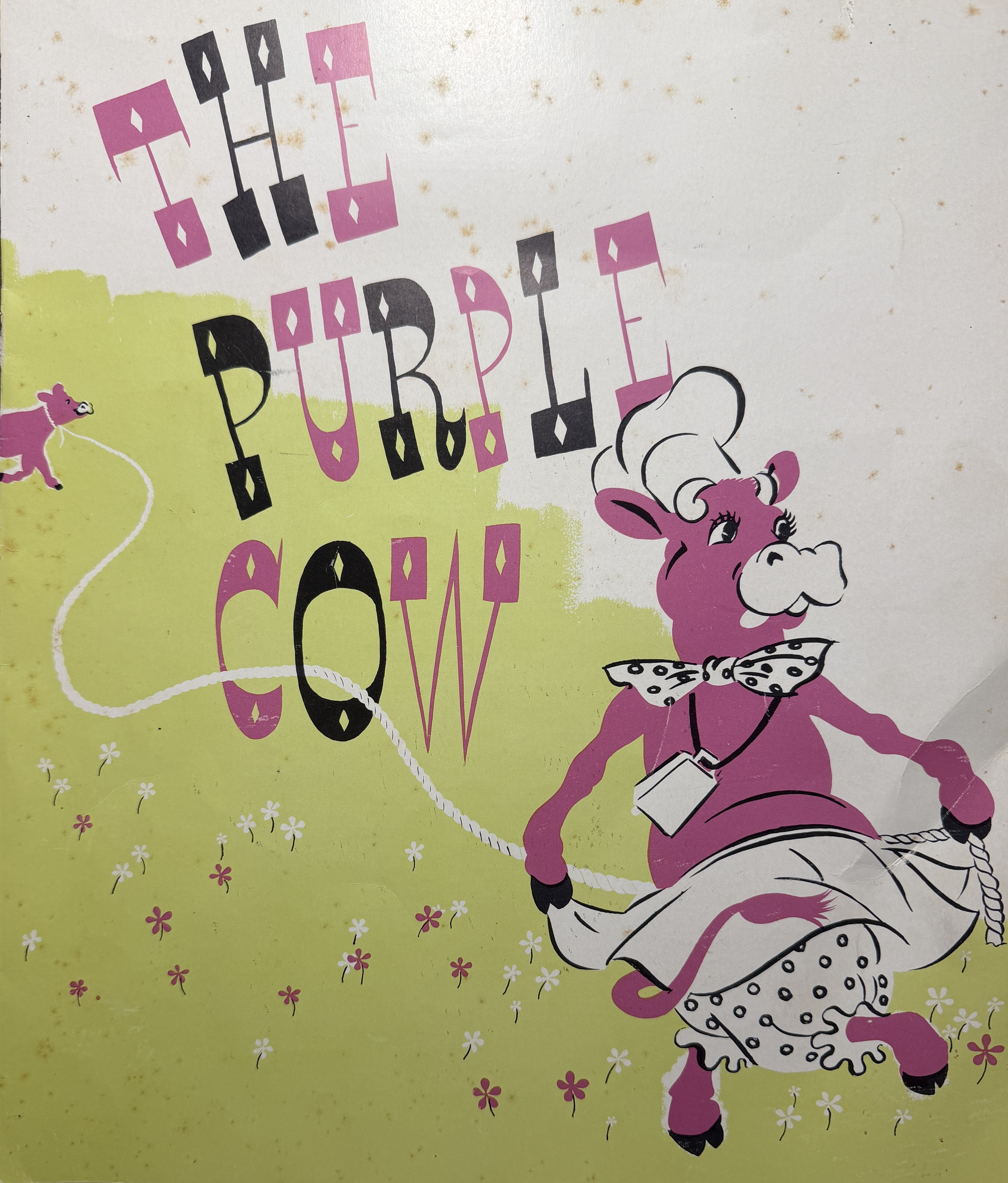
PURPLE COW MENU. Surviving example of the menu design photographed in Albert Pick Jr.’s hands during the Doris Day EVEN TRADE. Another example of the design was preserved through the Grell family archive.
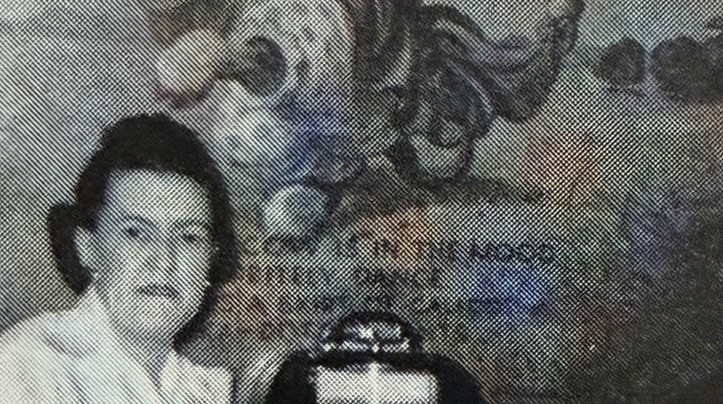
IN THE MOOD · Hotel Belden · Canton, Ohio. Grell’s monumental Purple Cow composition provides the mural counterpart for imagery adapted to the printed Purple Cow menu.
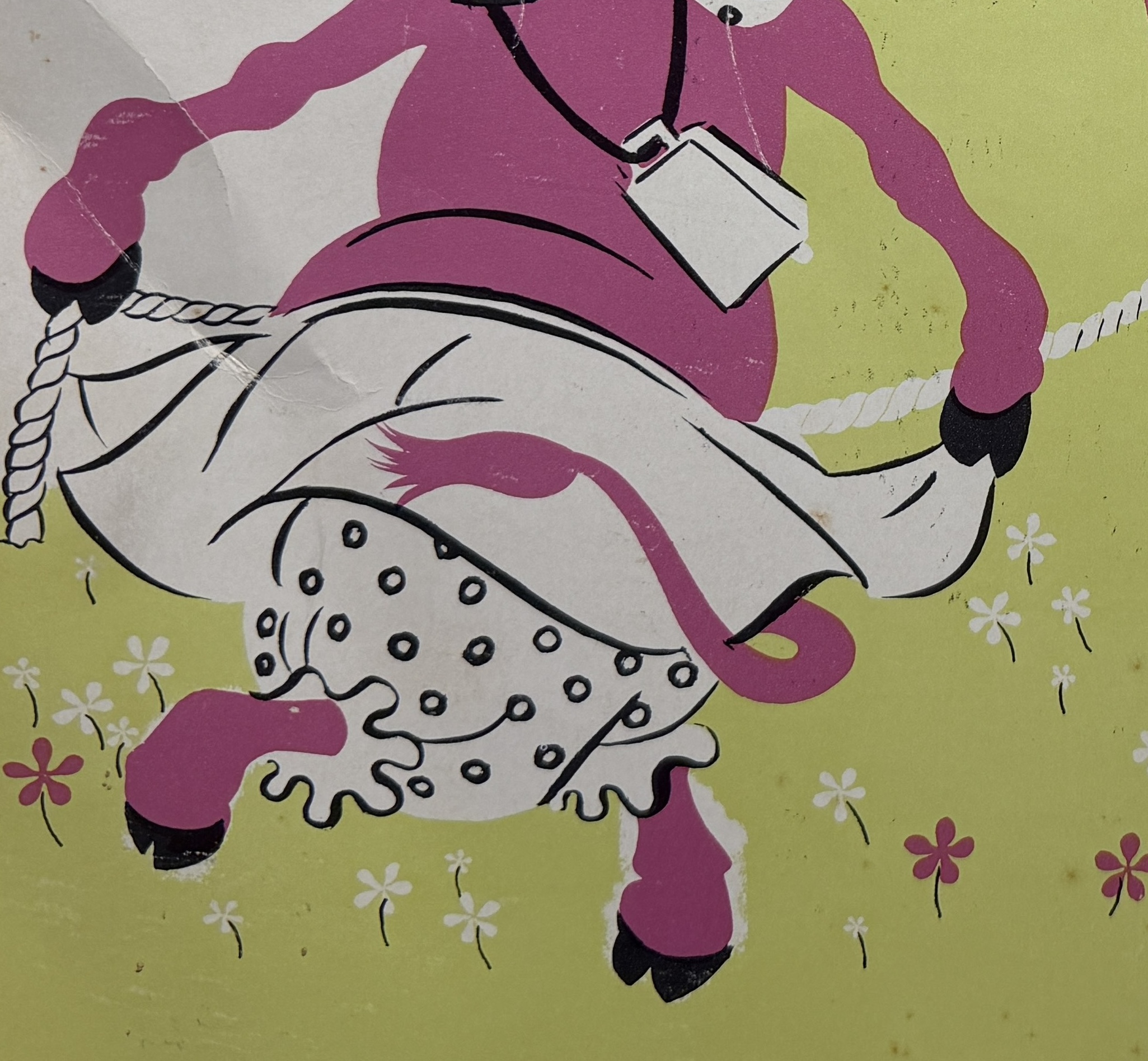
MURAL → MENU → EVEN TRADE. Comparative detail reconnecting Grell’s Hotel Belden imagery with the printed Purple Cow menu photographed during the 1953 Doris Day–Albert Pick Jr. promotion.
SURROUNDED BY GRELL AT THE CONGRESS HOTEL
The EVEN TRADE did not occur in an artistic vacuum. Only the year before Day’s stay, Pick Hotels had celebrated Grell’s thirteen monumental Congress Hotel lobby lunettes in Topicks under the heading GRELL MASTERPIECES. Separate period photographs identify the Glass Hat setting through its distinctive geometric wall treatment. Grell’s monumental work formed part of the broader Congress Hotel environment encountered during Day’s visit.
This context should be stated carefully: the tightly framed EVEN TRADE photograph does not itself show Grell’s large Glass Hat mural. The importance lies in the independently documented setting, the Grell-derived menu in Pick’s hands, and the larger Grell-decorated hotel environment around the promotion.
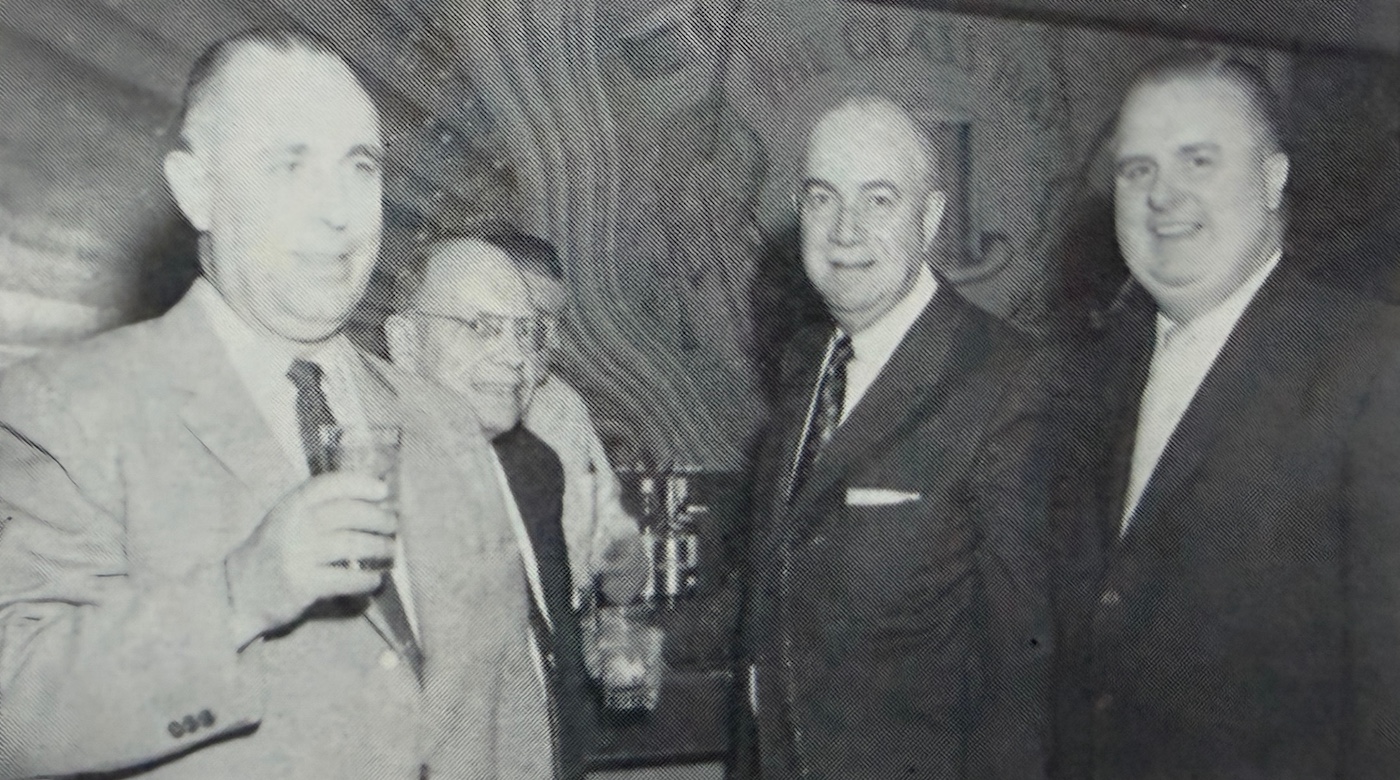
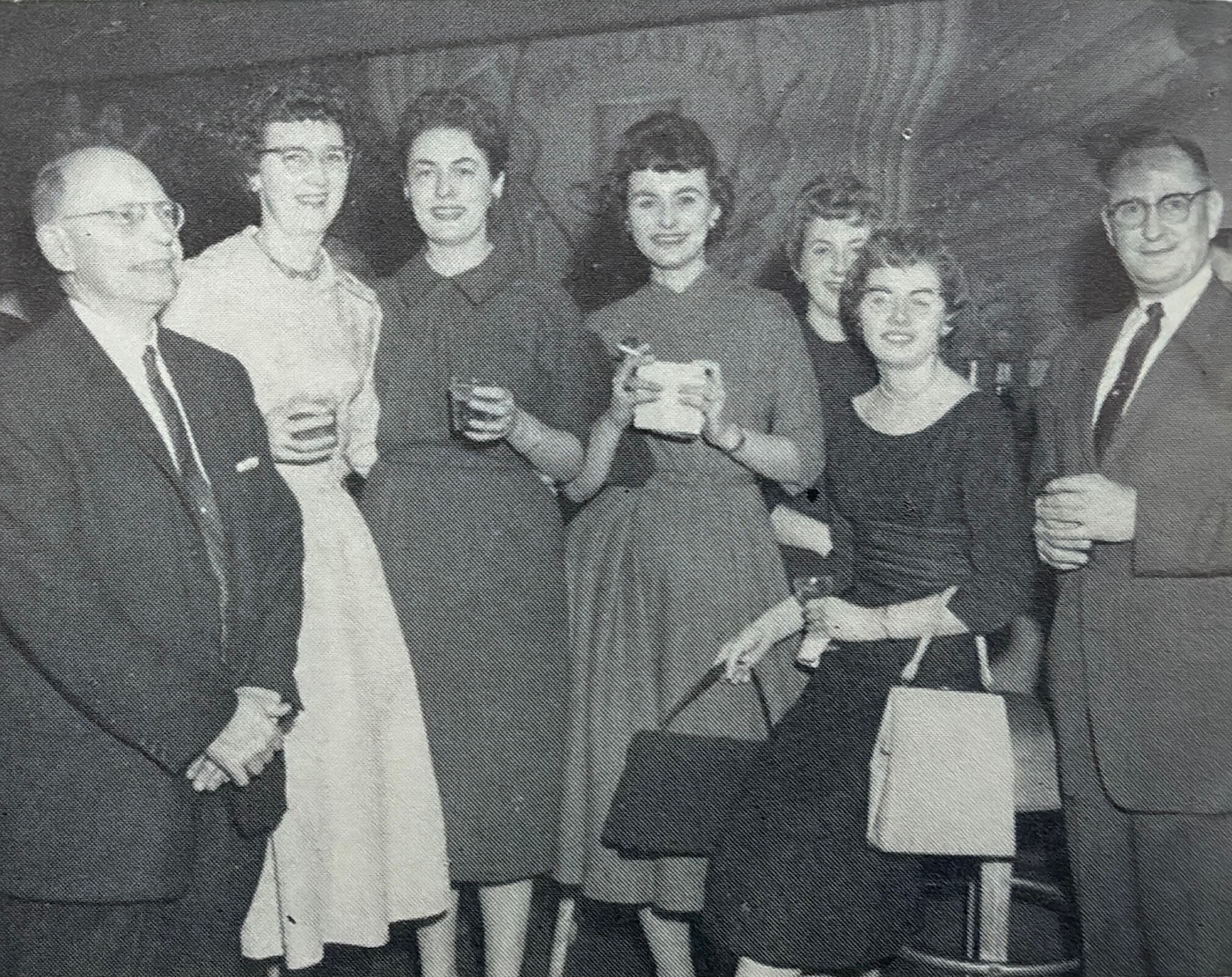
THE GLASS HAT · Congress Hotel · Chicago. Period interior photography identifies the room through its distinctive geometric wall treatment and documents Grell’s monumental decorative work within the surrounding environment.
FROM WALL PAINTING TO CORPORATE IDENTITY
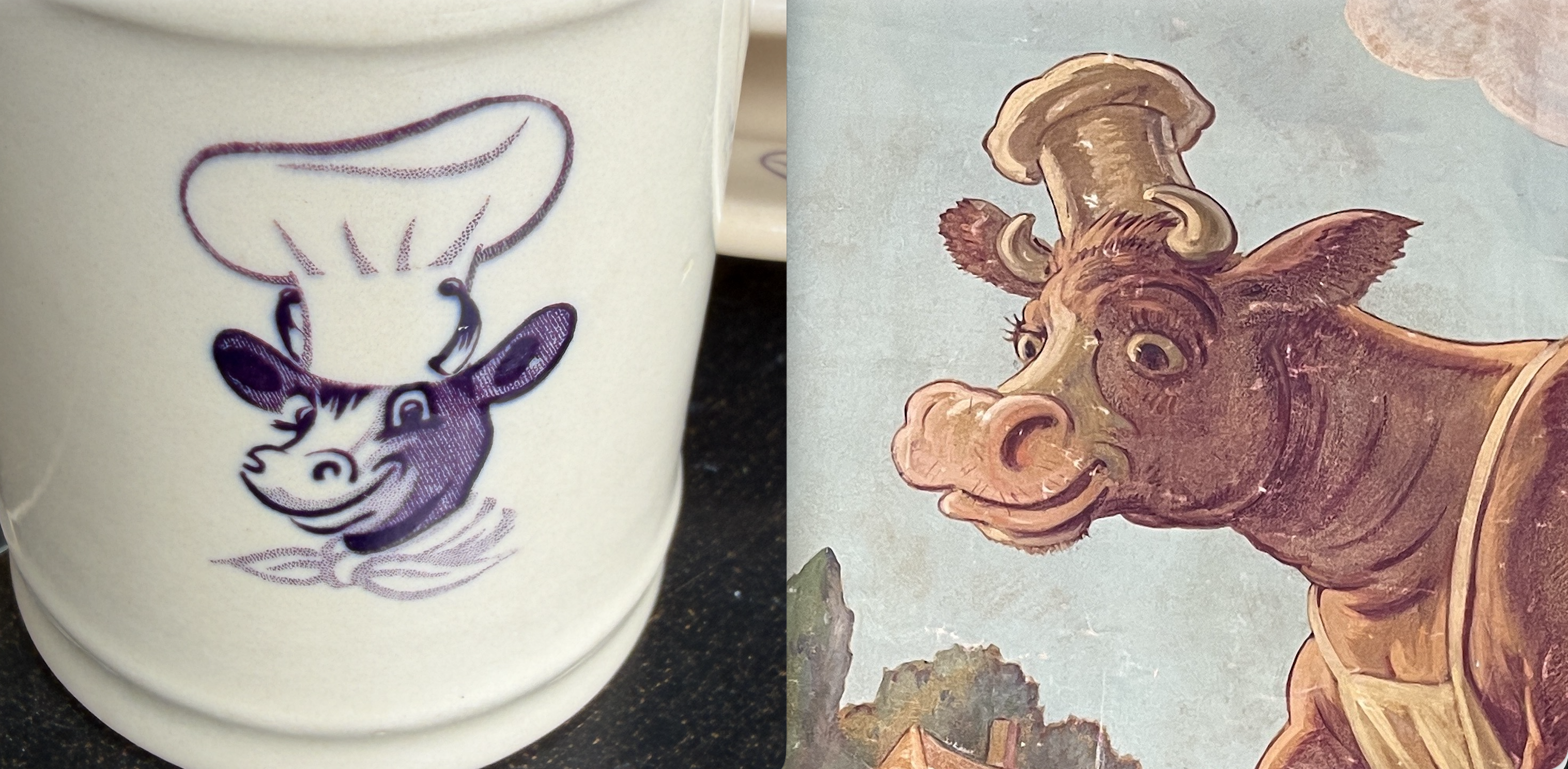
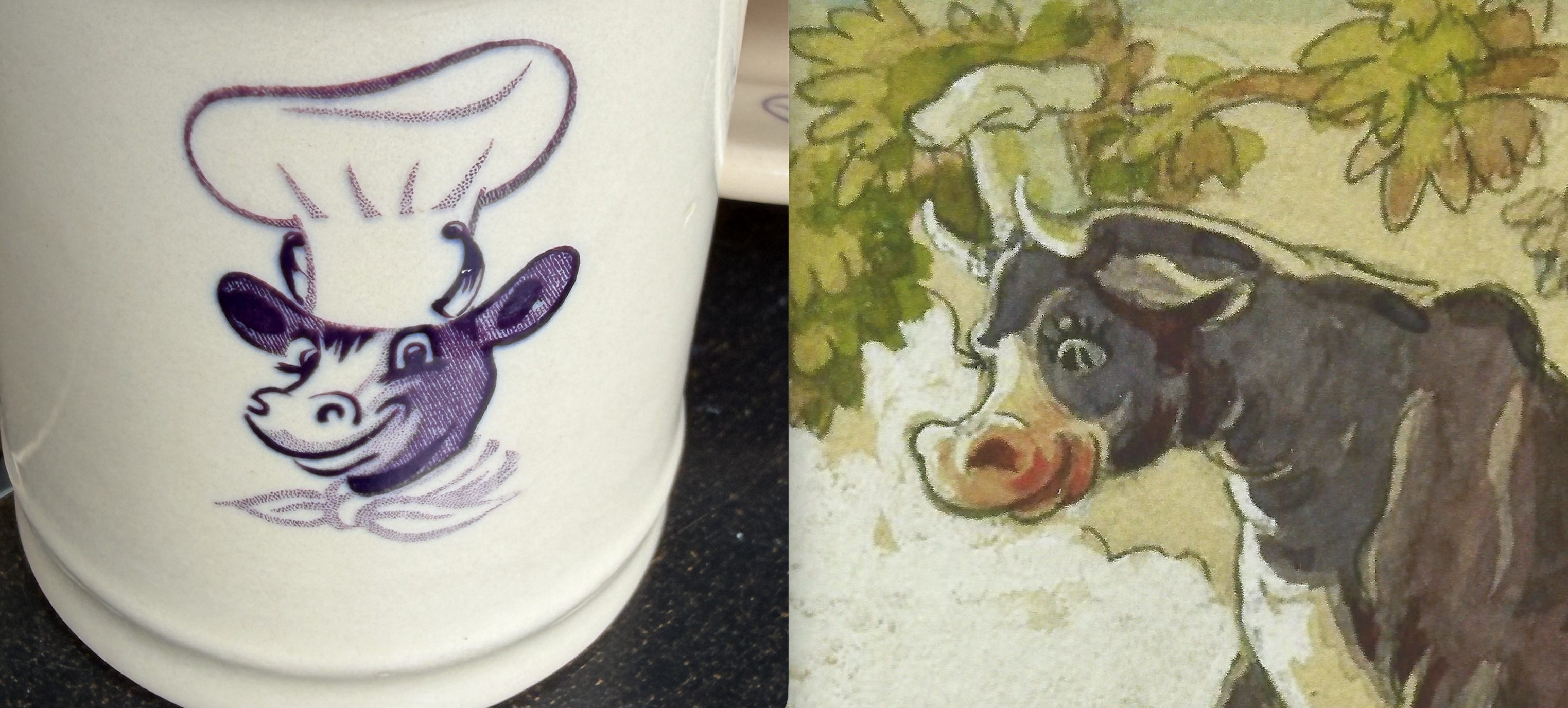
The Purple Cow imagery repeatedly crossed media. It appeared on menus, newspaper advertisements, corporate publications, restaurant glassware and tableware, exterior promotion and public contests. These objects show that Grell’s mural vocabulary became part of the restaurant identity rather than remaining confined to the painted wall.
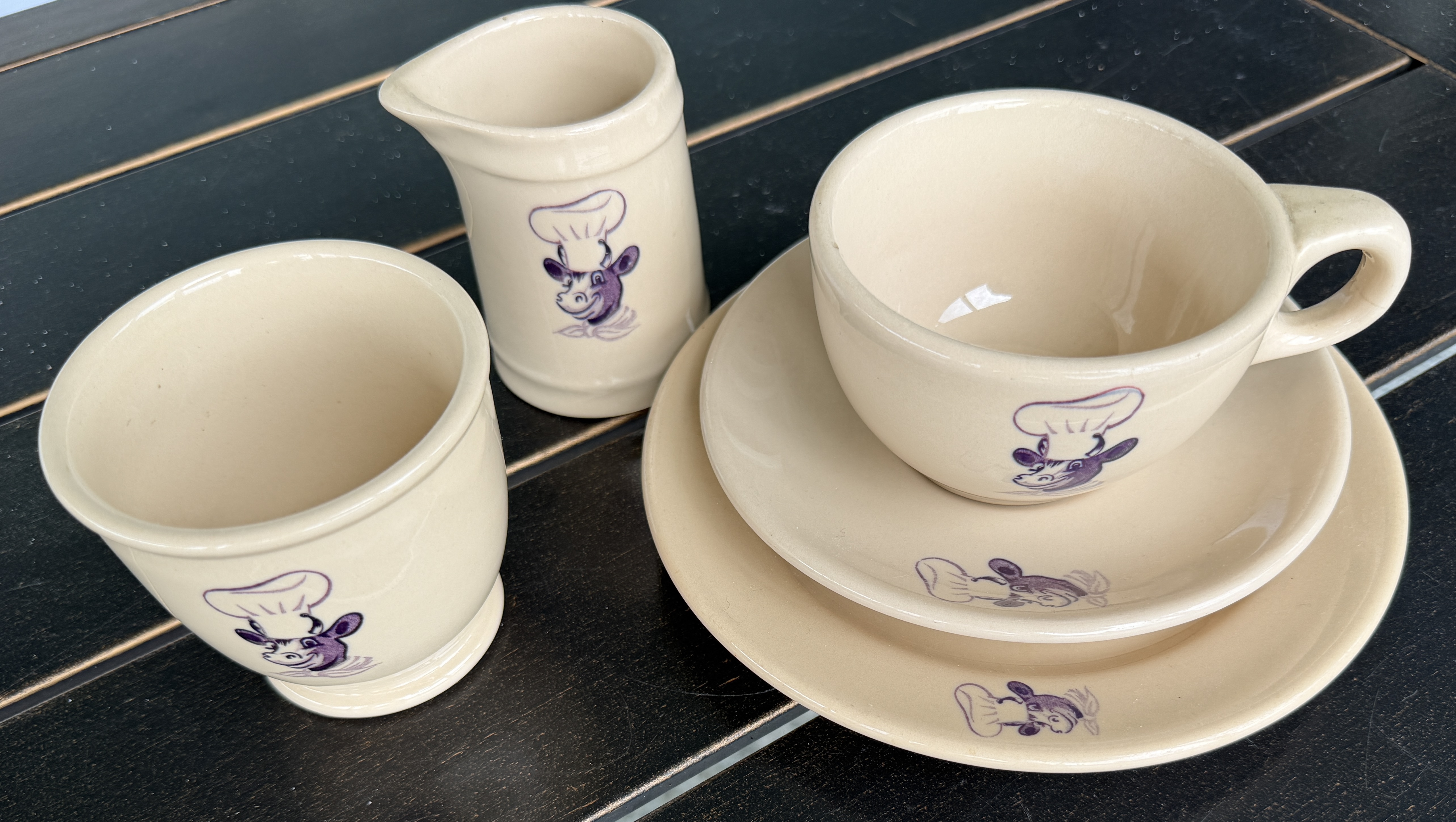
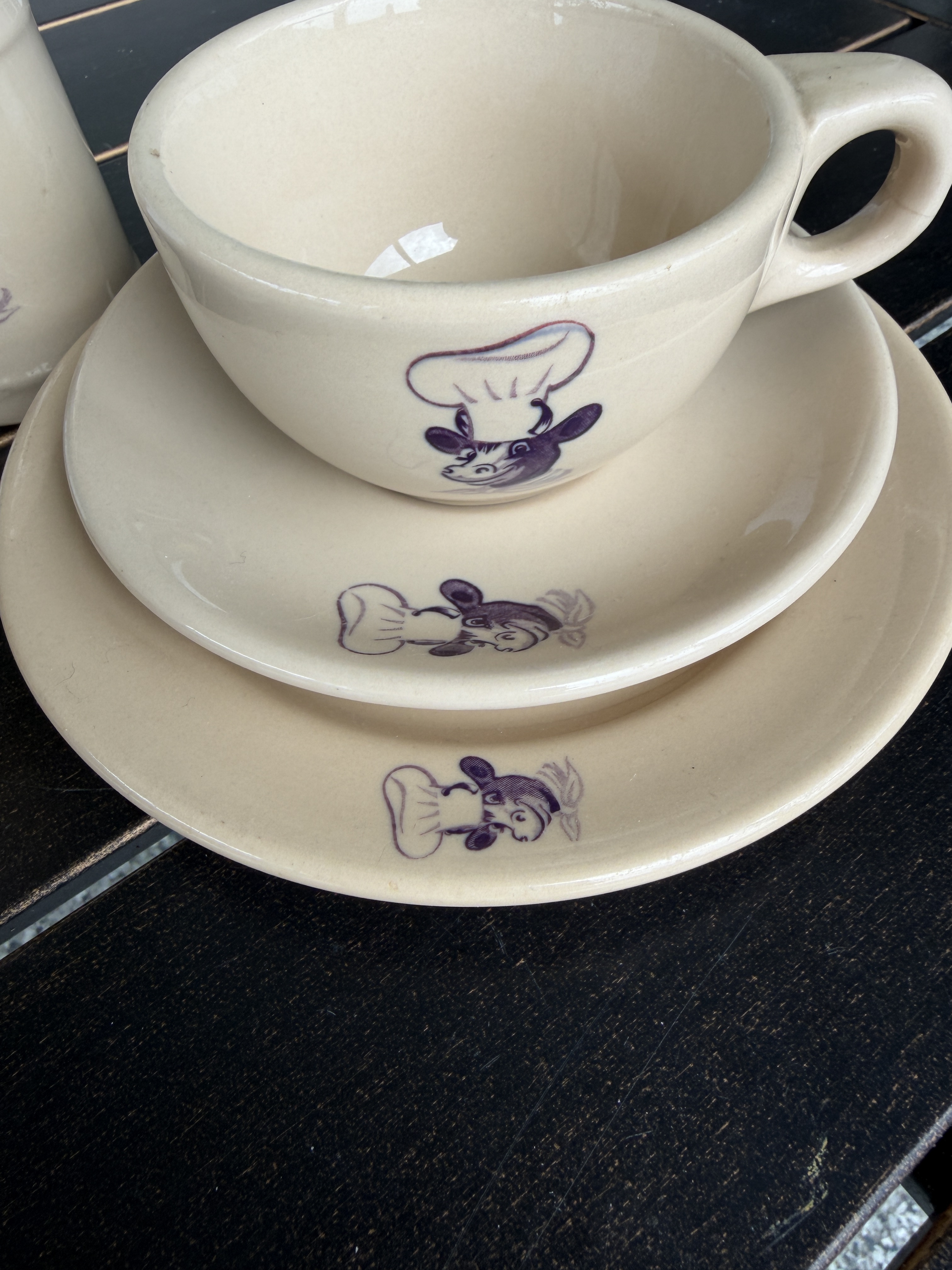
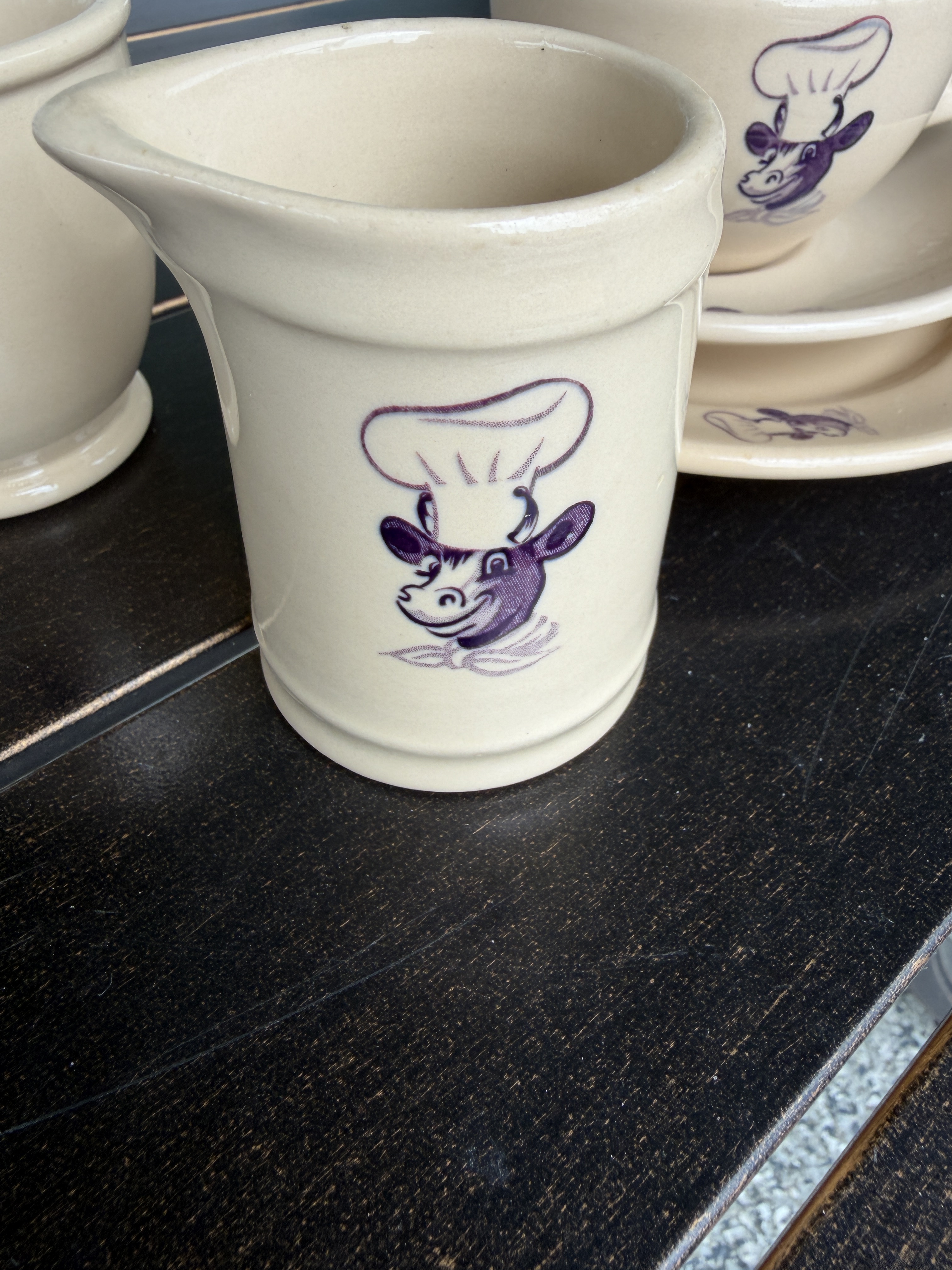
Purple Cow tableware. Grell’s comic restaurant world extended beyond the murals into objects encountered by guests.
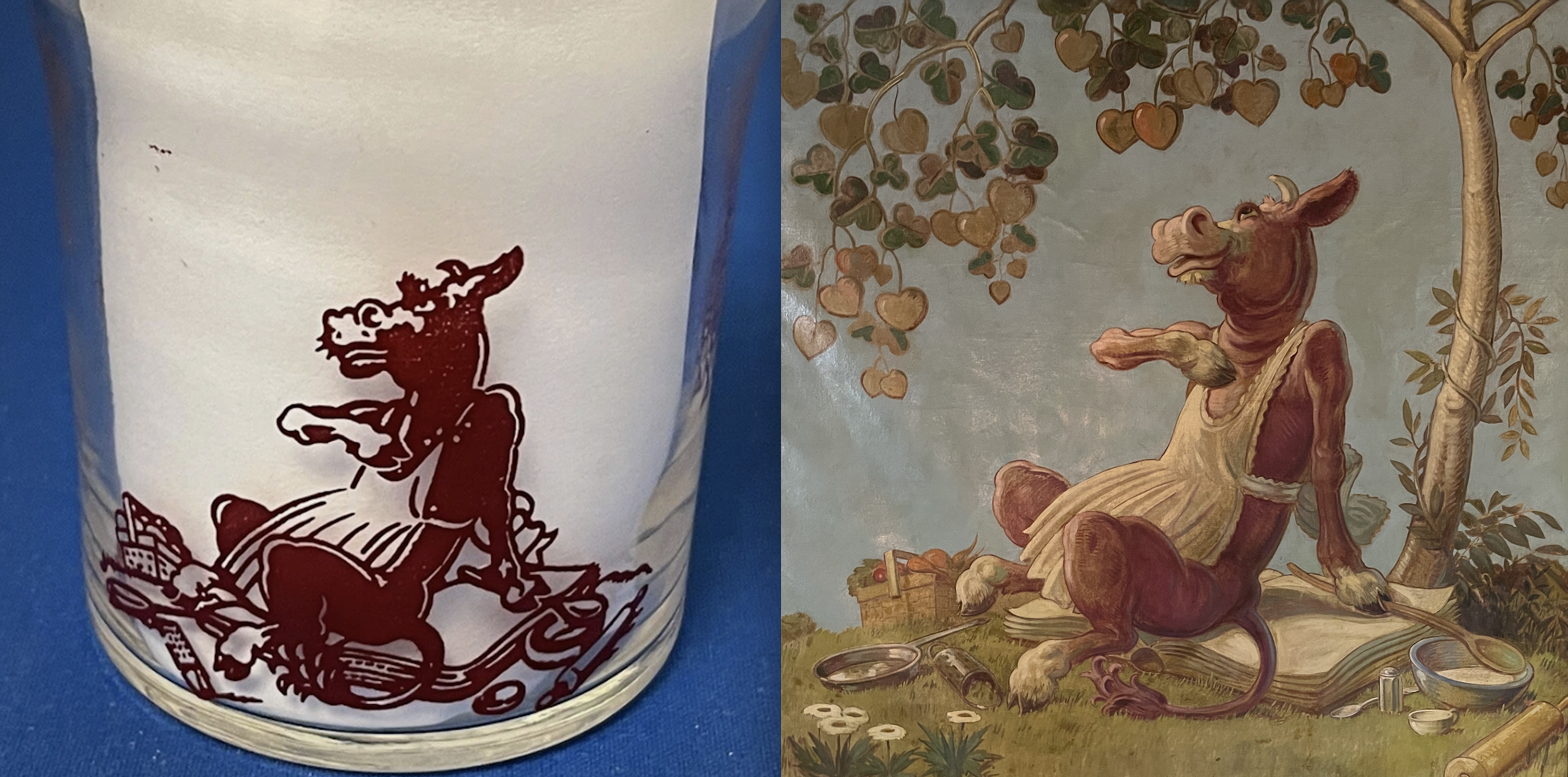
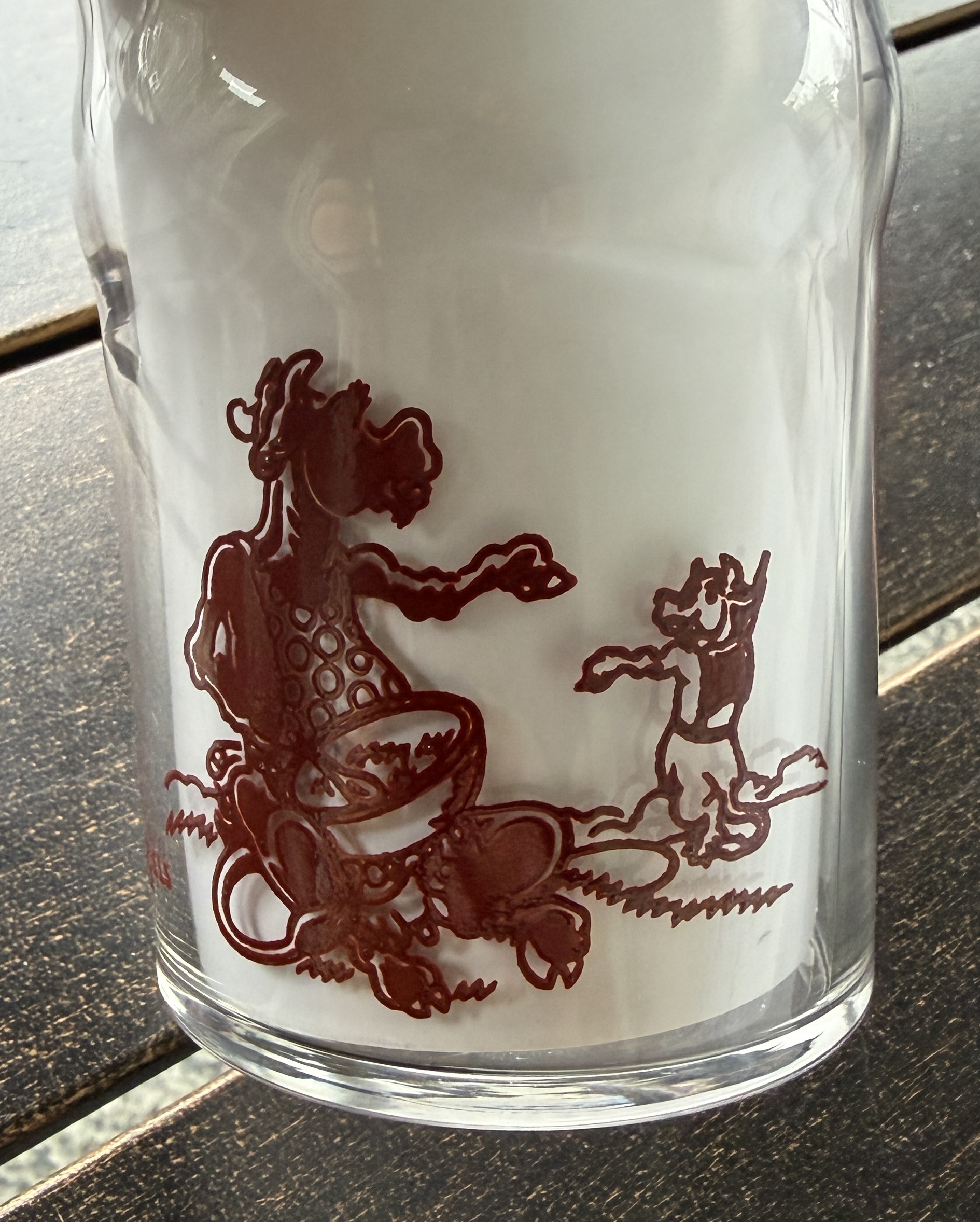
Purple Cow imagery across media. A recurring Grell composition can be compared between the mural environment and restaurant glassware.
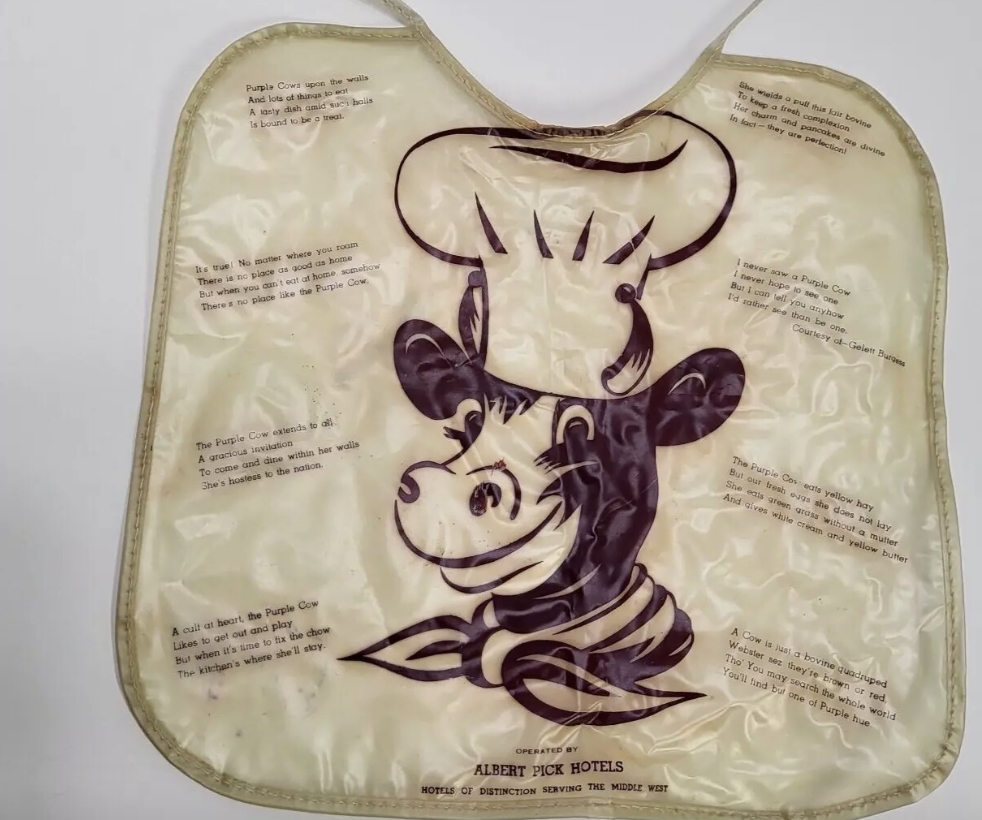
Purple Cow children’s bib. Surviving restaurant ephemera demonstrates how the visual identity moved into guest-facing objects.
WHAT SURVIVED
Most of Grell’s Purple Cow world disappeared as hotels changed ownership, restaurants closed and interiors were remodeled. Yet important physical survivors remain. Nine Hotel Durant murals survive together at Kettering University. The Hotel Jermyn Ferdinand fragment survived outside that institutional group. Young Thing and original Purple Cow watercolor designs preserve other stages of the process.
The photographs tell us what once existed. The publications tell us who created it. The contests tell us how the public interacted with it. The surviving murals show us the physical object. The original watercolors show us how Grell developed and enlarged his ideas. Their significance increases because the archival record allows them to be returned to the lost environments from which they came.
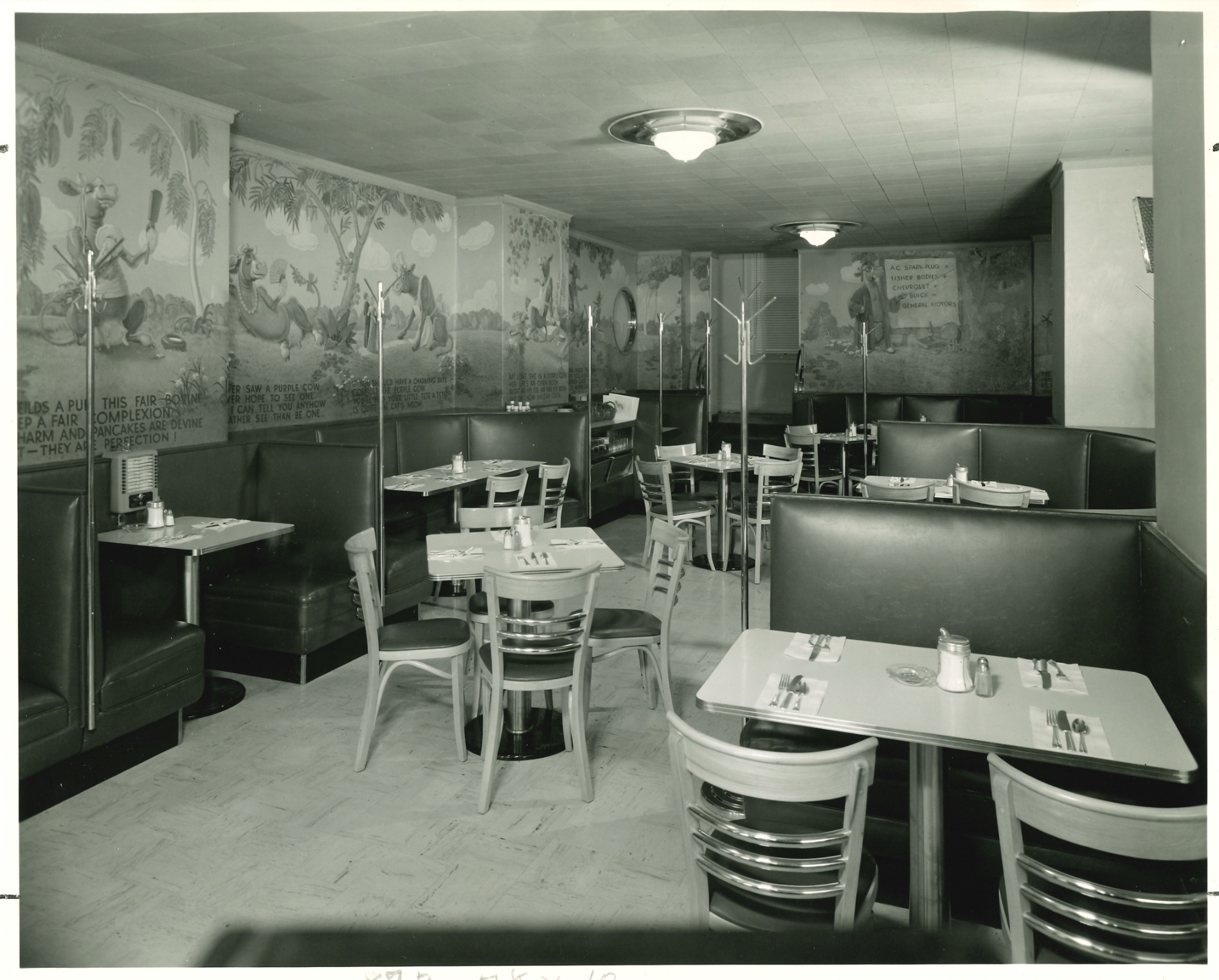
Purple Cow · Hotel Durant · Flint. Period photography preserves multiple Grell murals in situ and provides the architectural context for the institutional survivors now at Kettering University.
THE NUMBER: 94 DOCUMENTED MURAL IMAGES
The present catalogue contains 94 documented Purple Cow mural images. An earlier working total of 96 resulted from counting two documentary lines as though they were mural images. Removing those non-image entries produces the corrected total of 94.
The correction strengthens the catalogue because the number now means exactly what it says: 94 visual mural records. Anderson remains historically documented but contributes no image until a mural photograph is located. The 600-foot Roosevelt installation, chain-wide attribution and documented but unphotographed locations all demonstrate that Grell’s total historical production was substantially larger than the surviving image count.
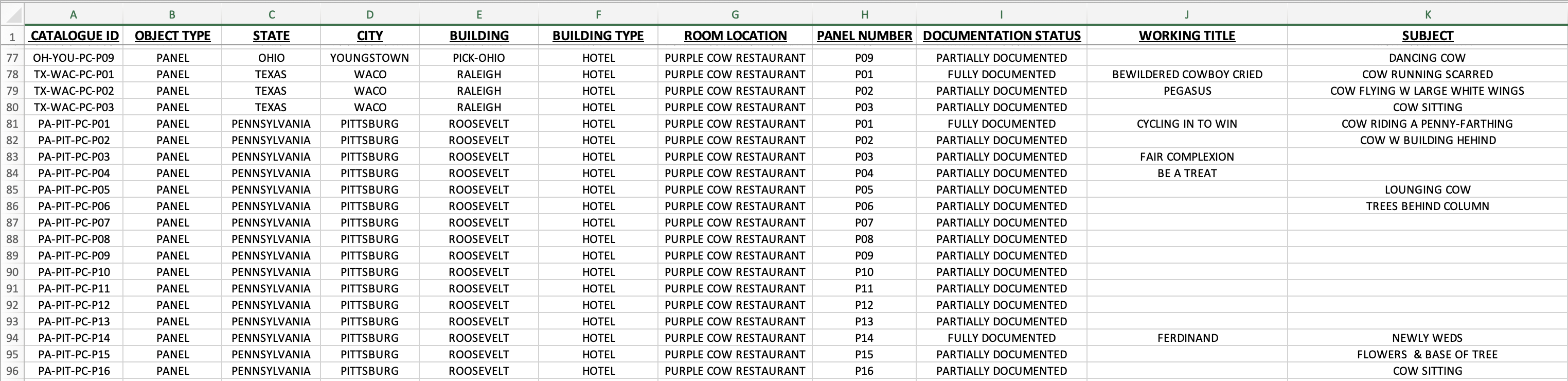
EARLIER WORKING MONTAGE. This archival montage was assembled when the working count stood at 96. Subsequent review showed that two documentary lines were not mural images. The corrected catalogue count is 94 documented mural images.
A PAINTED WORLD ACROSS AMERICA
Taken together, the evidence changes the scale at which the Purple Cow should be understood. Pick Hotels identified Grell as the creator of its Purple Cow murals and stated that his work adorned every other Purple Cow in the chain. One restaurant alone was reported to contain 600 feet of murals. Ninety-four individual mural images are presently documented, while Anderson and other records demonstrate that the photographic record is incomplete.
The murals were not identical franchise decorations. Grell reused favorite characters and ideas while continually rebuilding their surroundings. Ferdinand is the clearest recurring-character case: documented in multiple settings, recognizable from one hotel to another, yet repeatedly placed into new painted worlds.
The jingle contests show how Pick Hotels turned Grell’s local murals into public events. Waco, Pittsburgh and Anderson preserve explicit contemporary contest records, while GM TECH at Flint preserves the before-and-after mechanism in paint and photography.
The Doris Day EVEN TRADE shows the program moving still farther. A Grell image traveled from monumental mural to printed menu and into the hands of one of America’s best-known entertainers, with the promotion recorded both by Pick Hotels and by an independent newspaper.
And the surviving objects bring the vanished system back to physical reality. A gridded watercolor shows how Grell began. A period photograph shows the design on a wall. A jingle contest shows the public responding. A menu shows the image becoming corporate identity. Ferdinand shows a recurring character traveling through the chain. A surviving mural shows what remained when the hotel world disappeared.
NOT ONE MURAL.
NOT ONE RESTAURANT.
NOT ONE CITY.
ONE ARTIST.
MANY HOTELS.
ONE RECOGNIZABLE PAINTED WORLD.
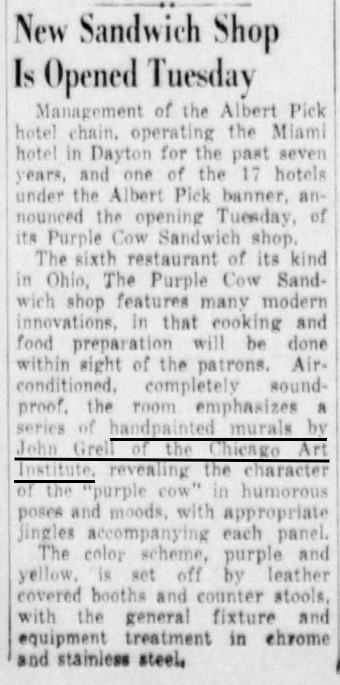
In 1940, the Dayton Daily News reported that a John Grell with the Chicago Art Institute hand painted murals for the Pick-Miami hotel’s Purple Cow sandwich shop which was “[t]he sixth restaurant of its kind in Ohio (June 4, p. 4).” We are uncertain how many of the other five Purple Cow shops in Ohio had murals hanging on the walls by 1940 besides the Pick-Miami in Dayton. We do know that all Purple Cow shops had murals. The fact that the newspaper had his first name incorrect is not surprising, since likely none of the murals were signed and there is no mention by Grell of many of his commissions because he was private about these things. Furthermore, Grell rarely visited the buildings where his murals ended up because he hand painted them in his studio in Chicago. Once completed and dried they were rolled up and shipped to the hotel for installation by local artisans. The only reason he agreed to conduct the one phone interview for the Topicks magazine in 1948 was to fulfill a promise he made to his sister Helen.
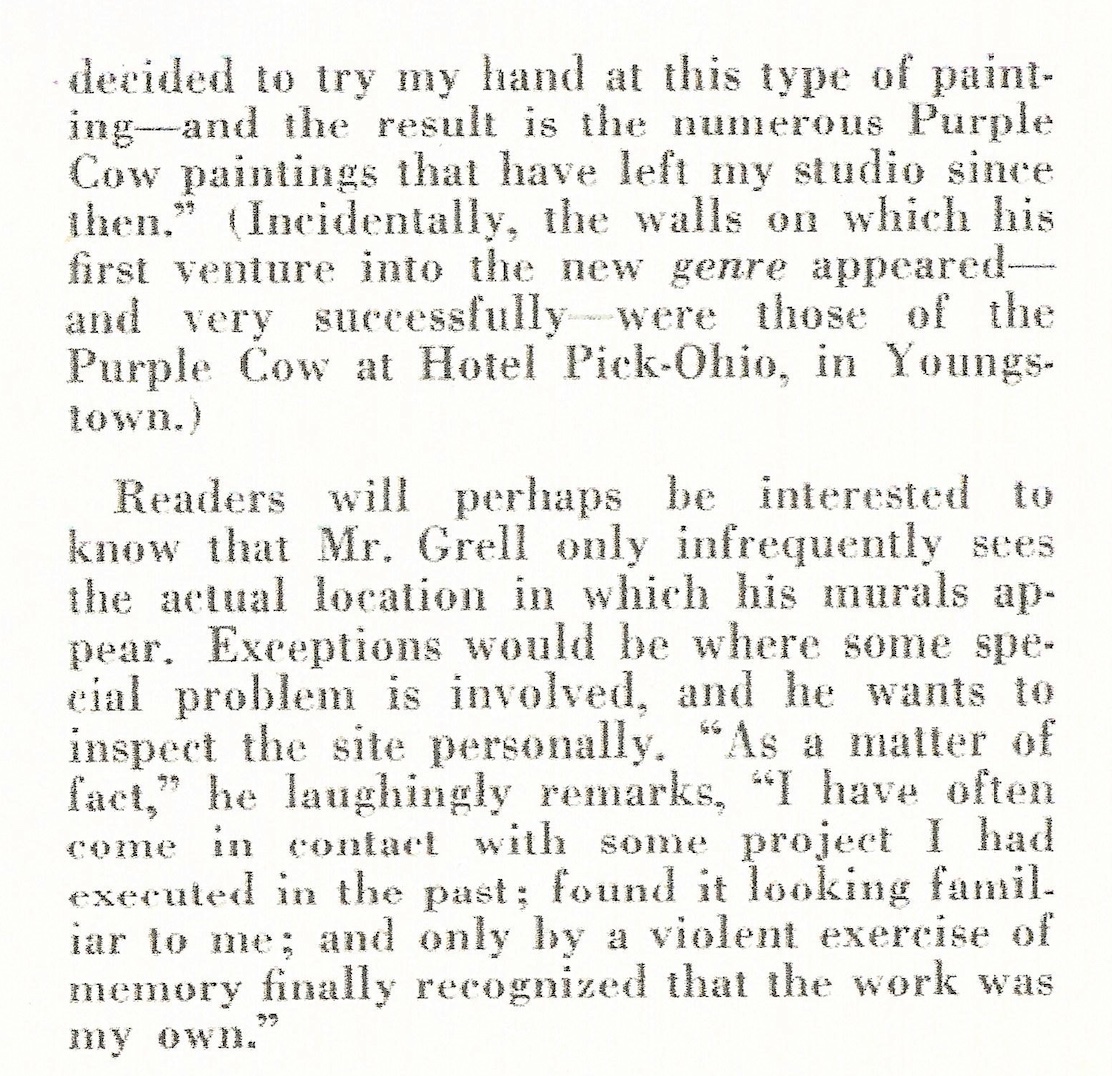
Pick Topicks May 1948 page 7
According to the above article published in the Albert Pick Hotels Corporation monthly magazine Pick Topicks, Grell’s fist Purple Cows were installed at the Pick-Ohio around 1939-1940 which included TEND A FURNACE (see below). Later reports claim that all Pick Hotels with Purple Cow shops included Purple Cow murals and one was always created with a local theme and initially installed with no poem so the competition could commence.
The four Purple Cow watercolor studies from c1940 shown above were utilized in many of the shops and the above advertisement thanking ‘Daytonians’ for supporting the Pick-Miami Hotel’s new Purple Cow restaurant. One locally themed mural specifically created by Grell for each hotel was installed and missing a jingle. The hotel announced a competition soliciting patrons to submit their own poem idea as part of a contest held with as many as 4,000 entrants competing to have their ‘jingle’ selected and later painted onto Grell’s mural. Menus were designed and specialty drinks created for the one-of-a-kind popular restaurants. Grell would routinely recreate a Purple Cow with the same poem and place the cow into a new scene with different surroundings such as trees and bushes for a different Pick hotel location. However, no two Purple Cow murals were exactly alike.
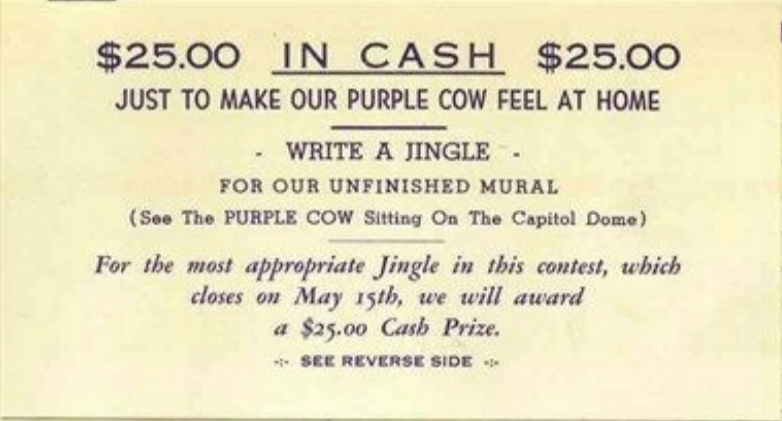
ABOVE – Entry card for this mural of a Purple Cow, Hotel Chittenden, Columbus, OH sitting on the State Capital dome. The unfinished part was the missing poem. It is entirely possible that the local artisans hired to glue Grell’s murals onto the walls and paint the winning jingle onto the locally themed mural would also do touch up work on the murals and the seams connecting them or corner touch up work. Inside Grell’s studio in Chicago were two large vertical rollers that were used to paint very long murals. Once a section dried, Grell would move onto the next section by rolling the canvas using the standing rollers. His fist large project back in the U.S. after his Hamburg days was in Utah, in late summer of 1907, was reportedly 140 feet long.
Hand written on the back page of a Hotel Miami (Dayton, OH) Purple Cow menu reveals several previously unknown jingles.
Likely for the Hotel Chittenden, Columbus, OH as noted on the entry card above.
“THIS PURPLE COW ATOP THE DOME
PREFERS TO SIT INSTEAD OF ROAM
TO WATCH THE PEOPLE ON THE STREET
COME IN THIS COZY ROOM TO EAT”
And this one for at least three known locations (Jermyn, Fountain Square & Miami):
“FERDINAND, THE LUCKY BULL
HAS WED A SPLENDID SPOUSE
IF WE HAD A PURPLE COW BACK HOME
I NEVER WOULD KEEP HOUSE”
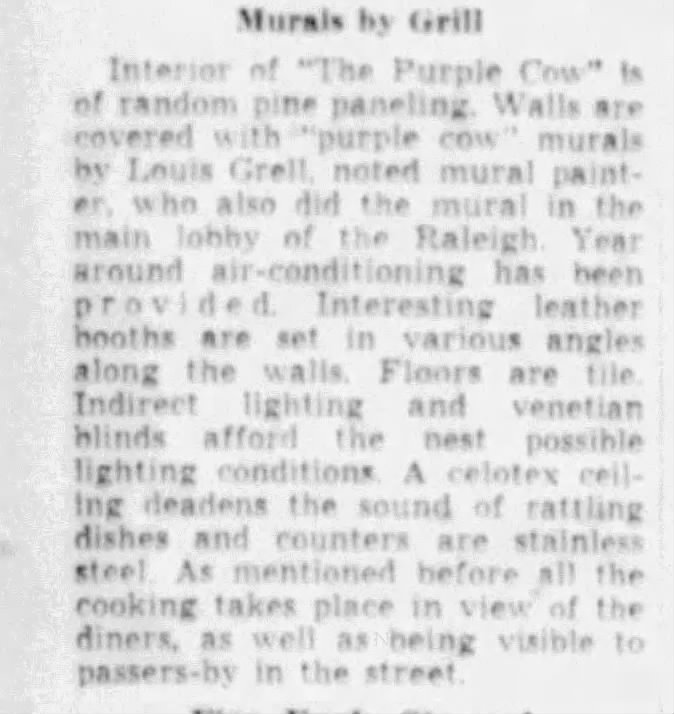
ABOVE – Confirms Grell painted the Purple Cow murals and the six foot by thirty-six foot lobby mural mounted above the registration desk (Murals by Grill[sic], Waco Tribune-Herald, December 14, 1941 page 8). The lobby mural was saved forty-five years later, placed in a vault, conserved and exhibited at a local museum where it remains.
But Grell didn’t just create, design and hand draw the image documented 94 murals for the Pick Hotels; his imagineered cow face and designs were utilized on all the Pick Hotels restaurant ware. The menus, ceramics and glasses all had Grell cow designs printed on them
THE WORLD BEHIND THE PURPLE COW
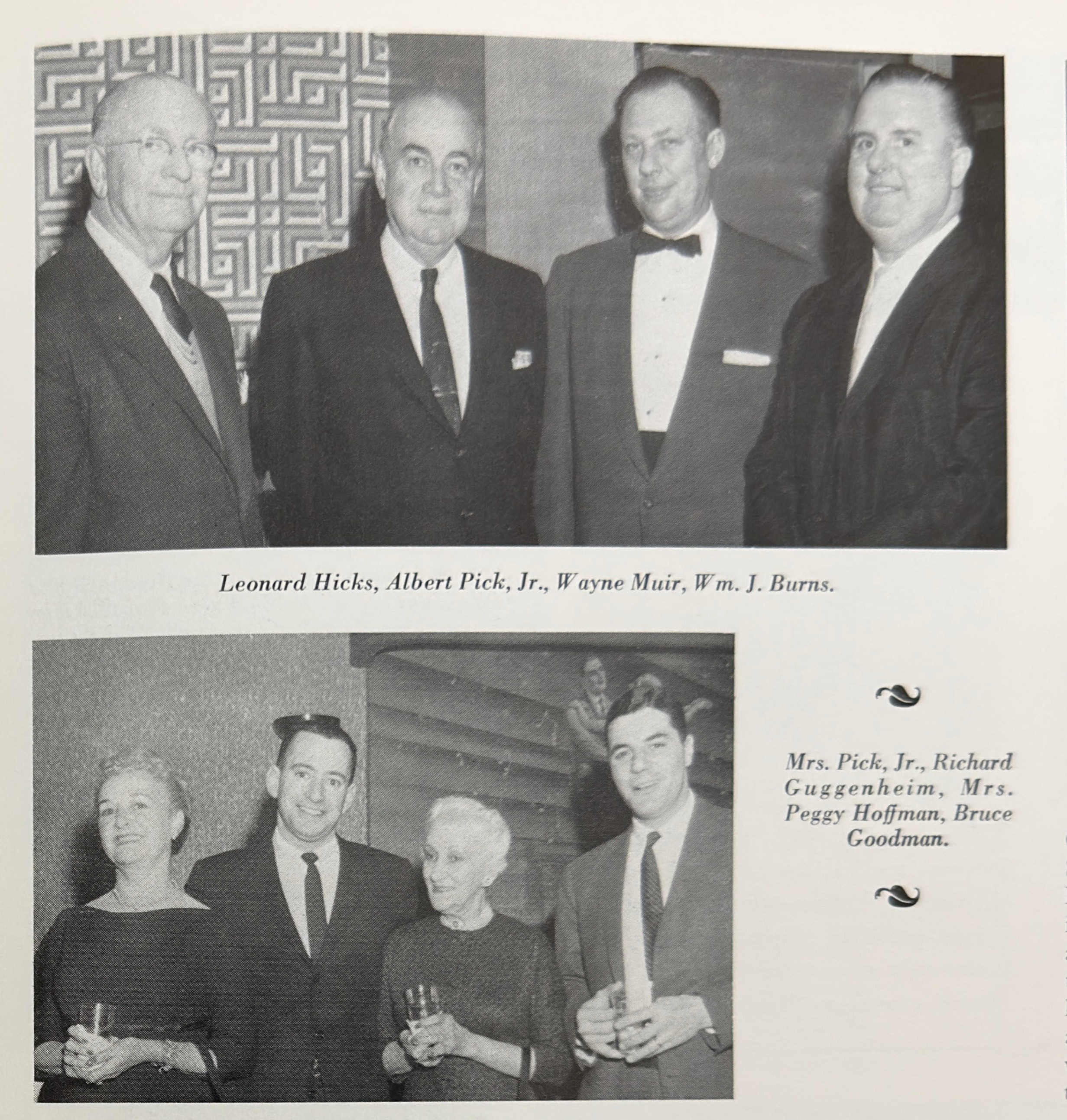
The Purple Cow murals were created within a hotel organization unusually attuned to publicity, entertainment and popular culture. Under Albert Pick, Jr., Pick Hotels cultivated relationships with nationally prominent figures in entertainment, politics and public life. The surviving Pick photographic record documents actors, entertainers, political leaders and other public figures being welcomed at Pick properties, escorted by hotel executives, entertained at company events and, in some instances, hosted personally by the Pick family.
Among the surviving photographs and corporate publications are records involving Joan Crawford, Esther Williams, Lana Turner, Bob Hope, Gene Autry, General Douglas MacArthur, Richard Nixon and other prominent figures of the period. Additional material documents Pick in political and international settings, including a presidential reception in Havana involving Cuban President Fulgencio Batista.
Some of these encounters went beyond ordinary hotel publicity. A photograph personally inscribed to Albert Pick by Richard Nixon reads:
“With best wishes and appreciation for your friendship over the years.”
A Pick Hotels publication likewise records members of the Nixon family as guests of Mr. and Mrs. Albert Pick, Jr. aboard the Picks’ yacht during the Republican National Convention.
This broader cultural environment is important to understanding the Purple Cow. Pick Hotels did not treat its restaurants simply as places to eat. The company employed distinctive interiors, murals, jingles, contests, menus, advertising, promotional events and celebrity publicity to create memorable public experiences. Louis Grell’s Purple Cow paintings became one of the most unusual manifestations of that promotional culture—a recurring cast of comic characters that moved from hotel walls onto menus, restaurant ware, advertisements and other Pick material.
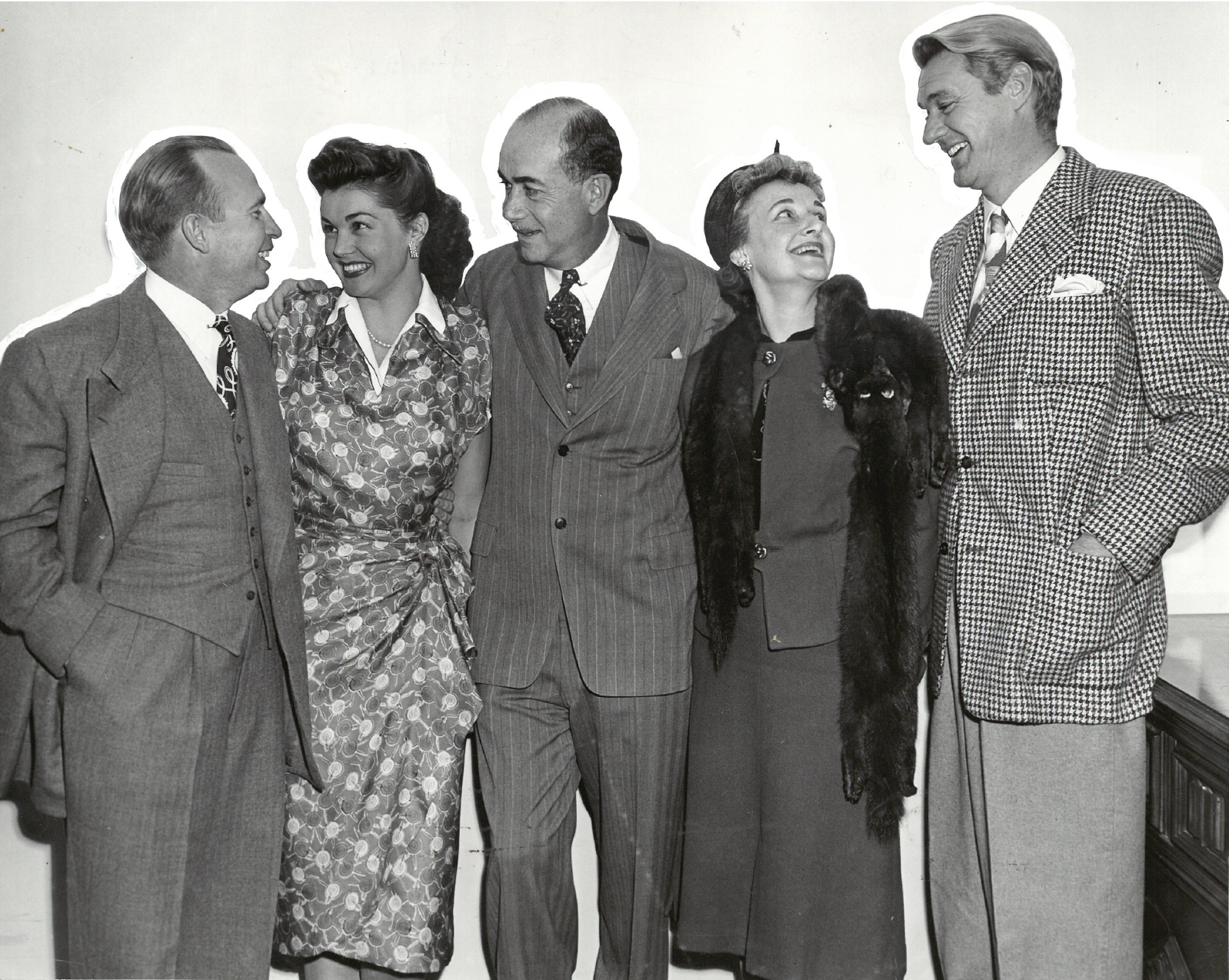
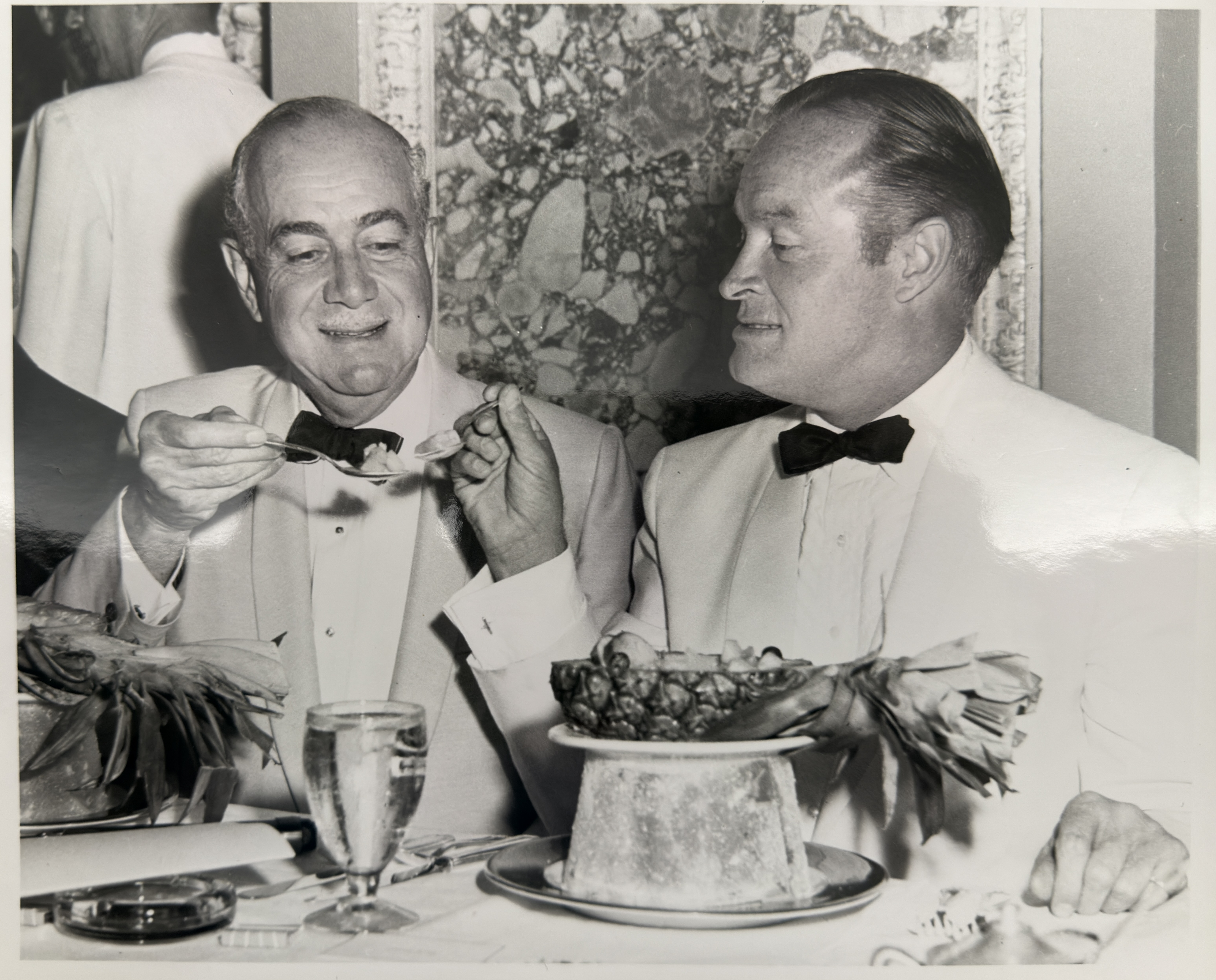
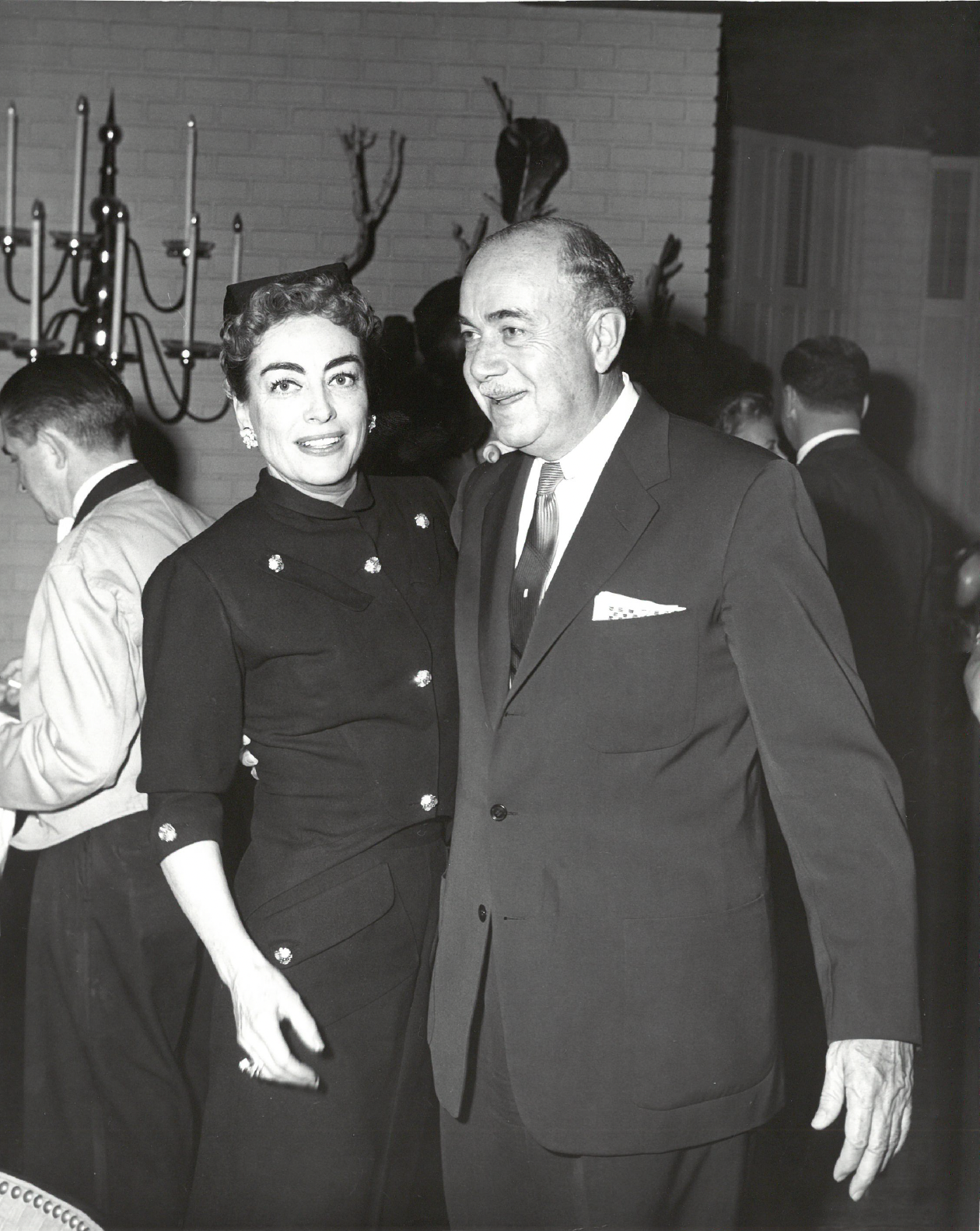
Esther Williams, Pick, Sonny Tufts – Pick & Bob Hope – Joan Crawford & Pick
The connection became particularly visible in 1953, when Doris Day’s recording of “A Purple Cow” intersected directly with the Pick Hotels identity. Contemporary Pick material records Albert Pick, Jr. and Day together at Chicago’s Congress Hotel in the publicity exchange described as “EVEN TRADE”: Day offered her Columbia recording and Pick presented the Purple Cow menu.
THE PURPLE COW WAS MORE THAN A RESTAURANT DECORATION. IT EXISTED INSIDE A NATIONAL CULTURE OF ENTERTAINMENT, PERSONALITY AND PUBLICITY.
Research Philosophy
The Louis Grell Digital Archive is committed to presenting documentary evidence as accurately as possible. New discoveries are evaluated using primary sources whenever available, and interpretations are revised as additional evidence emerges. Where questions remain unresolved, they are identified as subjects for continued research rather than presented as established fact.
