


Walt Disney, Paramount Pictures and Doris Day intersect in a remarkable lost chapter of American art. Louis Grell—Disney’s former Chicago art teacher and the muralist behind numerous Paramount theatres—had never made a cartoon when he was asked in 1939 to create an entire world of Purple Cows. So the teacher became the student. Grell transformed Disney’s popular cow characters into something new: an episodic architectural cartoon world of recurring characters, visual jokes, jingles and local stories that spread through the Albert Pick hotel chain. Clarabelle became the model for his recurring heroine, Disney’s Ferdinand entered Grell’s world and married her, and individual cities were written into the story through locally themed murals and public jingle contests. The Purple Cow restaurants became popular enough to inspire Doris Day to sing “A Purple Cow.” Almost the entire painted world vanished. Today, 94 unique murals have been documented.
Louis Grell, the Purple Cow and the Mural That Survived
At the corner of Eighth Street and Austin Avenue in downtown Waco once stood one of the most important hotels in the early history of the Albert Pick organization. Opened in 1914 as the Riggins Hotel, the building became the Hotel Raleigh after its acquisition by Albert Pick in 1916. By the 1940s its street-level Purple Cow Sandwich Shop was wrapped in signs inviting Waco into one of Pick Hotels’ most unusual restaurant concepts, while inside Louis Grell’s painted cows inhabited the walls.
Grell’s presence at the Raleigh extended far beyond the Purple Cow. Above the hotel’s registration desk stretched a monumental 6-by-36-foot oil-on-canvas mural depicting Sir Walter Raleigh spreading his cloak before Queen Elizabeth I. When the old hotel was redeveloped in 1985, that enormous painting was removed from its plaster backing rather than destroyed. After years of conservation it returned to public view and today survives at Waco’s Taylor Museum.
The Purple Cow murals were not so fortunate.
Yet they did not disappear completely.
Period photographs, Waco newspaper accounts, Albert Pick Hotels publications preserved at the Chicago History Museum, and a signed 1944 Louis Grell watercolor now make it possible to reconstruct something of what Waco diners once saw when they entered the Raleigh’s Purple Cow.
FROM THE RIGGINS HOTEL TO THE RALEIGH
The building began as the Riggins Hotel, named for Waco businessman and former mayor James Wyatt Riggins. Baylor University’s Texas Collection identifies Waco architect Roy E. Lane as the architect of the Chicago School-style building and dates its opening to August 1, 1914.
The ambitious hotel proved financially difficult for Riggins. On January 19, 1916, the Albert Pick Company of Chicago purchased the property, and within days the hotel had been renamed the Raleigh.
The acquisition would assume greater significance as the Pick organization expanded. Decades later, Albert Pick Hotels’ own house publication, Pick Topicks, celebrated the Waco property as:
“Famous As ‘First of the Pick Chain’!”
The corporate history accompanying that article recounted Pick’s early acquisition of the hotel, its later reacquisition in 1932 and the extensive modernization that followed.
By the early 1940s the Raleigh had become much more than an aging downtown hotel. Pick was remaking it as a modern hospitality complex, and Louis Grell became part of that transformation.

Hotel Raleigh, Waco, Texas. Originally opened as the Riggins Hotel in 1914, the property entered the Albert Pick organization in 1916.
LOUIS GRELL COMES TO THE RALEIGH
Louis Grell was already an experienced architectural muralist when he worked at the Raleigh.
By then his paintings had appeared in major theaters, hotels and public buildings across the United States. His commissions included monumental work for the Chicago Theatre, Paramount theaters and other large architectural interiors.
At the Raleigh, Grell was given an appropriately monumental subject.
Stretching approximately 36 feet across the hotel lobby, his mural depicted the legendary act of chivalry associated with Sir Walter Raleigh: Raleigh spreading his cloak across a muddy path so that Queen Elizabeth I could pass without soiling herself.
The painting was executed in oil on canvas and mounted directly to plaster.
A 1985 Waco Tribune-Herald account described it as a 6-by-36-foot mural that had hung in the Raleigh lobby for more than forty years. Contemporary reporting identified its painter explicitly as the “famous muralist Louis Grell of Chicago.”
The commission is also documented in Grell’s artist file at the Art Institute of Chicago, where photographs of the Raleigh mural were preserved among the records of his career.
Even more importantly, an original preparatory sketch for the mural survives in a private collection, allowing the development of the composition to be followed from Grell’s working conception to the enormous finished painting.

Original preparatory sketch for Louis Grell’s Hotel Raleigh mural, private collection.

Louis Grell’s Sir Walter Raleigh mural installed above the registration area of the Hotel Raleigh. Period photographs of the commission are also preserved in Grell’s artist file at the Art Institute of Chicago.
But Grell’s work at the Raleigh was not confined to the dignified historical world of Elizabethan England.
Elsewhere in the same hotel, he was painting something radically different.
THE PURPLE COW COMES TO WACO
At street level, the Raleigh housed a Purple Cow Sandwich Shop, part of the unusual restaurant concept developed by Albert Pick Hotels and expanded through a number of Pick properties across the country.
The surviving exterior photographs are unusually revealing.
Large script signs reading “Purple Cow Sandwich Shop” stretched across the storefront facing downtown Waco. The restaurant occupied a highly visible ground-floor location rather than an obscure interior corner of the hotel.

The Hotel Raleigh with the Purple Cow Sandwich Shop plainly visible at street level. The restaurant was integrated into the public face of the hotel.

Detail of the Raleigh storefront. The Purple Cow was promoted directly to pedestrians and downtown traffic.
Inside was an entirely different visual world from Grell’s monumental Raleigh lobby mural.
Purple cows danced, worked, courted, performed and wandered through fanciful landscapes. Comic verses accompanied the painted scenes. Characters and compositions could recur from hotel to hotel while landscapes and surrounding details changed.
These were not printed decorations or wallpaper.
They were hand painted mural compositions executed on canvas and incorporated into the architecture of the restaurant.
And at Waco, period Albert Pick Hotels photography allows us to see them in place.
INSIDE THE RALEIGH PURPLE COW
During research at the Chicago History Museum in July 2026, previously little-known Raleigh material was examined within the Albert Pick Hotels collection, including issues of the company’s house publication, Pick Topicks.
One Raleigh feature included an extraordinary photographic tour of the hotel.
The lobby.
Ballroom.
Flamingo Dining Room.
Colonial Room.
Guest rooms.
And the Purple Cow Sandwich Shop.
The Purple Cow photograph is particularly valuable because it shows the paintings as diners actually encountered them.
They were not isolated pictures viewed one at a time.
They occupied the restaurant walls as part of a continuous decorative environment.

The Hotel Raleigh as presented in Albert Pick Hotels’ house publication, Pick Topicks. The Purple Cow Sandwich Shop appears among the hotel’s principal public interiors. Albert Pick Hotels collection, Chicago History Museum.
The accompanying corporate description singled the restaurant out:
“The new ‘Purple Cow’ Sandwich Shop is crowded the clock around.”
That one sentence helps establish the Purple Cow’s position within the hotel. It was not simply decorative novelty. Pick was promoting it as one of the Raleigh’s active public rooms.
A closer view reveals Grell’s mural world surrounding the dining area.

Purple Cow Sandwich Shop, Hotel Raleigh. Period Pick Hotels photograph showing Grell’s mural compositions incorporated into the restaurant walls. Albert Pick Hotels collection, Chicago History Museum.
The image is grainy, but one composition is particularly important.
It can be identified.
THE SIGNED ANCHOR: PEGASUS
Among the Purple Cow artworks associated with the Raleigh is one of the most important surviving attribution links in the reconstruction of Grell’s entire Purple Cow program.
A watercolor dated 1944 depicts a fanciful Purple Cow episode known as PEGASUS.
And unlike the great majority of surviving Purple Cow material examined to date, the watercolor bears Grell’s signature:
L. GRELL 1944
The same composition can be recognized in period photography of the Raleigh Purple Cow.

PEGASUS, 1944. Watercolor signed “L. GRELL 1944.” Private collection.

Period photograph of the Raleigh Purple Cow showing the PEGASUS composition installed on the restaurant wall. Albert Pick Hotels collection, Chicago History Museum.
This is an unusually valuable evidentiary connection.
The eleven surviving Purple Cow murals personally examined during this research reveal no signatures, and no signatures have been identified in more than forty sufficiently clear period photographs examined to date. Four small Purple Cow watercolors preserved by the Grell family are likewise unsigned.
PEGASUS is different.
It gives us a rare chain of evidence:
a signed Louis Grell watercolor → the same recognizable composition → installed in an operating Purple Cow restaurant.
The Raleigh photograph therefore does more than show what the restaurant looked like.
It helps reconnect Grell’s hand directly to the largely unsigned Purple Cow visual world.
A RESTAURANT BUILT AROUND STORIES
The Raleigh photograph also helps explain something easily lost when the individual Purple Cow images are viewed separately today.
Grell was not merely producing a series of unrelated cow cartoons.
He was building an environment.
Across the larger surviving Purple Cow record, characters move through romance, music, work, recreation, fantasy and local jokes. A Purple Cow might appear as a fashionable young woman in one composition, an artist in another, a musician or performer elsewhere. Male characters, calves and other bovine personalities expand the cast.
Some particularly successful compositions recur in several Pick Hotels.
But their architectural surroundings could change.
Trees moved. Flowers changed. Landscapes expanded or contracted. Individual compositions were fitted into different walls and different rooms.
The result was neither conventional mural decoration nor ordinary restaurant advertising.
It was something closer to an architectural cartoon world.
At the Raleigh, the diner did not merely look at the Purple Cow.
The customer sat inside the story.
WACO WAS INVITED INTO THE STORY
Albert Pick Hotels went one step further.
In individual cities, one locally themed Purple Cow mural could be installed without its accompanying verse. Residents were then invited to write the missing jingle.
The contest was not an invitation for the public to write the Purple Cow program generally. It centered on a particular local mural whose caption had deliberately been withheld.
In Waco, the response was extraordinary.
Contemporary reporting records approximately 4,000 entries in the Raleigh Purple Cow contest.
The winning verse was submitted by Helen Thompson, who received a $25 prize:
Why all this love for the Purple Cow?
The bewildered cowboy cried
She gives to us the best of food
The Texans all replied.

The above mural is the second mural depicted in the Topicks interior view period photograph. There is a bull in the background and a human cowboy depicted to the left of the female bovine heroine cow shown above.
The scale of the response demonstrates how effectively Pick transformed Grell’s painted environment into local promotion.
Thousands of Waco residents were not simply being advertised to.
They were being asked to participate.
The Purple Cow became simultaneously a restaurant, a mural program, a recurring cast of characters and a local public event.
PART OF A MUCH LARGER PURPLE COW WORLD
Waco was only one part of a larger program.
Research into Albert Pick Hotels publications, newspaper archives, institutional collections and surviving artworks has now reconstructed 94 unique Purple Cow mural images within the surviving visual record.
Contemporary evidence indicates that Purple Cow shops operated across a network reported to have reached fifteen Pick locations.
Grell reused successful characters and episodes, but the surviving photographs show that individual installations were adapted to different architectural spaces. One city might receive a locally themed composition; another could receive a familiar character surrounded by altered landscape or decorative elements.
The Raleigh is especially important because it preserves several different kinds of evidence at once:
the hotel itself in period photographs;
the exterior Purple Cow signage;
the restaurant interior;
the Pick Hotels corporate description;
the Waco jingle contest;
and PEGASUS, a signed Grell watercolor corresponding to a composition visible inside the restaurant.
Few individual Purple Cow locations presently offer such a complete documentary chain.
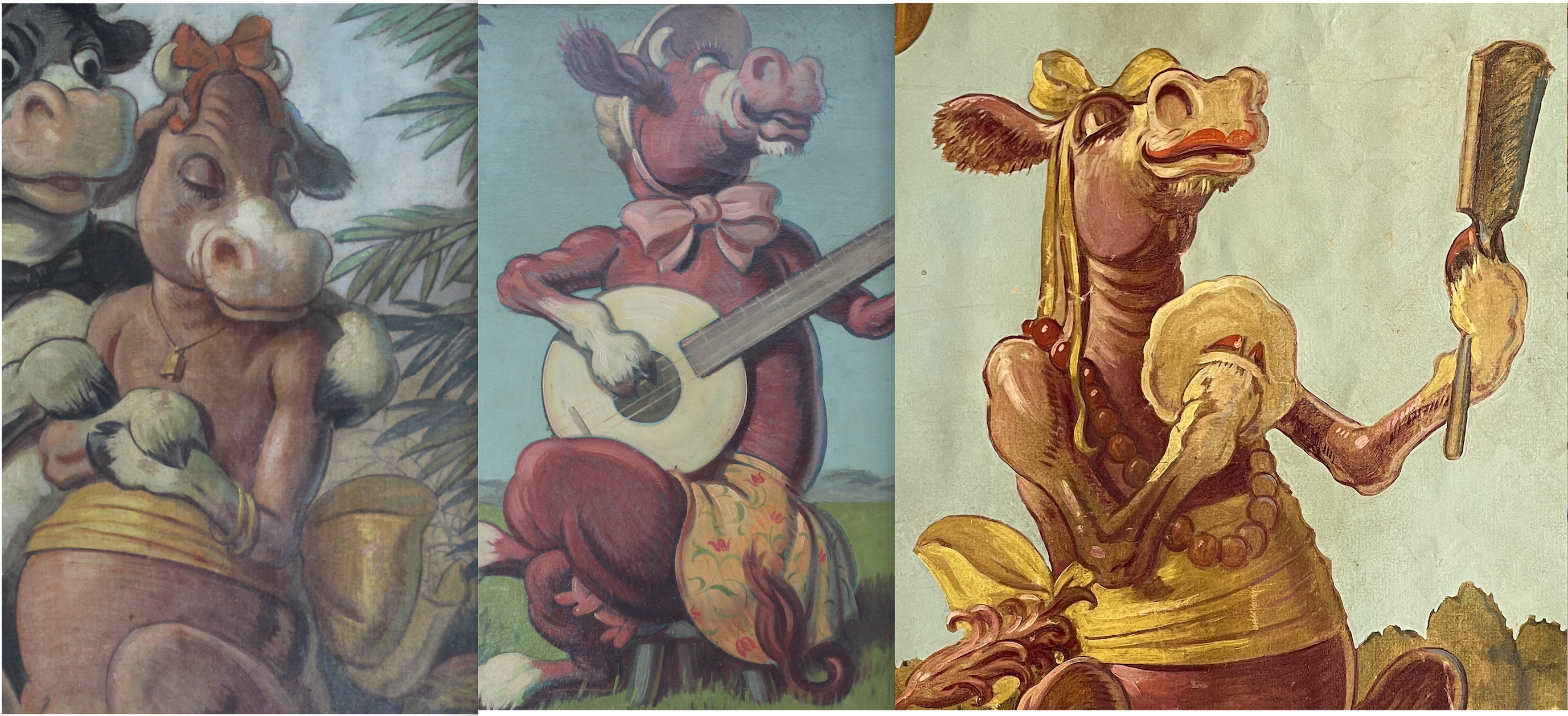
The Raleigh formed part of a larger Purple Cow program extending through the Albert Pick hotel system. Ninety-four unique mural images have now been identified within the surviving photographic and archival record.
TWO VERY DIFFERENT GRELL WORLDS UNDER ONE ROOF
The Raleigh also provides a remarkable demonstration of Grell’s range.
In the lobby, visitors encountered an enormous historical painting of Sir Walter Raleigh and Queen Elizabeth I—a traditional monumental mural intended to lend dignity and historical identity to the hotel.
Downstairs or at street level, diners entered a world populated by comic Purple Cows.
The same artist could move from monumental historical painting to humorous commercial fantasy.
That contrast is particularly significant because Grell himself later recalled that, when first confronted with the Purple Cow assignment, cartooning was unfamiliar territory for him.
The Raleigh allows us to see both sides of his career within a single Pick Hotel:
Louis Grell the monumental muralist.
And Louis Grell the creator of a national Purple Cow mural world.
One of those worlds survives physically in Waco.
The other survives principally through the archive.
1985: THE RALEIGH COMES DOWN
By the 1980s the Raleigh’s glory years were over.
The building was slated for extensive redevelopment, and Grell’s enormous lobby mural suddenly faced an uncertain future.
On February 14, 1985, the Waco Tribune-Herald reported that the 6-by-36-foot mural had been removed and placed in a vault.
Two representatives from Hall’s Art Gallery in Fort Worth had managed to separate the canvas from its plaster backing. The newspaper again identified its creator plainly:
“The piece was done by famous muralist Louis Grell of Chicago.”
The community was already looking for a way to restore and publicly display it.
The rescue was not easy.
Another February report discussed the mural’s condition, possible restoration costs and concern about finding a permanent home. It also recorded an important piece of history: W. P. Davis, a mural committee member, remembered that Grell stayed at the Raleigh while painting the mural. Waco_Tribune_Herald_1985_02_09_2
That is a wonderful human detail and belongs in the story.
Grell had not simply shipped a finished decorative canvas to Waco. Contemporary memory placed the Chicago artist at the hotel while the commission was being executed.
By November, the Tribune-Herald reported that the mural had been saved from the redevelopment and given to the Historic Waco Foundation for restoration. Waco_Tribune_Herald_1985_11_01_…
The building could change.
The painting would survive.
THE MURAL RETURNS
Restoration took years.
In 1991, Waco newspaper columnist Virginia Plunkett announced that Historic Waco Foundation’s restored Sir Walter Raleigh mural was finally making a public appearance.
The article described the work again as a 6-by-36-foot mural and recounted its rescue from behind the Raleigh registration desk.
It also provided valuable conservation history.
Grell had painted the scene in oil on canvas and mounted it on plaster. Removing that enormous canvas from the wall proved difficult. After its rescue, Waco artist Walter McCown, assisted by John Cameron Orr, completed the conservation work.
The columnist concluded simply that:
“the Sir Walter mural is again magnificent.” Waco_Tribune_Herald_1991_09_08_…
Today, Grell’s Raleigh mural remains preserved in Waco at the Taylor Museum, displayed prominently across a long wall.

Louis Grell’s monumental Sir Walter Raleigh mural as preserved and displayed today at the Taylor Museum in Waco. Removed from the Raleigh before redevelopment, conserved and returned to public view, the painting is a rare surviving monumental Grell hotel mural.
Place the surviving original sketch beside this photograph and the historical sequence becomes particularly compelling.

From working sketch to surviving monumental painting: Grell’s original conception and the restored 36-foot Raleigh mural.
WHAT DID NOT SURVIVE
The fate of the Purple Cow murals appears to have been different.
No Raleigh Purple Cow mural has presently been identified as surviving from the restaurant itself.
But disappearance is not the same as erasure.
The exterior photographs preserve the restaurant’s place on the streets of Waco.
Pick Topicks preserves its interior.
The corporate publication preserves Pick’s own description of the restaurant.
Newspaper reporting preserves the public contest.
And the signed PEGASUS watercolor reconnects one of the painted compositions visible on the walls directly to Louis Grell.
Piece by piece, a room that no longer exists becomes visible again.
That process is occurring across the larger Purple Cow project. Ninety-four unique mural images have now been identified from a program whose physical installations have almost entirely vanished.
The Raleigh is therefore more than another entry in a list of lost Pick Hotels.
It is a particularly complete example of how a vanished architectural art program can be reconstructed from dispersed evidence.
THE RALEIGH’S TWO SURVIVALS
In Waco, Louis Grell left two very different bodies of work.
One was monumental, historical and dignified: Sir Walter Raleigh placing his cloak before Queen Elizabeth.
The other was comic, commercial and fantastical: Purple Cows inhabiting their own painted universe around diners eating breakfast and sandwiches.
The first survived as an object.
The second survived as evidence.
One can still be seen on a museum wall.
The other has had to be reconstructed from photographs, newspapers, corporate publications, surviving artwork and archival research.
Together they reveal something larger about Grell’s career.
For decades, his work occupied spaces Americans actually used—hotel lobbies, restaurants, theaters and other public interiors. People checked into hotels beneath his paintings, ate breakfast surrounded by his cows and walked past his murals as part of ordinary life.
When those buildings were remodeled or demolished, much of that art disappeared with them.
The Hotel Raleigh was nearly another example.
Instead, Waco saved one enormous Grell painting.
And the archive has begun to recover the rest.
RESEARCH NOTE
This reconstruction draws upon period Waco newspaper reporting; Albert Pick Hotels publications and photographs preserved in the Albert Pick Hotels collection at the Chicago History Museum; historical photographs of the Hotel Raleigh; Louis Grell material preserved in the Art Institute of Chicago artist files; surviving artwork and research materials in private collections; Baylor University historical resources; and continuing research conducted by The Richard Grell Archival Collection.
The Raleigh Purple Cow material reproduced from Pick Topicks was examined during research at the Chicago History Museum in July 2026.
The 94 Purple Cow images referenced above represent unique mural images presently identified within the surviving visual record, not the original total number of murals painted for the Albert Pick Hotels Purple Cow program.
Research continues.

Above article -Waco Tribune-Herald, February 3, 1985 page 42
Six to eleven Purple Cow murals, oil on canvas, likely unsigned
watercolor 12″ x 12″ signed “L. Grell 1944”
