

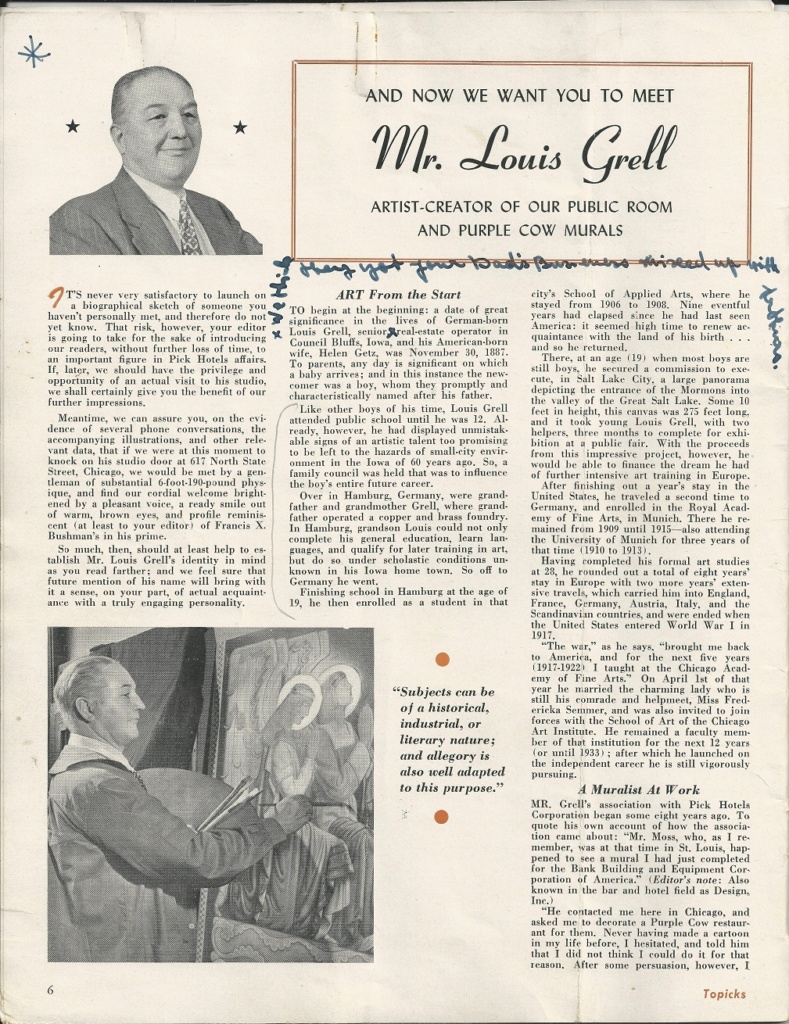
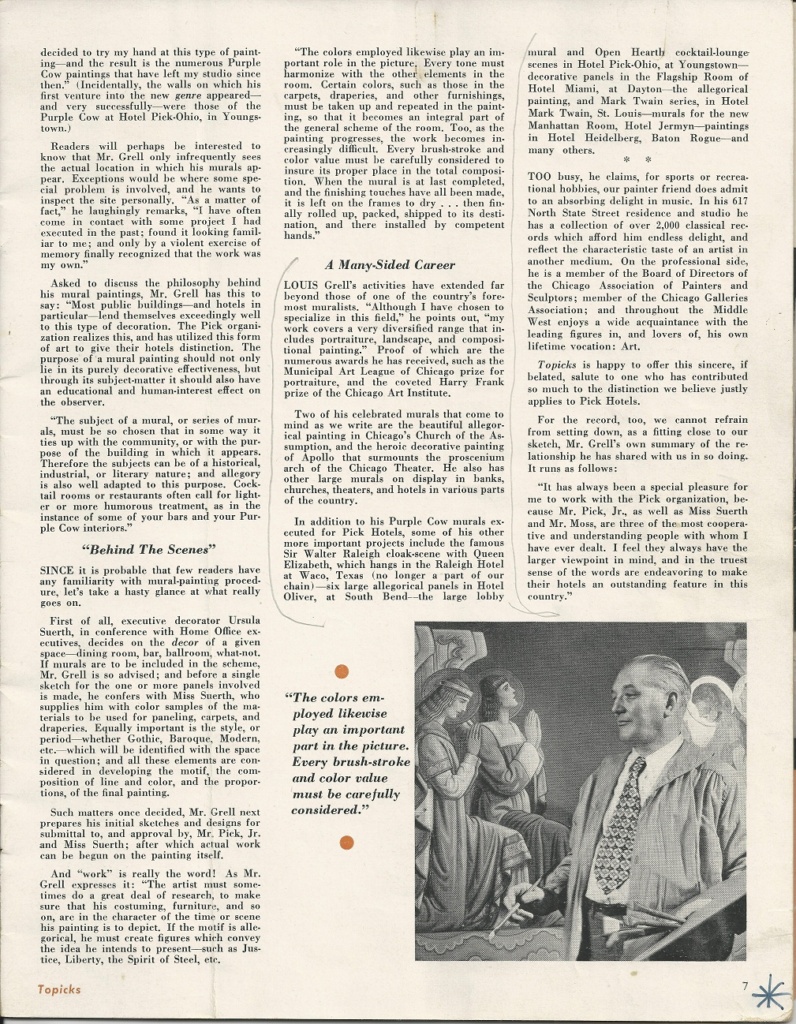
Walt Disney, Paramount Pictures and Doris Day intersect in a remarkable lost chapter of American art. Louis Grell—Disney’s former Chicago art teacher and the muralist behind numerous Paramount theatres—had never made a cartoon when he was asked in 1939 to create an entire world of Purple Cows. So the teacher became the student. Grell transformed Disney’s popular cow characters into something new: an episodic architectural cartoon world of recurring characters, visual jokes, jingles and local stories that spread through the Albert Pick hotel chain. Clarabelle became the model for his recurring heroine, Disney’s Ferdinand entered Grell’s world and married her, and individual cities were written into the story through locally themed murals and public jingle contests. The Purple Cow restaurants became popular enough to inspire Doris Day to sing “A Purple Cow.” Almost the entire painted world vanished. Today, 94 unique murals have been documented.
Louis Grell, Walt Disney and the Lost Purple Cow Murals of the Albert Pick Hotels
The story of the only known surviving Ferdinand Marries Clarabelle Cow mural by Louis Grell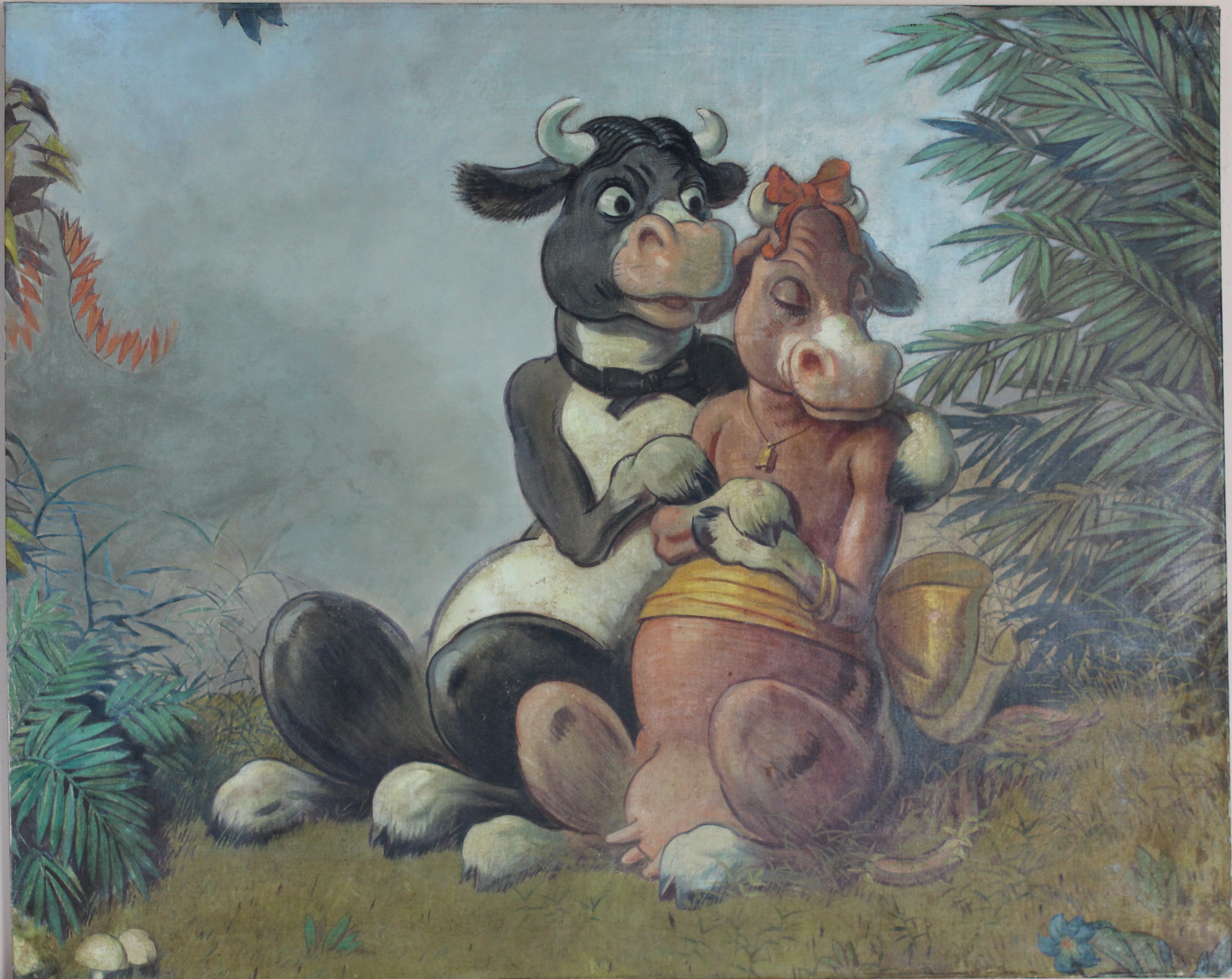
1945 oil on canvas, 48 x 60 inches, Hotel Jermyn, Scranton, PA
Introduction
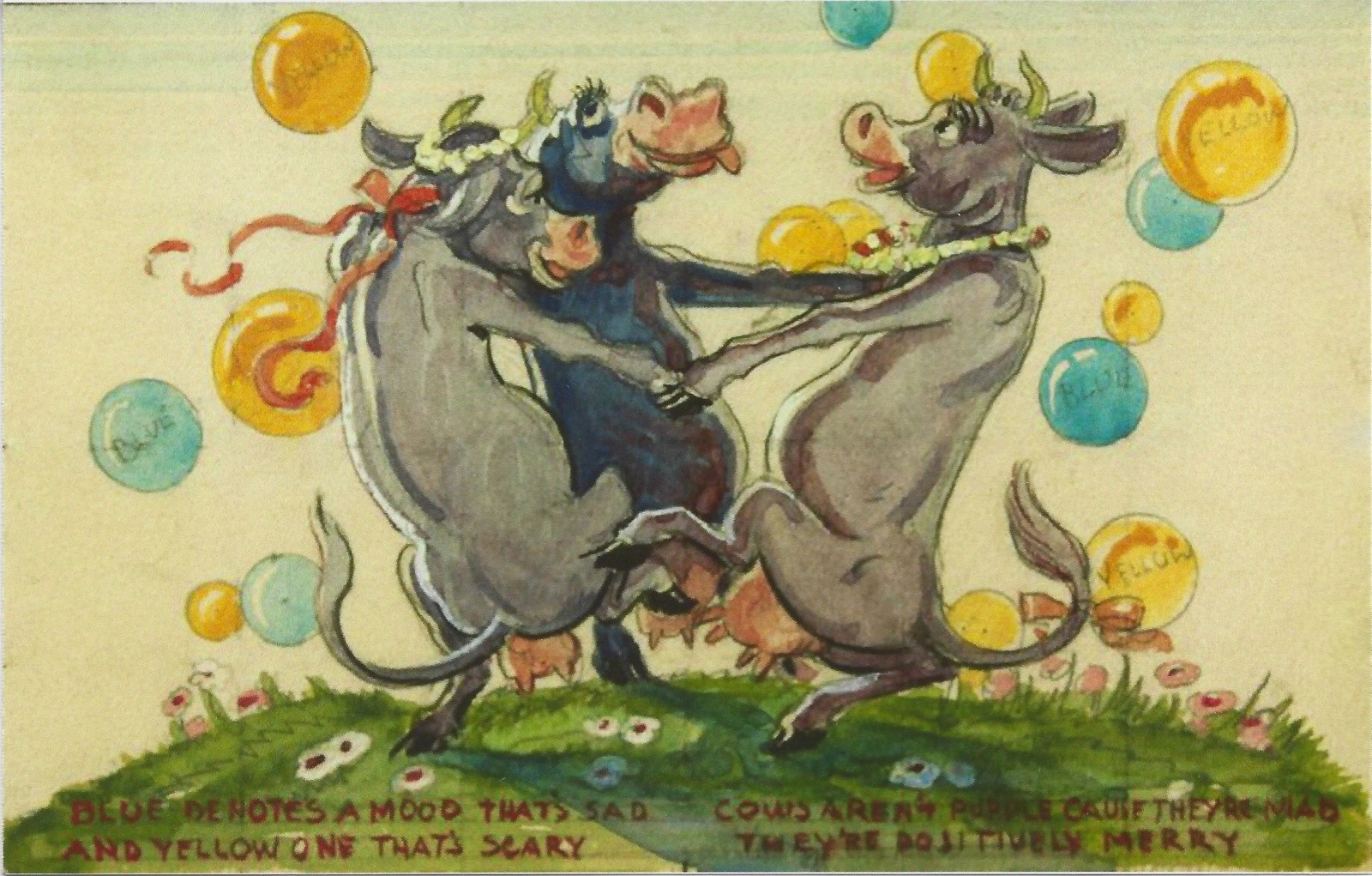
For decades following Louis Grell’s death in 1960, the Grell family knew only of four small Purple Cow watercolors accompanied by humorous poems:
POSITIVELY MERRY
RATHER SHY
TO HER HOME INVITES YOU
CHARMING DATE
Little else was known. The family simply referred to them as “the Purple Cow paintings.”
Everything began to change in 2012, when research into Grell’s career began in earnest.
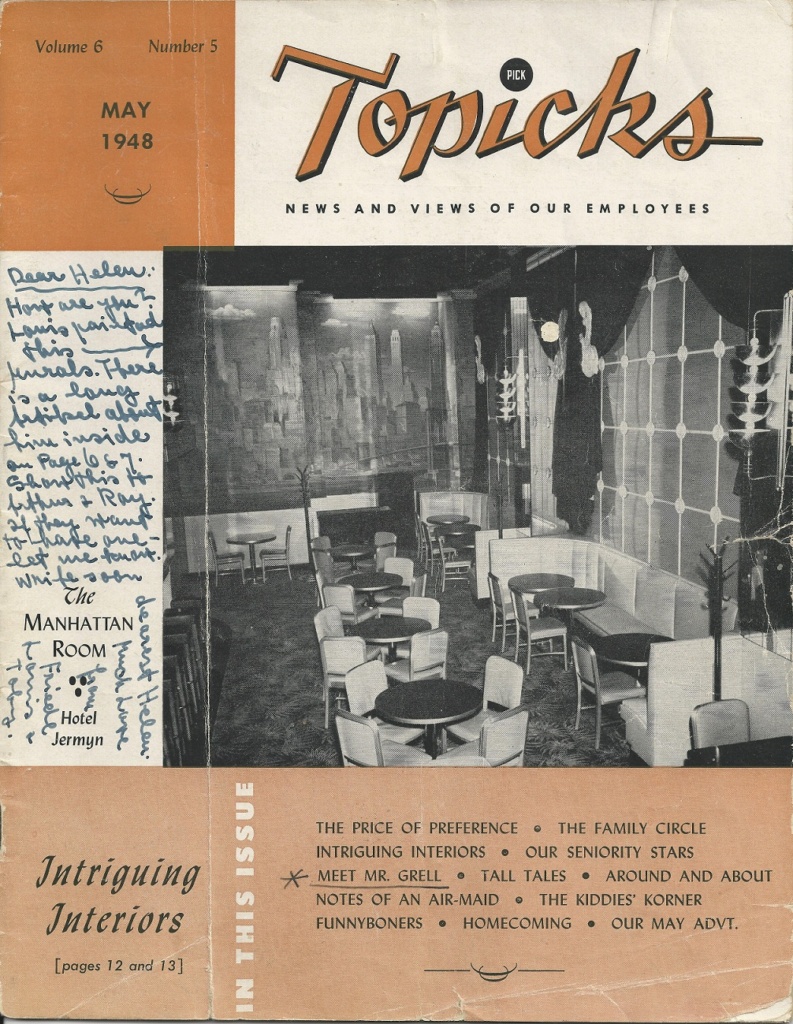
Among the discoveries was a remarkable May 1948 issue of Pick Topicks, the official publication of the Albert Pick Hotels Corporation. Inside appeared the only known interview in which Louis Grell publicly discussed his work for the Pick Hotels.
The article, “Meet Mr. Grell,” identified Grell as the artist-creator of the corporation’s Public Room and Purple Cow murals and described the numerous Purple Cow paintings that had left his Chicago studio.
That single publication transformed what had once appeared to be a handful of whimsical watercolors into evidence of an extraordinary national mural program.
Continued research has since revealed something larger. Grell’s Purple Cow paintings were not simply unrelated restaurant decorations. They formed a recurring comic world of anthropomorphic characters, humorous situations and rhyming jingles that appeared throughout the Pick Hotels system. Characters and compositions were repeated and adapted from hotel to hotel, while the imagery extended beyond the walls into menus, advertising, promotional material and other elements of the Purple Cow identity.
Today, 94 individual Purple Cow mural images have been photographically identified and catalogued across twelve hotel locations. Contemporary documentary evidence establishes additional Purple Cow mural installations for which no mural photographs are presently known.
The surviving evidence therefore represents a minimum—not the full extent of Grell’s Purple Cow production.
None of the surviving or photographically documented Purple Cow murals are signed. Their attribution instead rests upon an unusually extensive body of contemporary Pick Hotels documentation, surviving original Grell studies, photographs, menus, publications and related archival evidence. A signed Grell Purple Cow study is reproduced below.
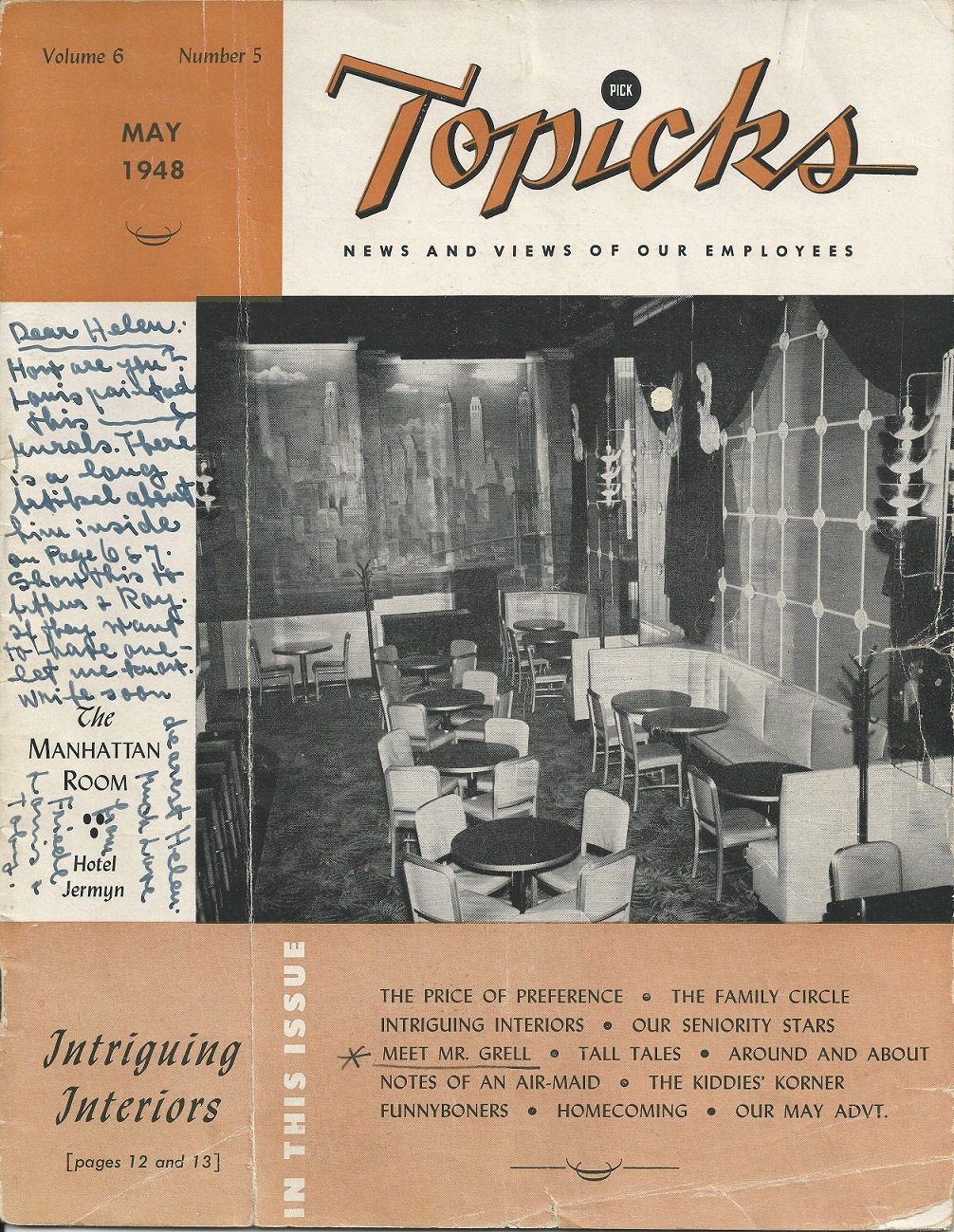
May 1948 Pick Topicks cover and “Meet Mr. Grell” article
THEN FERDINAND ENTERED THE PURPLE COW WORLD
If Ferdinand stood alone, the similarities might reasonably be regarded as a singular homage.
He no longer stands alone.
By the time Ferdinand appears in Grell’s Purple Cow paintings, the reconstructed record already reveals a recurring anthropomorphic cow heroine whose visual and behavioral vocabulary invites comparison with Disney’s Clarabelle Cow, together with Pick promotional material invoking another animated popular-culture tradition involving the jumping cow and laughing dog.
Research has now documented Ferdinand murals at multiple Pick Hotel locations, including:
- Hotel Miami, Dayton, Ohio (1940)
- Hotel Jermyn, Scranton, Pennsylvania (1945)
- Hotel Kansan, Topeka, Kansas (1947)
- Hotel Roosevelt, Pittsburg, Pennsylvania (1948)
Additional examples may once have existed elsewhere throughout the Pick Hotels system.
Ferdinand appears repeatedly at different hotels with the same basic composition while the surrounding scenery changes from location to location.
This pattern mirrors Grell’s established practice throughout the Purple Cow series, where successful scenes were adapted and repainted for multiple hotels rather than copied exactly. No two murals are alike – Grell always changed the scenery surrounding the cows.
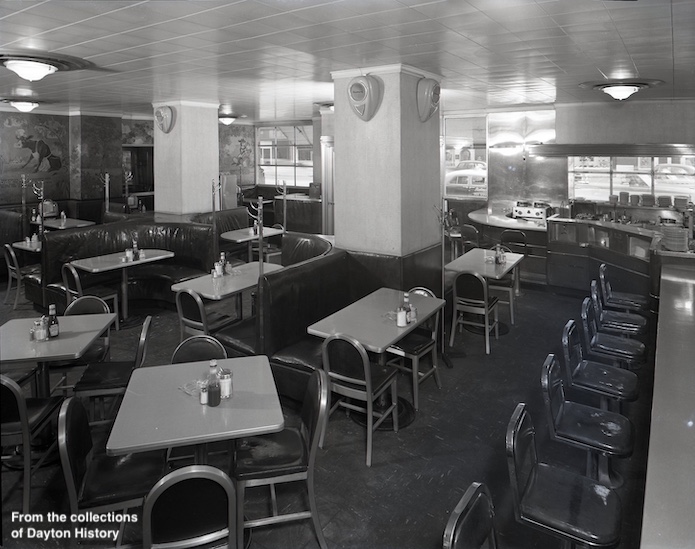
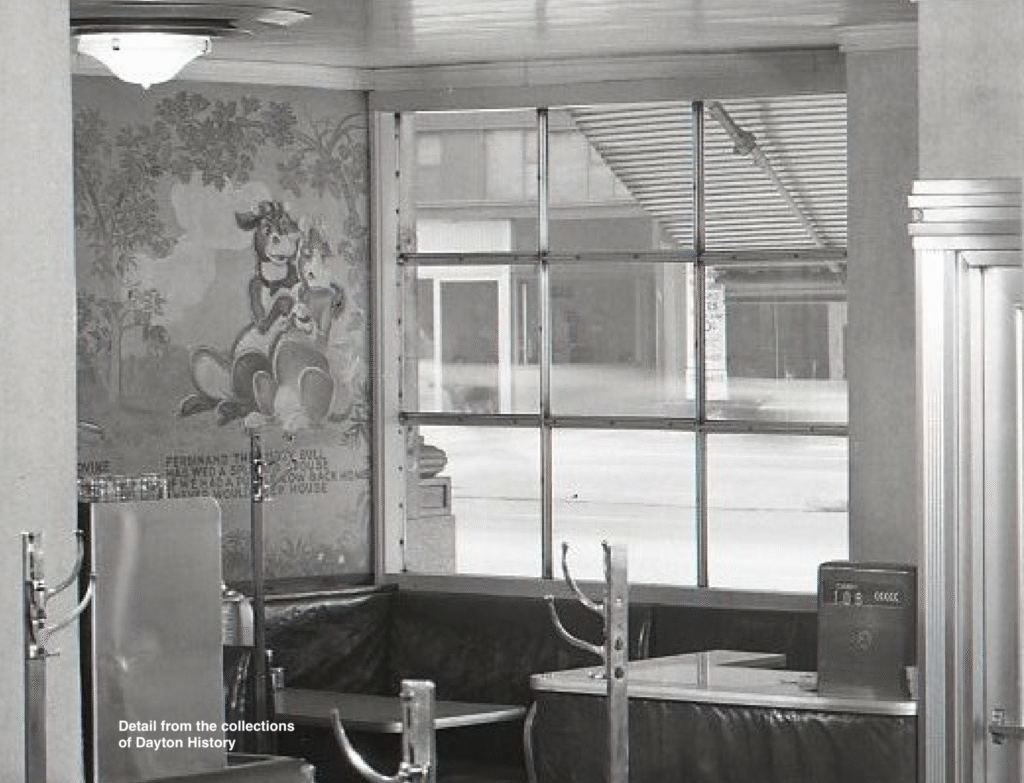
At present, the Hotel Miami photograph, discovered in early 2026, is the earliest known contemporaneous image showing a Ferdinand mural installed inside an operating Purple Cow Shop.
PICK HOTELS “OWN THE EXCLUSIVE RIGHTS”
This was not simply an artist placing a familiar cartoon character on the wall of an independent restaurant.
A contemporary account of the Purple Cow described it as one of fifteen restaurants operated by Albert Pick Hotels and reported that the company “own[ed] the exclusive rights.” Other contemporary Pick records identify Louis Grell as the artist-creator of the Purple Cow murals and state that his work adorned every Purple Cow in the chain.
By 1940, Ferdinand had entered that proprietary Purple Cow world.
That creates an obvious historical question:
Exclusive rights to what—and from whom?
No surviving agreement presently known to this research answers that question. But the documentary record makes the question unavoidable. Pick Hotels was operating a controlled, nationally distributed Purple Cow restaurant identity; Grell was creating its mural world; and Disney’s Ferdinand appears inside that world shortly after Disney’s film received the Academy Award.
Was Ferdinand simply an unauthorized contemporary cultural reference? Was some form of permission obtained? Or did another arrangement exist that has not yet surfaced?
The title of this article expresses the historical interpretation explored below: that Grell’s Ferdinand was drawn from Disney’s celebrated bull, while the recurring female Purple Cow he marries was constructed in the visual and behavioral tradition of Disney’s Clarabelle Cow. The conclusion emerged only after the larger Purple Cow mural program was reconstructed from surviving paintings, photographs, menus, corporate publications and archival records.
The Hotel Jermyn fragment presented here remains the only known surviving Ferdinand mural by Louis Grell.
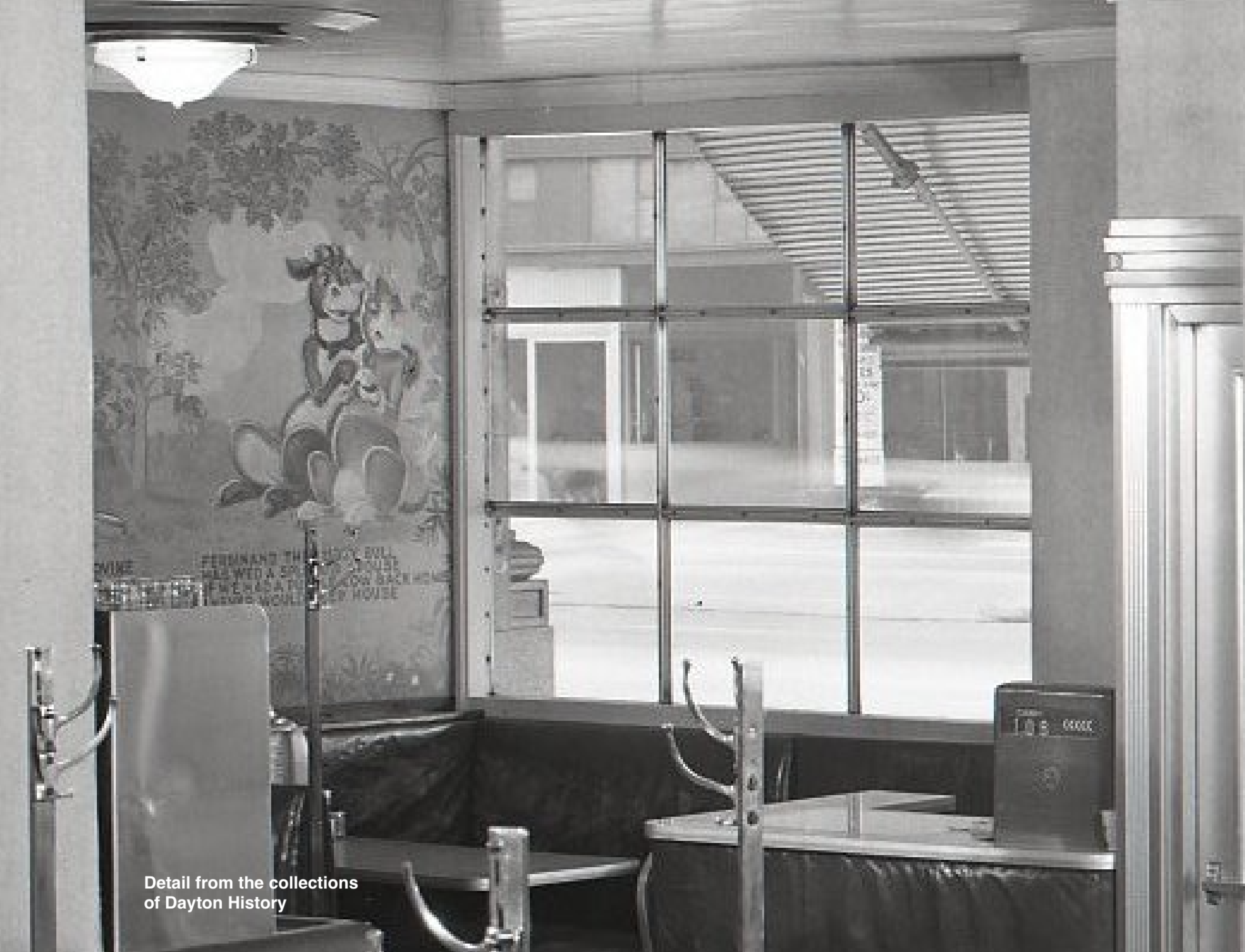
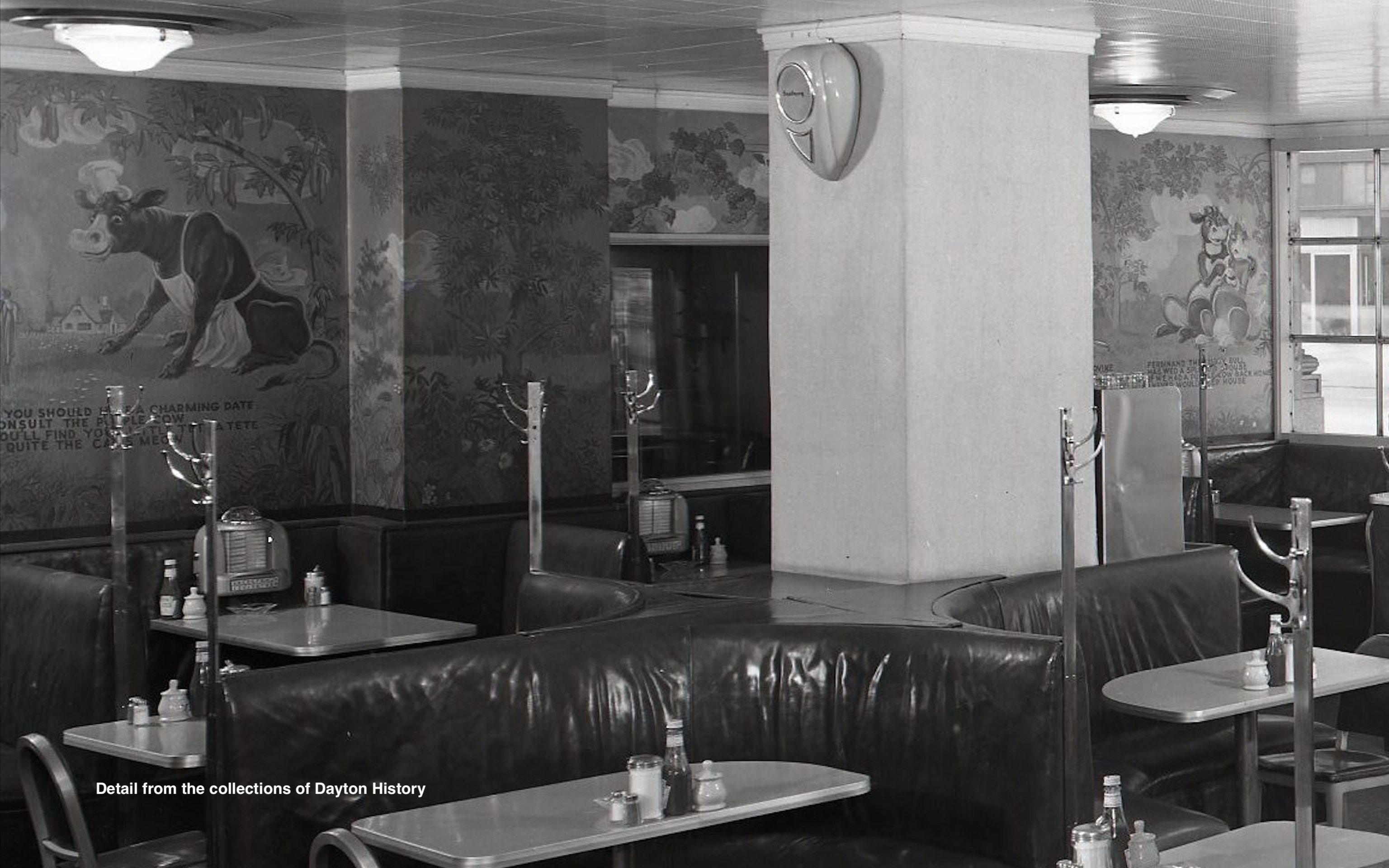
Hotel Miami Purple Cow interior showing Ferdinand mural (1940)
Currently the earliest known photograph documenting a Ferdinand mural installed inside a functioning Purple Cow restaurant.
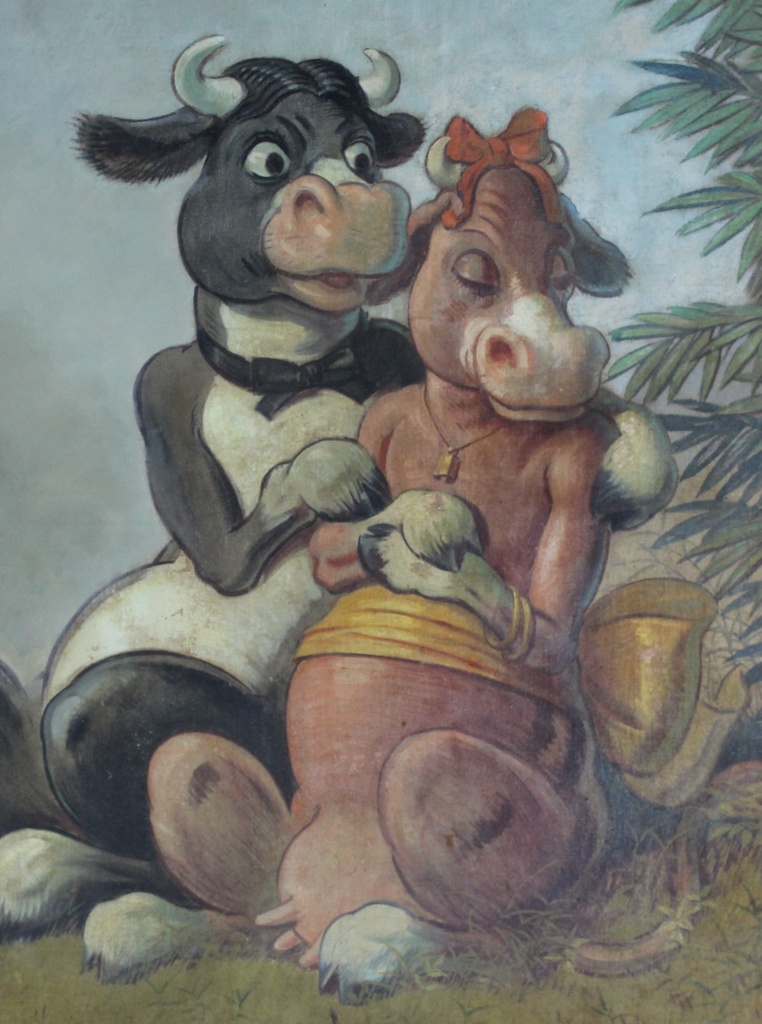
Hotel Jermyn Ferdinand mural fragment. – The only known surviving Ferdinand mural by Louis Grell.
Ferdinand and Walt Disney
One of the most intriguing questions raised during this research concerns the possible inspiration for Grell’s Ferdinand.
In November 1938 Walt Disney released his Academy Award-winning animated short. It won the 1939 Academy Award for Short Cartoon.
Ferdinand the Bull.
Within approximately one year, Grell’s first documented Ferdinand mural appears inside the Hotel Miami Purple Cow. All evidence establishes that Grell began his Purple Cow program in late 1939.
No surviving document presently states that Grell intentionally based his Ferdinand on Disney’s famous character.
Nevertheless, the visual similarities are remarkable.
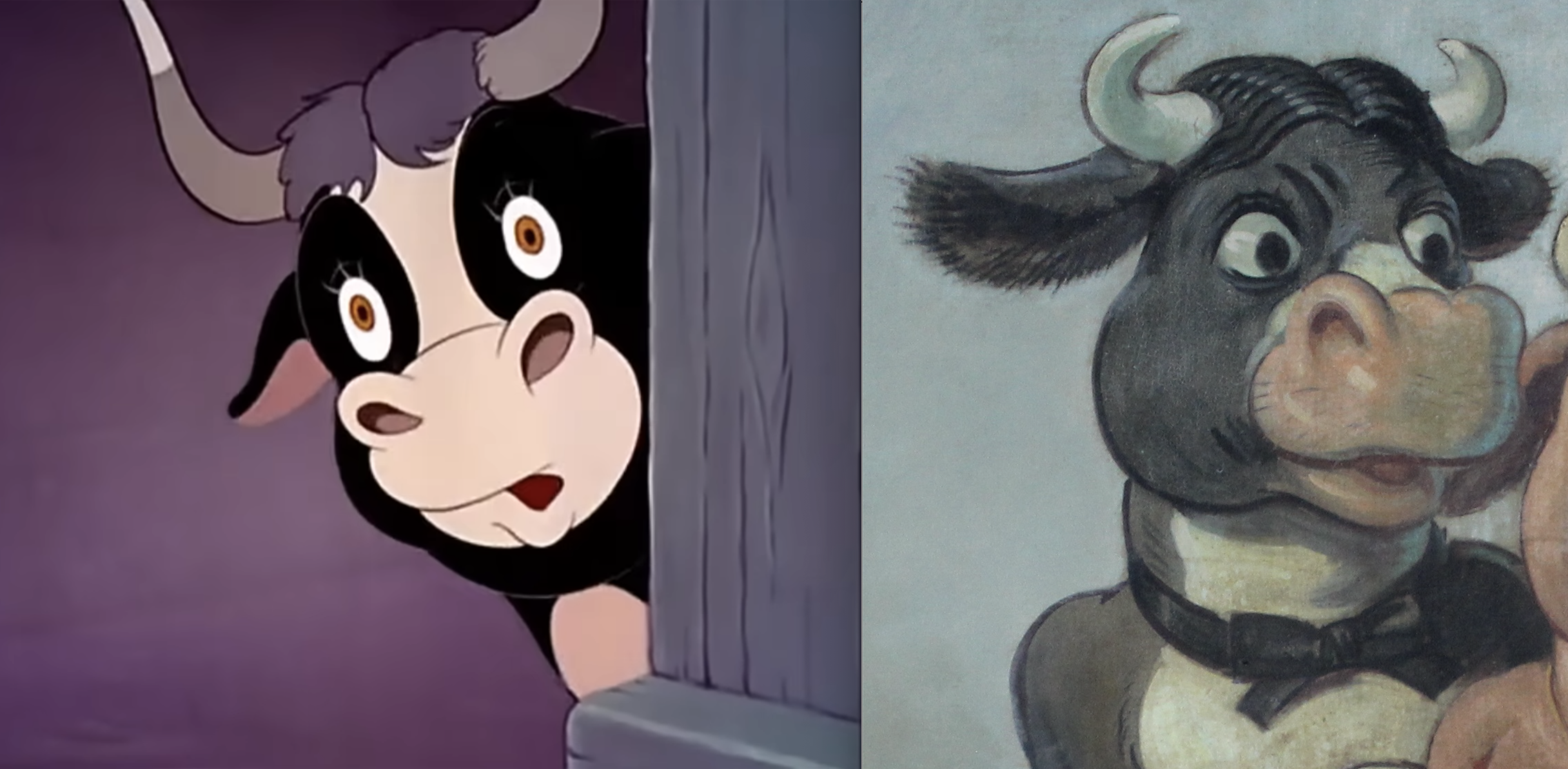
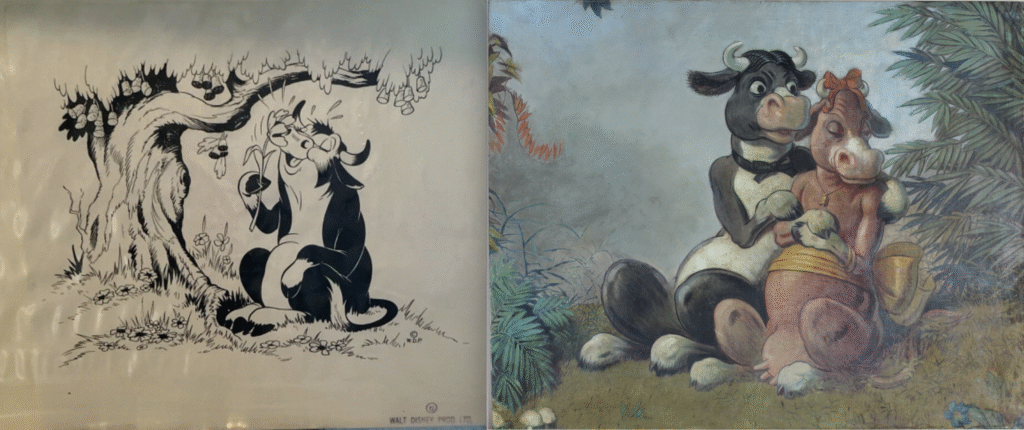
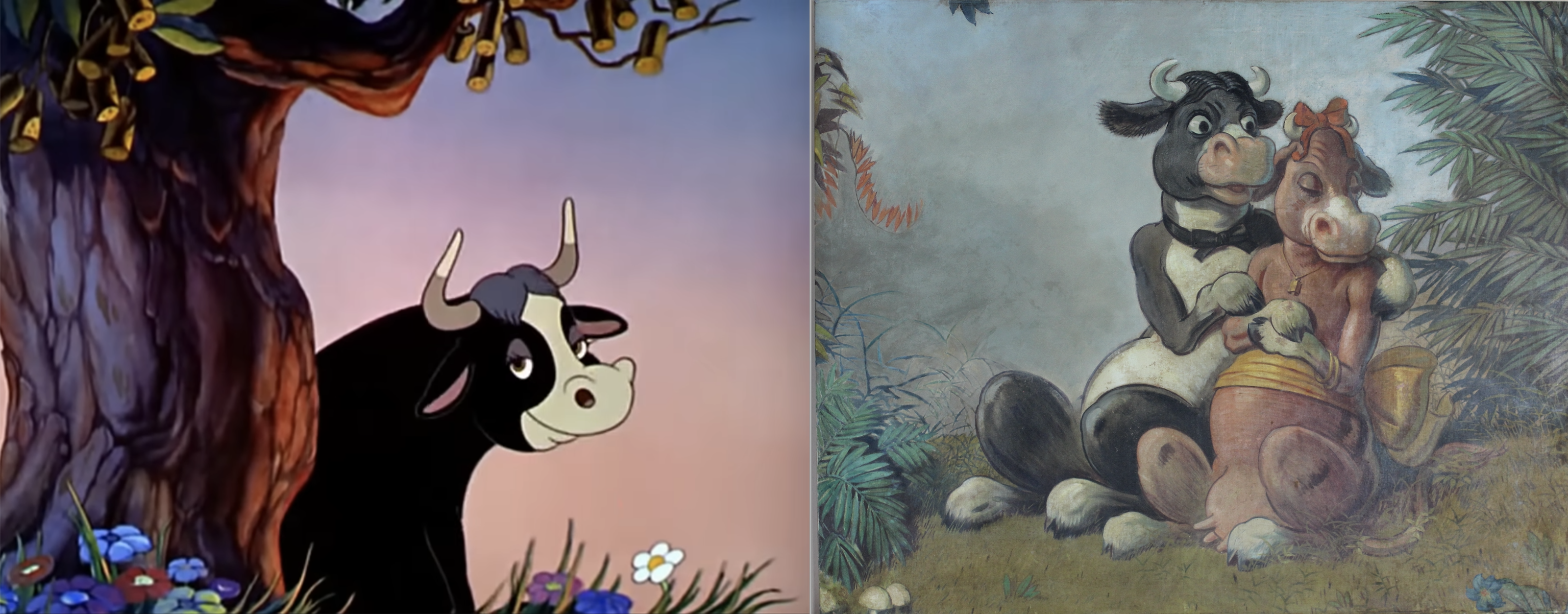
Disney Ferdinand and Grell Ferdinand (head comparison)
Several characteristics deserve careful attention.
Unlike every other documented Purple Cow character, Grell painted Ferdinand with a black coat rather than purple.
His hair is carefully parted down the center, remarkably similar to Disney’s Ferdinand.
Both characters possess:
- large expressive eyes
- broad rounded muzzles
- gentle facial expressions
- peaceful personalities
Even the distinctive hairstyle appears unusually close.
Individually, none of these observations proves artistic influence.
Taken together, however, they invite comparison.
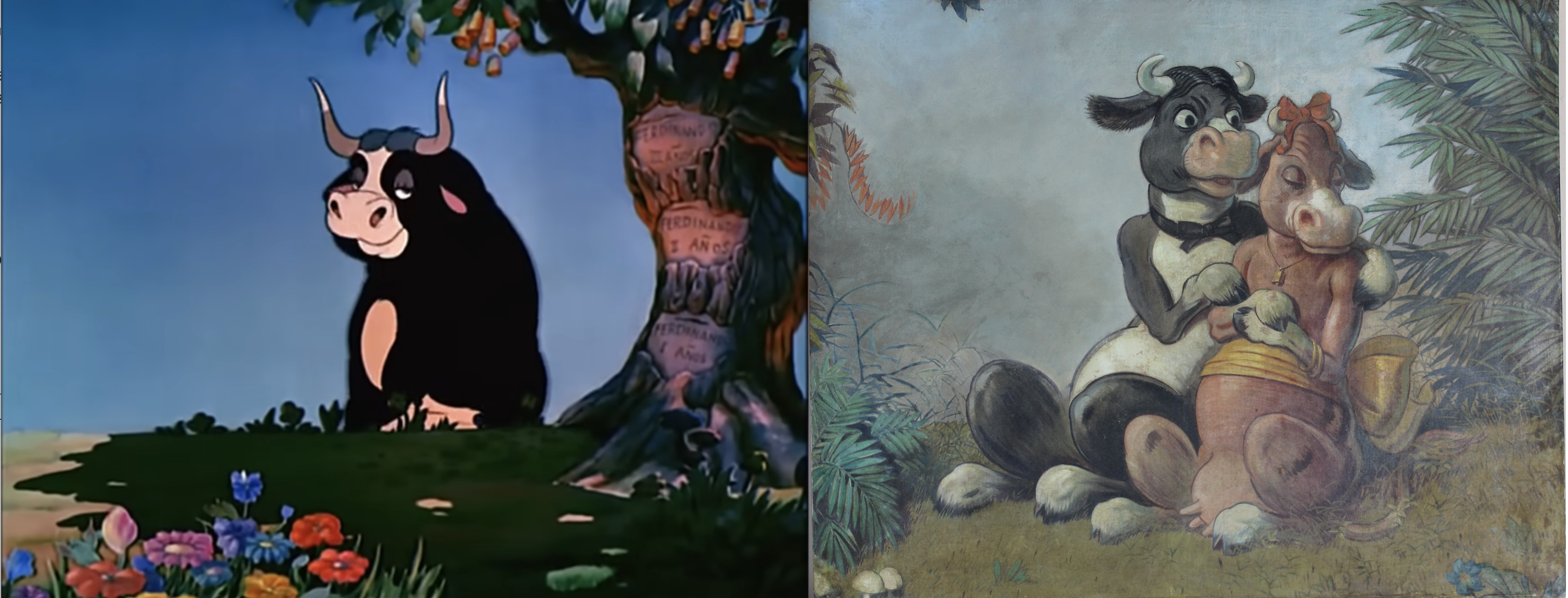
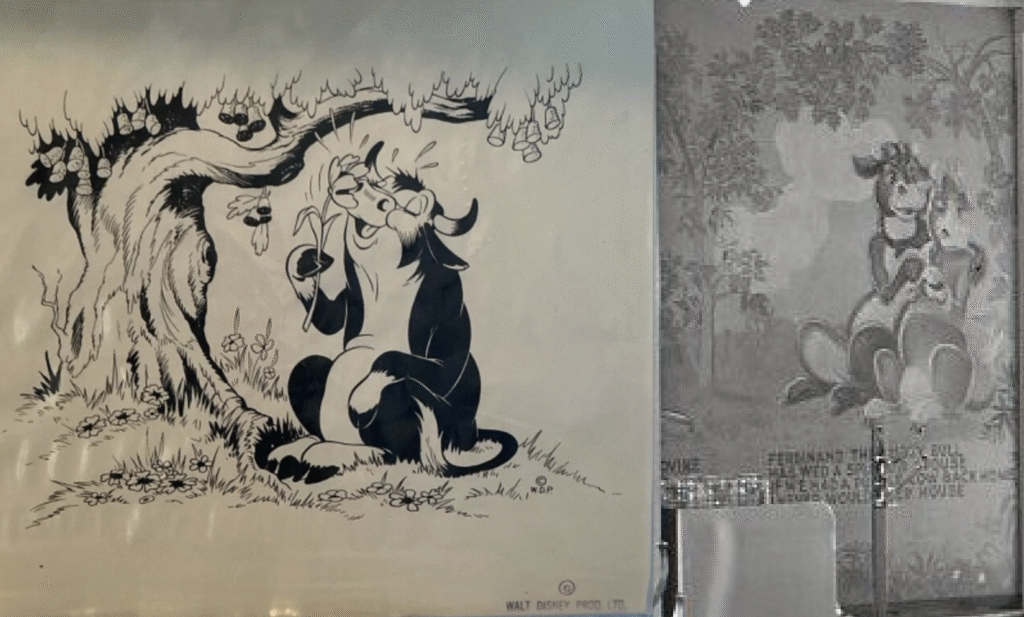
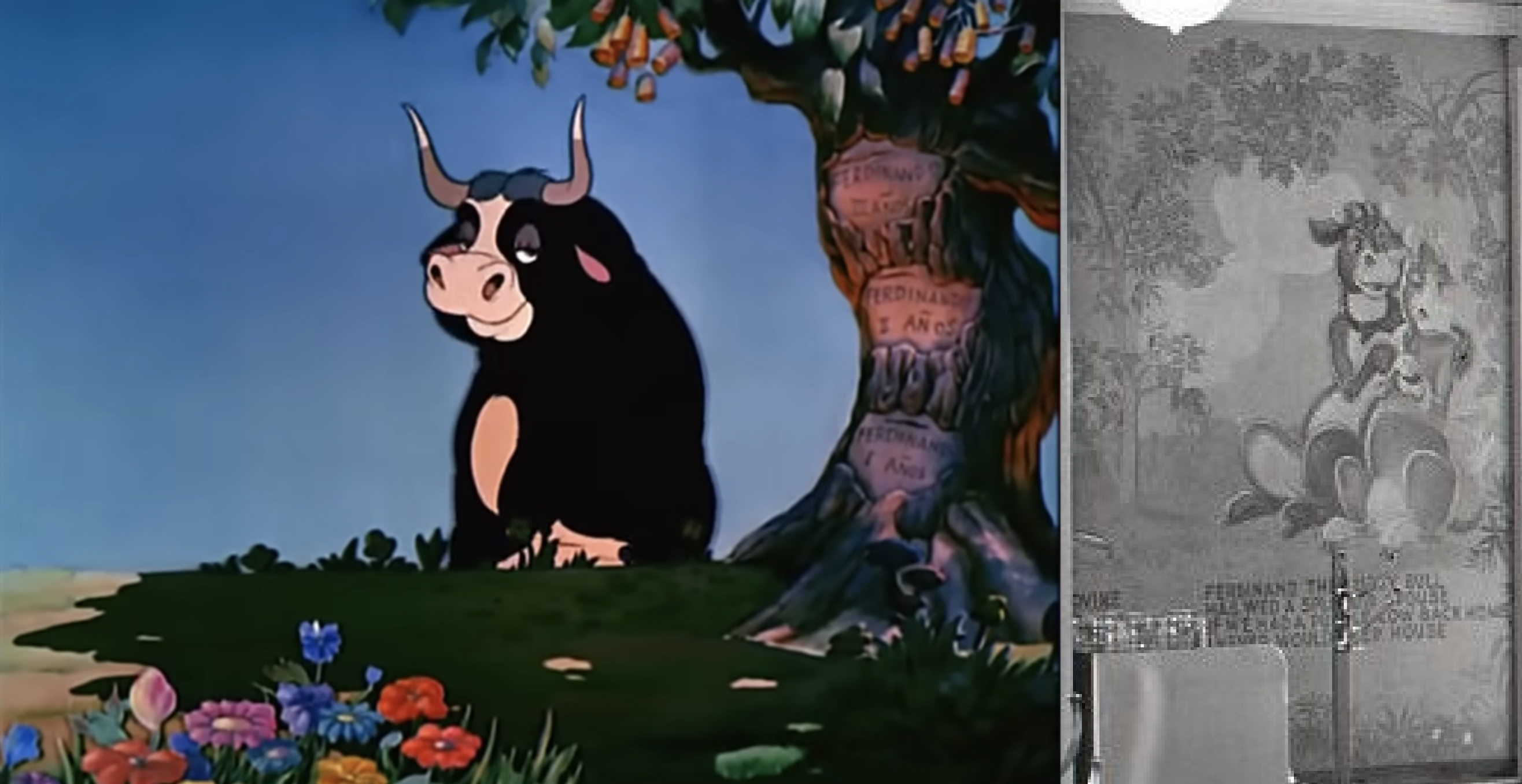
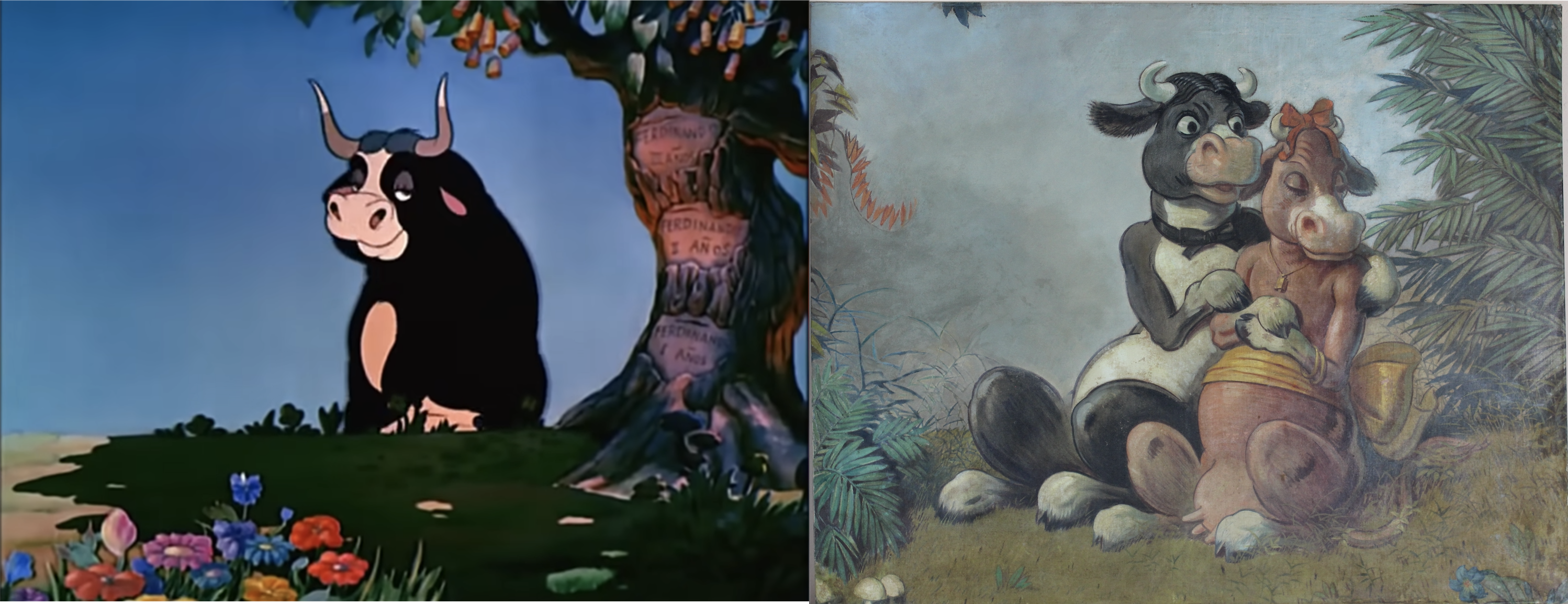
Disney Ferdinand beneath the cork tree compared with Grell’s Ferdinand beneath his tree
The similarities extend beyond appearance.
Disney’s Ferdinand is happiest beneath his famous cork tree surrounded by flowers.
Grell likewise places Ferdinand beneath a tree surrounded by flowers and lush vegetation.
Rather than depicting a fighting bull, Grell imagines Ferdinand living peacefully within the whimsical world of the Purple Cow.
Instead of entering the bullring, Grell’s Ferdinand Marries Clarabelle Cow.
The humorous jingle beneath the mural reads:
FERDINAND THE LUCKY BULL
HAS WED A SPLENDID SPOUSE
IF WE HAD A PURPLE COW BACK HOME
I NEVER WOULD KEEP HOUSE
Rather than copying Disney’s story, Grell appears to have continued it—imagining what Ferdinand’s peaceful life might become after happily avoiding the bullfight.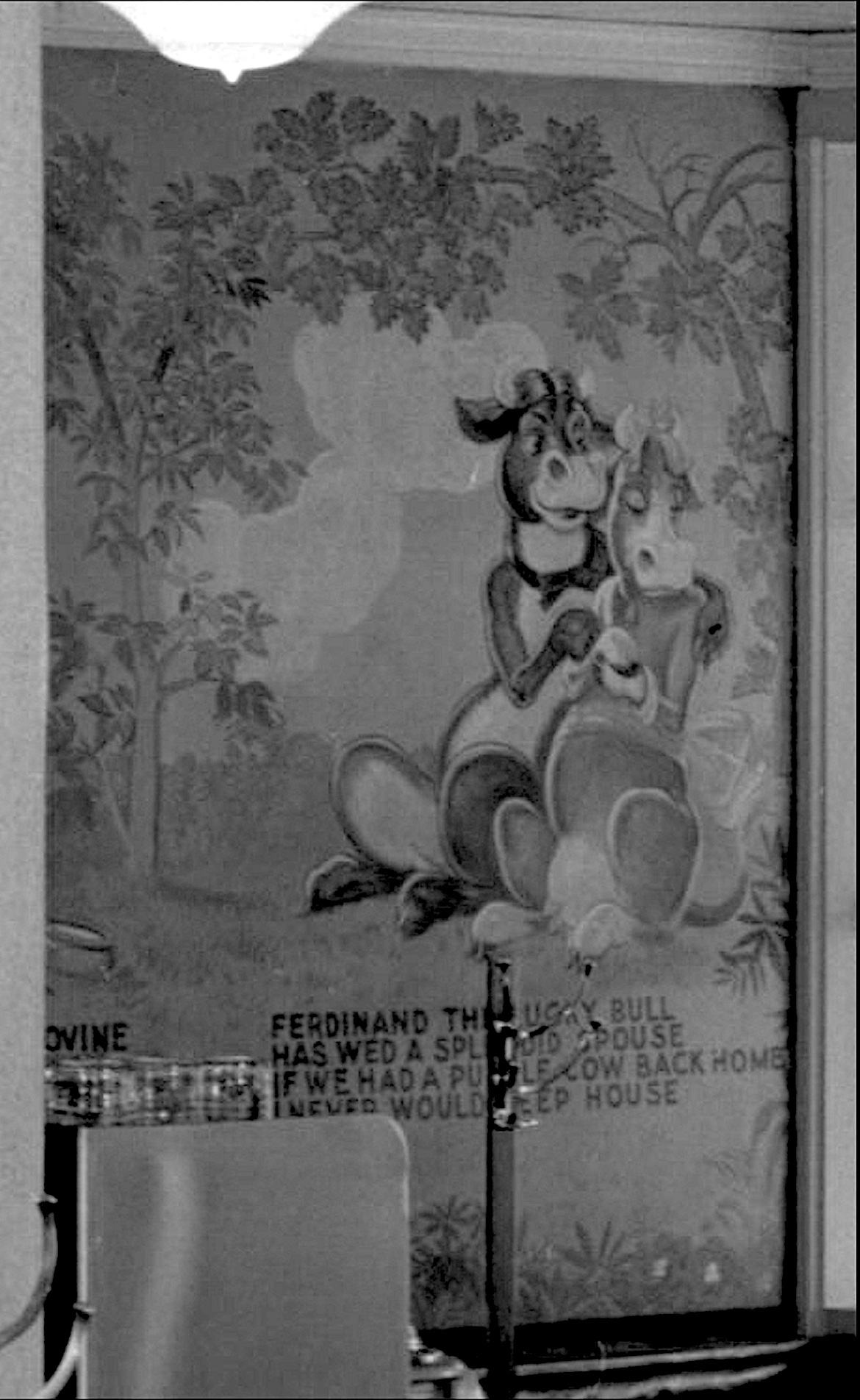
Hotel Miami close-up showing Ferdinand and original jingle
CLARABELLE COW AND GRELL’S PURPLE COW
Ferdinand may not be the first Disney-associated character to emerge from Louis Grell’s Purple Cow world.
Grell had already established his own recurring female Purple Cow character. When he brought Ferdinand into that world, he married Ferdinand to this established heroine while presenting her with a particularly concentrated group of attributes associated with Disney’s female cow character, Clarabelle.
As the surviving murals have been assembled and compared, another pattern has become increasingly difficult to overlook: Grell repeatedly painted a highly anthropomorphic female Purple Cow whose appearance and personality invite comparison with Clarabelle Cow, one of Walt Disney’s established characters of the 1930s.
Clarabelle was not simply a cartoon cow. She was a female character given distinctly human personality and behavior. She dressed, socialized, danced, performed and participated in romantic and comic situations. Among her familiar visual attributes were exaggerated feminine eyes and eyelashes, bows and other feminine accessories—and the cowbell worn around her neck.
Grell’s Purple Cow heroine was constructed from a remarkably similar vocabulary.
Across the surviving Purple Cow compositions, she appears with enormous expressive eyes and long eyelashes, pronounced lips and makeup, bows and elaborate headwear, jewelry and other accessories. She wears clothing, dances, sings, plays musical instruments, powders her complexion, cooks, flirts and participates in romantic situations. In several Grell compositions she also wears a conspicuous cowbell around her neck.
The recurrence of these characteristics matters. This is not a comparison based upon one cartoon cow resembling another. Grell appears to have created a continuing female character, recognizable through repeated physical attributes, accessories, behavior and personality as she moves from one Purple Cow situation to another.
THE COWBELL
One detail deserves particular attention.
The cowbell is one of Clarabelle Cow’s characteristic accessories in Disney imagery. Grell repeatedly gives his female Purple Cow a prominent bell as well.
In some Purple Cow compositions the bell is large and unmistakable. In the surviving FERDINAND mural, however, the bride wears a considerably smaller, more delicate bell suspended from a thin necklace.
The difference makes sense within the scene Grell has painted.
This is her wedding day.
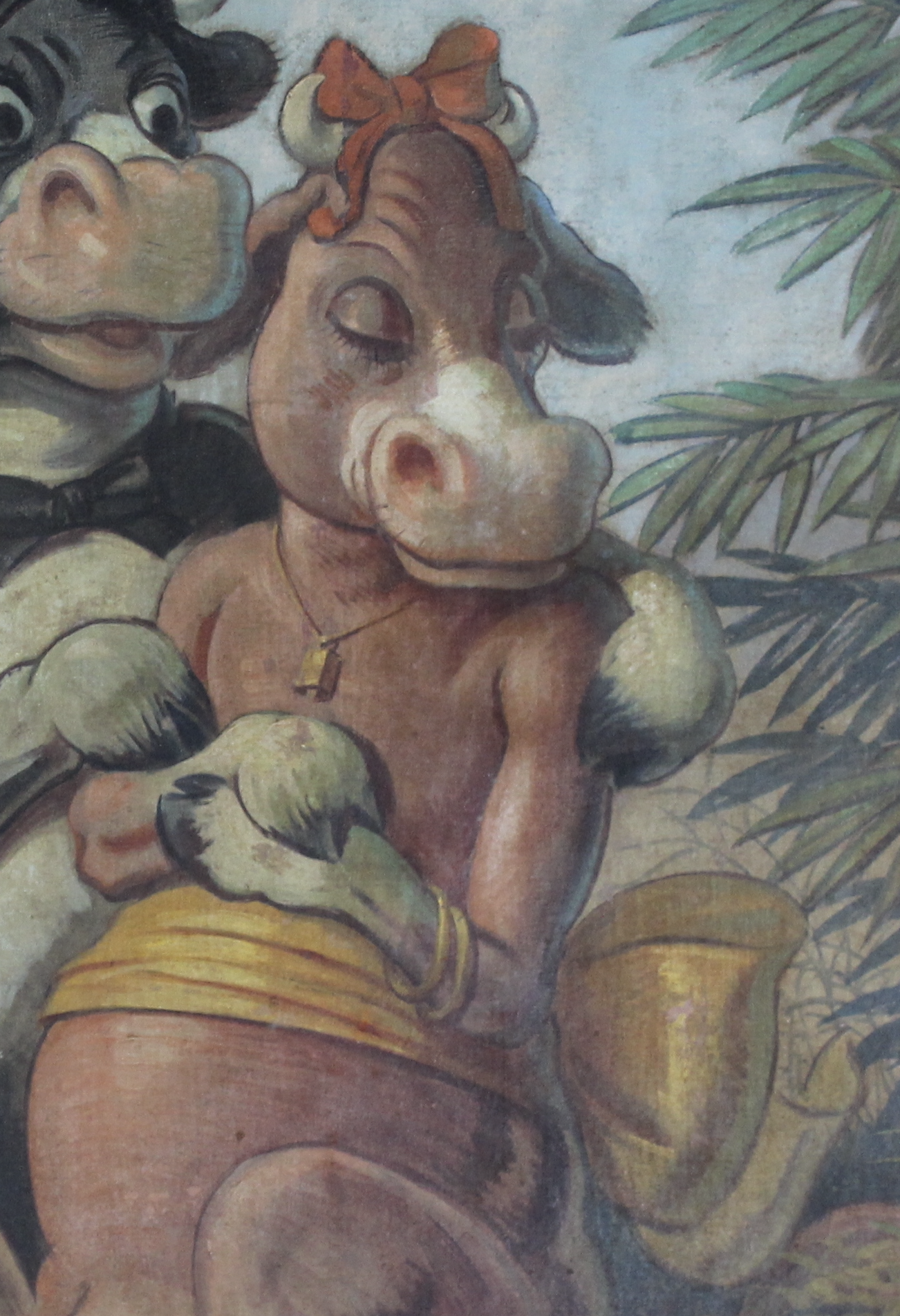
FERDINAND AND HIS BRIDE — DETAIL. Grell presents the couple as a wedding pair: Ferdinand wears a bow tie while the Purple Cow wears makeup, a large hair bow, bracelets and a small bell at her throat. A broad bonnet rests around her waist as the couple embraces beneath exotic foliage. The bride’s bell is especially noteworthy because larger cowbells recur on Grell’s female Purple Cow elsewhere in the series and were also a characteristic accessory of Disney’s Clarabelle Cow.
She is not presented in her usual comic costume. Grell has dressed the character for the occasion.
The bride wears a large red hair bow, makeup, gold bracelets and the small formal golden bell at her throat. A broad gold bonnet appears around her waist. Her eyes are closed as she leans affectionately toward Ferdinand. Ferdinand himself has been dressed for the occasion with a bow tie.
They embrace beneath a tree surrounded by luxuriant, exotic foliage. In the Hotel Miami version of the composition, flowers can also be seen at the couple’s feet beneath the large exotic tree.
This is not simply a picture of two cattle standing together.
Grell has staged a wedding portrait.
THE BRIDE WAS ALREADY PART OF THE PURPLE COW WORLD
That distinction changes the interpretation of FERDINAND.
The female cow beside Ferdinand does not appear to have been created merely because Grell needed a bride for a joke. Her characteristic feminine treatment belongs to the larger Purple Cow vocabulary visible elsewhere in the mural program.
In FAIR COMPLEXION, Grell presents the Purple Cow as a glamorous female personality concerned with her appearance. She wears feminine accessories and uses a powder puff and mirror while the accompanying jingle celebrates her complexion and charm.
In YOUNG THING, the Purple Cow becomes a performer. With exaggerated eyelashes, feminine clothing and accessories, she sits beneath a tree playing a stringed instrument while her verse describes a character who “laughs and sings.”
Other surviving Purple Cow images continue the pattern through dancing, courtship, fashion, cooking and other human activities.
Taken together, these compositions reveal something that was difficult to recognize when the murals were studied individually:
Grell’s female Purple Cow was a recurring character.
And that character existed before she became Ferdinand’s bride.
FERDINAND MARRIES CLARABELLE COW?
Disney’s Clarabelle Cow was already an established anthropomorphic cow character when Grell began developing the Purple Cow mural world around 1939–1940. Grell’s recurring heroine shares not simply her species, but an unusual constellation of character traits: exaggerated feminine features, prominent eyelashes, bows and clothing, jewelry and accessories, a recurring cowbell, musical and dancing roles, romantic behavior and participation in a thoroughly humanized comic world.
Then Grell introduced Ferdinand.
And Ferdinand married her.
The surviving mural makes the event explicit. Grell paints the couple embracing beneath a tree, dressed for the occasion, while the accompanying verse announces:
FERDINAND, THE LUCKY BULL
HAS WED A SPLENDID SPOUSE
IF WE HAD A PURPLE COW BACK HOME
I NEVER WOULD KEEP HOUSE.
The significance is difficult to miss.
If Grell’s Ferdinand represents an intentional adaptation or continuation of Disney’s celebrated Ferdinand—and the evidence examined elsewhere in this article strongly supports that interpretation—then Grell did something considerably more imaginative than reproduce a popular cartoon character.
He brought Ferdinand into the Purple Cow world and married him to its established heroine.
And if that heroine was herself constructed in conscious dialogue with Disney’s Clarabelle Cow, Grell’s joke becomes considerably more sophisticated:
FERDINAND MARRIES CLARABELLE COW.
The Flowers, Trees and Daisies
For many years researchers wondered why Grell repeatedly filled his Purple Cow murals with flowers, daisies, and unusual trees bearing human food.
These motifs appear throughout the Purple Cow series regardless of location.
Disney’s Ferdinand is famous for quietly sitting beneath his cork tree while smelling flowers, particularly daisies.
Likewise, Grell consistently surrounded many Purple Cow scenes with flowering plants while placing his characters beneath distinctive trees.
Some trees even bear pancakes, doughnuts, sausages, cookies and other breakfast foods, transforming ordinary landscape elements into whimsical visual jokes appropriate for a coffee shop.
Whether these recurring themes originated independently or were inspired in part by Disney’s enormously popular film remains unknown.
They nevertheless form an interesting visual dialogue between two artists working only a short time apart.
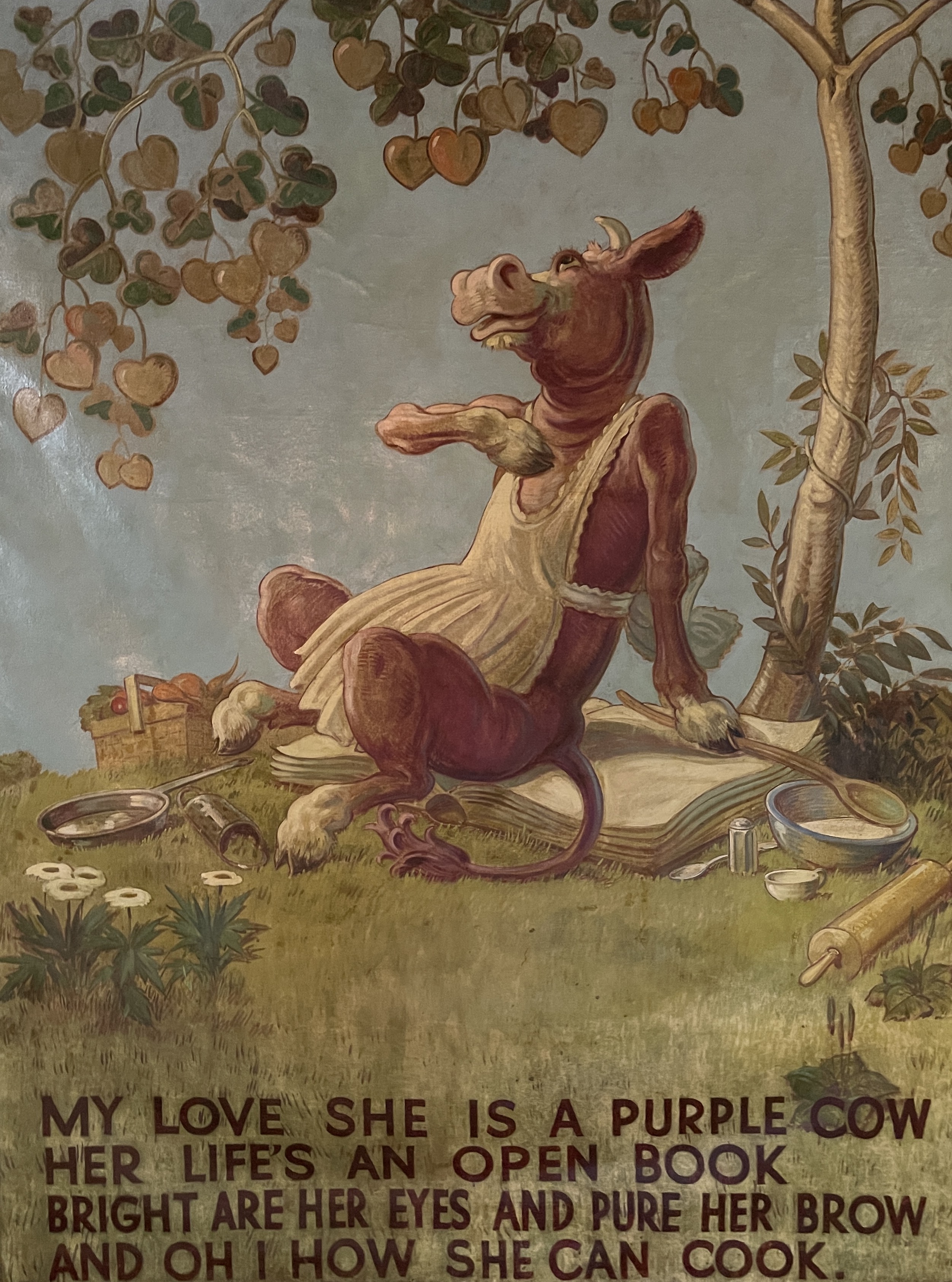
HOW SHE CAN COOK (Heart-shaped cookies)
Beyond Ferdinand
The Purple Cow murals were far more than simple restaurant decorations.
Research now indicates that Louis Grell created an extensive visual identity system for the Albert Pick Hotels Purple Cow Shops.
Recurring characters, repeated compositions, local city references, humorous poems, and hotel-specific adaptations combined to create a unified decorative program installed throughout the Pick Hotels chain.
Ferdinand represents only one recurring character within this much larger artistic achievement.
The Only Known Survivor
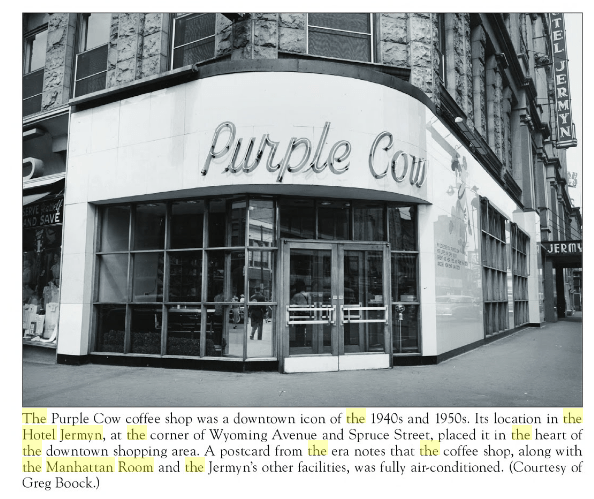
The mural presented here once hung inside the Hotel Jermyn Purple Cow Shop in Scranton, Pennsylvania.
Installed in 1945, it survived when nearly every other Purple Cow mural disappeared during later renovations.
Today it remains the only known surviving Ferdinand mural and one of the very few surviving Purple Cow murals attributable to Louis Grell.
Its survival provides an extraordinary glimpse into one of the most ambitious yet least-known mural programs created for an American hotel chain during the 1940s.
ALBERT PICK, JR.: HOTELS, HOLLYWOOD AND NATIONAL PUBLIC LIFE
The cultural reach of the man directing the Pick Hotels organization also deserves consideration.
Albert Pick, Jr. was not an isolated hotel proprietor. The surviving Pick Hotels photographic and corporate archive documents extensive personal and professional contact with major figures in entertainment, politics and public life. Pick and his hotel executives received and entertained nationally prominent actors, entertainers, military leaders and politicians; company photographers documented their arrivals, dinners, receptions and visits to Pick properties.
The surviving record includes encounters and events involving Joan Crawford, Esther Williams, Lana Turner, Bob Hope, Gene Autry, General Douglas MacArthur, Richard Nixon and other prominent figures, as well as international political figures.
Some relationships were clearly more substantial than ceremonial hotel greetings. One photograph presented to Pick by Richard Nixon carries the personal inscription:
“With best wishes and appreciation for your friendship over the years.”
Pick Hotels publications also document members of the Nixon family being personally entertained by Mr. and Mrs. Pick aboard their yacht during a Republican National Convention.
The entertainment connection became directly intertwined with the Purple Cow in 1953, when Doris Day’s recording of “A Purple Cow” produced the Pick Hotels publicity event remembered as “EVEN TRADE.” Day and Albert Pick, Jr. exchanged her Columbia recording and a Pick Purple Cow menu—bringing a nationally known entertainer directly into the promotional life of the Purple Cow.
The Purple Cow was therefore not created within an obscure or culturally isolated hotel operation. It belonged to a sophisticated national organization whose leadership moved comfortably within the worlds of entertainment, publicity, politics and celebrity.
Conclusion
What began as an investigation of a single Purple Cow character named FERDINAND has developed into a much broader question about Louis Grell’s engagement with Disney-era animation and American popular culture.
The surviving evidence now reveals several distinct but converging lines of inquiry.
Disney’s Ferdinand the Bull became a national cultural phenomenon beginning in late 1938. Shortly thereafter, during the formative period of Grell’s Purple Cow mural program, a character named FERDINAND entered Grell’s newly created comic world.
The similarities extend well beyond the name. Grell’s Ferdinand is uniquely painted as a dark bull, unlike the Purple Cows surrounding him, and shares striking visual and narrative characteristics with Disney’s celebrated character—including his distinctive forelock, gentle expression, association with flowers and fanciful trees, peaceful temperament and, most significantly, his encounter with a matador and refusal to fight.
But Ferdinand no longer stands alone.
Across Grell’s Purple Cow murals appears a recurring female protagonist: an elaborately anthropomorphic cow who dresses, powders her complexion, wears jewelry and bows, dances, sings, plays musical instruments, cooks, flirts and participates in human social and romantic situations. Her visual and behavioral construction invites comparison with Disney’s Clarabelle Cow, already familiar to American audiences through Disney cartoons of the 1930s.
The comparison becomes particularly intriguing in the Ferdinand composition. Grell’s Ferdinand does not simply visit the Purple Cow world.
He marries its recurring heroine.
A separate surviving Hotel Mark Twain Purple Cow artifact invokes the jumping cow and laughing dog of Hey Diddle Diddle, declaring that they had “Created a great sensation” before contrasting them with Pick’s Purple Cow as a “REAL Creation.” Disney had repeatedly animated Mother Goose material during the decade immediately preceding the Purple Cow program, making this another important avenue for continued investigation.
These discoveries take on additional historical interest because Grell taught at the Chicago Academy of Fine Arts during the period Walt Disney attended the school, and the Grell family preserved the account that Disney had been one of Grell’s students long before the Ferdinand mural was rediscovered.
The corporate setting was equally sophisticated. Albert Pick, Jr. operated a national hotel organization deeply engaged with publicity, entertainment and popular culture. Surviving Pick Hotels records document his personal and professional relationships and encounters with prominent figures from Hollywood, politics and national public life. The Purple Cow itself eventually intersected directly with American entertainment culture through Doris Day’s 1953 recording of “A Purple Cow” and her documented promotional exchange with Albert Pick, Jr.
Taken individually, any one of these discoveries might be regarded as coincidence, cultural influence or playful borrowing.
Taken together, they present a different historical question.
Was Grell’s Ferdinand simply an isolated tribute to one enormously popular Disney character? Or was the Purple Cow program itself Grell’s sustained engagement with the visual language of American animation—transforming familiar elements of contemporary popular culture into a proprietary character world for the Albert Pick Hotels?
The evidence presently points strongly toward intentional artistic engagement. Whether that engagement resulted from Grell’s familiarity with Disney and his work, a broader response to Disney’s enormous cultural influence, a relationship or understanding involving the Pick organization, or some combination of these remains an important subject for continued research.
What can now be said with considerably greater confidence is this:
Ferdinand no longer stands alone.
He belongs to a much larger and increasingly recoverable story at the intersection of Louis Grell, Walt Disney, the Purple Cow, the Pick Hotels and American popular culture.
WHOSE “EXCLUSIVE RIGHTS”?
One surviving Pick Hotels statement may ultimately prove especially important to understanding the larger Purple Cow program.
Pick asserted “exclusive rights” in connection with its Purple Cow operation.
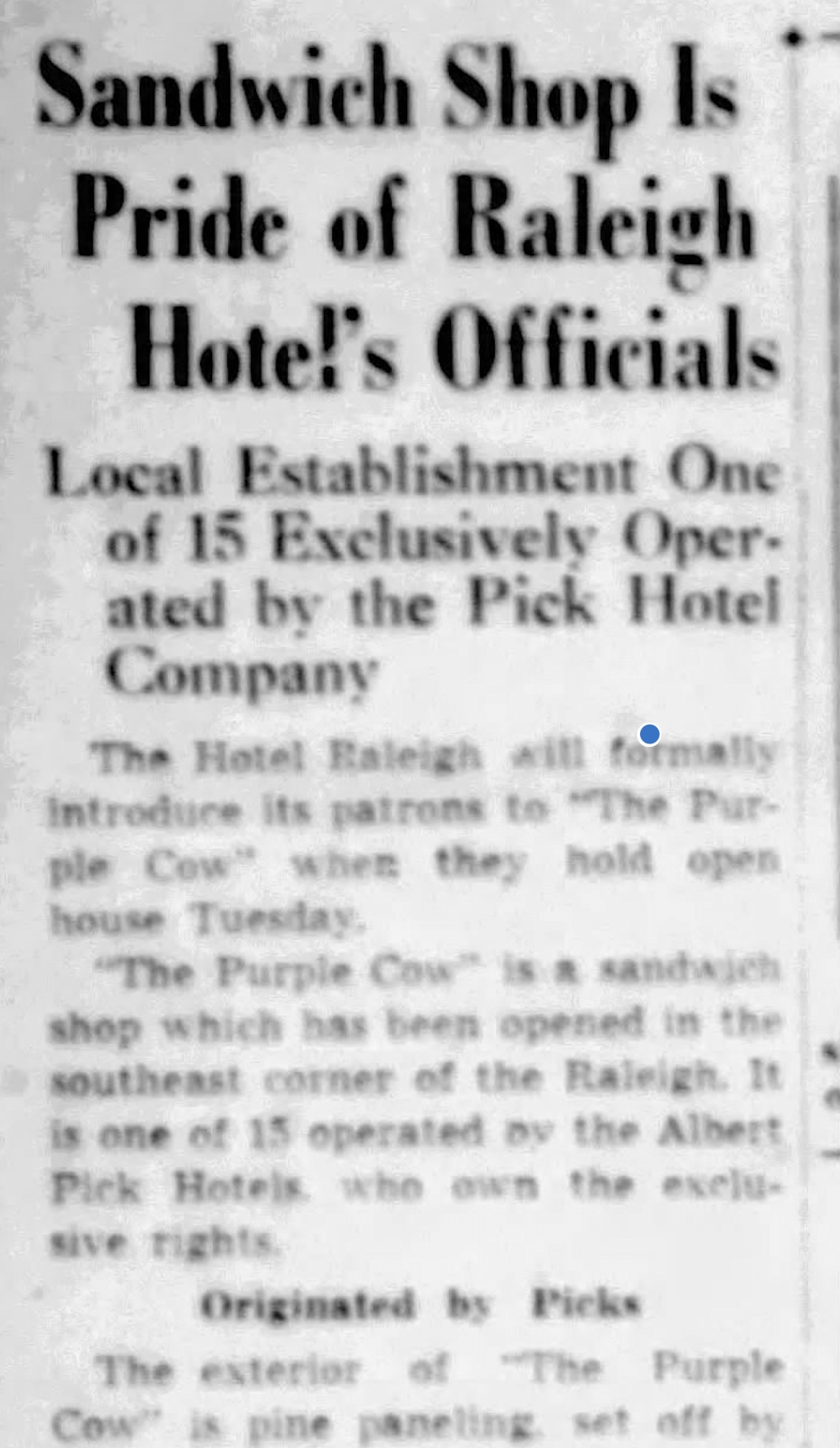
Screenshot

When this statement was first encountered, the most obvious explanation appeared to be the literary history of the Purple Cow itself and the famous verse associated with Gelett Burgess.
The reconstruction of Grell’s mural program now makes the wording worth reconsidering.
The Purple Cow was not merely a restaurant name. It developed into an extensive character environment incorporating recurring anthropomorphic cows, mural narratives, jingles, menus, advertising and promotional material. Within that world, Grell created a recurring female Purple Cow whose character vocabulary invites comparison with Disney’s Clarabelle Cow; Pick material invoked the jumping cow and laughing dog of Mother Goose after Disney had repeatedly animated Mother Goose subjects; and Grell introduced a character explicitly named FERDINAND, whose appearance, temperament and matador narrative closely parallel Disney’s Academy Award-winning Ferdinand.
Sources
- Pick Topicks, Albert Pick Hotels, May 1948, Vol. 6, No. 5, including Friedl Grell’s handwritten inscription identifying Louis Grell as the painter of the Pick Hotel murals.
- Pick Topicks, various issues, 1940–1953.
- Interior photograph, Hotel Miami Purple Cow Shop, Dayton History.
- Interior photograph, Hotel Jermyn Purple Cow Shop, Lackawanna Historical Society.
- Interior photograph, Hotel Pick-Ohio Purple Cow Shop, Luther College Archives.
- Hotel Miami menu featuring the Ferdinand jingle.
- Ferdinand the Bull (1938), Walt Disney Productions; adapted from the story by Munro Leaf with illustrations by Robert Lawson.
- FERDINAND the BULL, Louis Grell, oil on canvas mural fragment, approximately 48 × 60 inches, c. 1945, professionally conserved, private collection.
- Walt Disney’s Chicago Academy of Fine Arts student transcripts authorized release to Richard Grell by Diane Disney Miller in 2012.
Further Reading
Below is the menu with the first FERDINAND (discovered in 2023) clue handwritten by a customer during a visit.
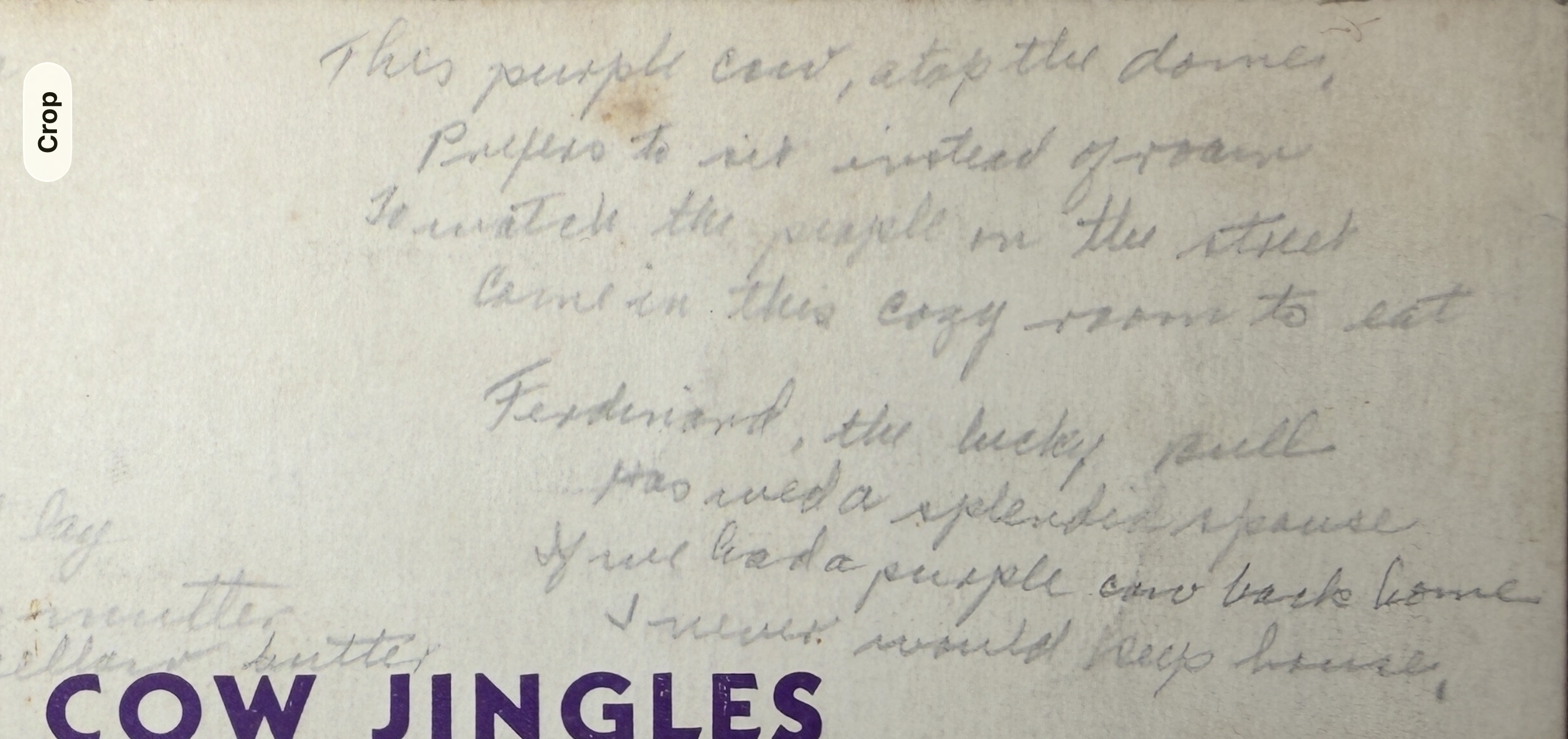
Screenshot
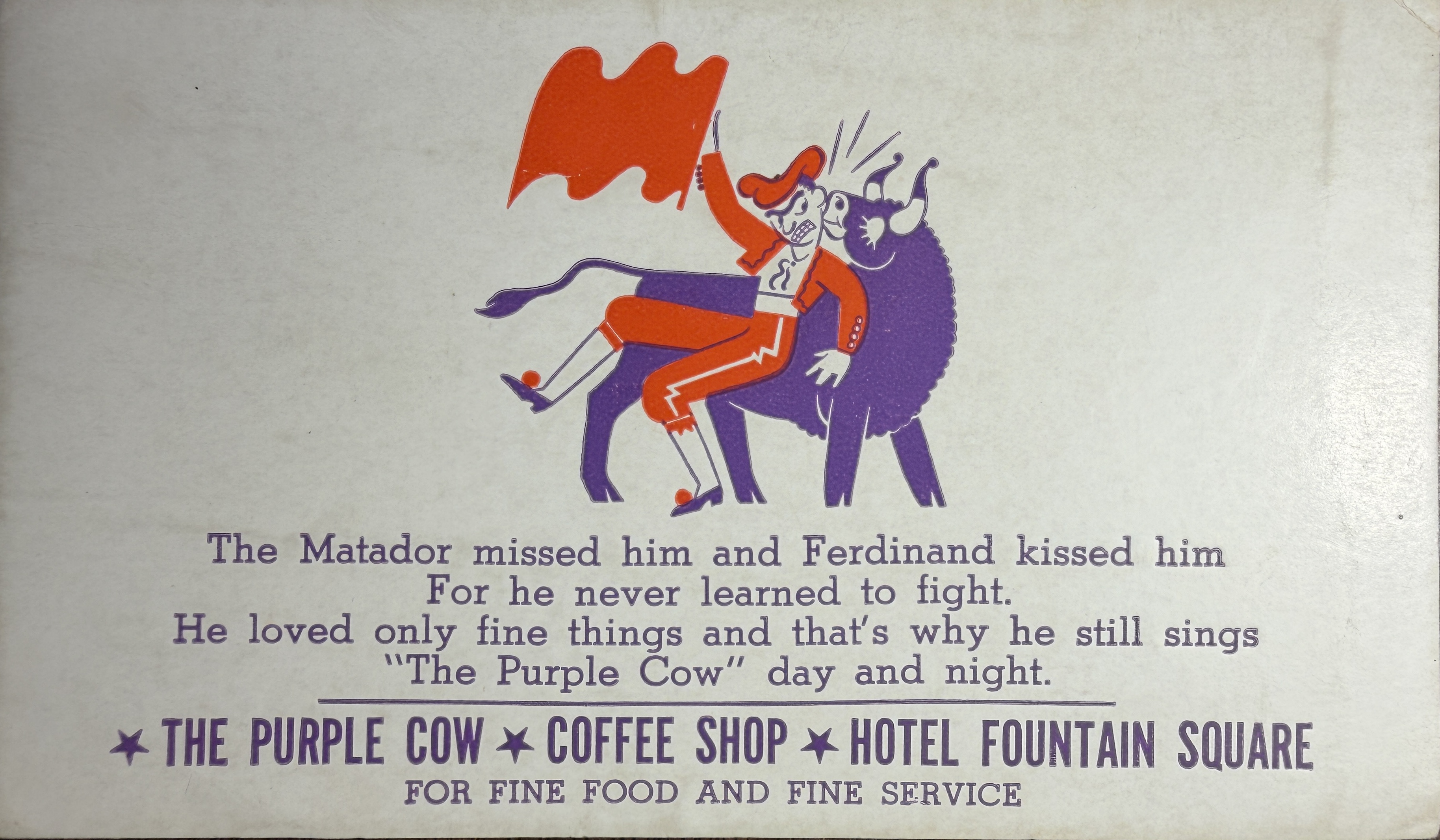
This promotional card from the Fountain Square, Cincinnati is strikingly similar to Walt Disney’s 1938 FERDINAND the BULL animated cartoon movie that won the 1939 Academy Award for animated short cartoon and is evidence that a FERDINAND mural was installed at this Purple Cow location. In the movie, FERDINAND refused to fight the Matador, instead licked him after he exposed a tattoo of a daisy on his chest. Interesting note; Walt Disney is the Matador caricature in this Disney animated short cartoon.
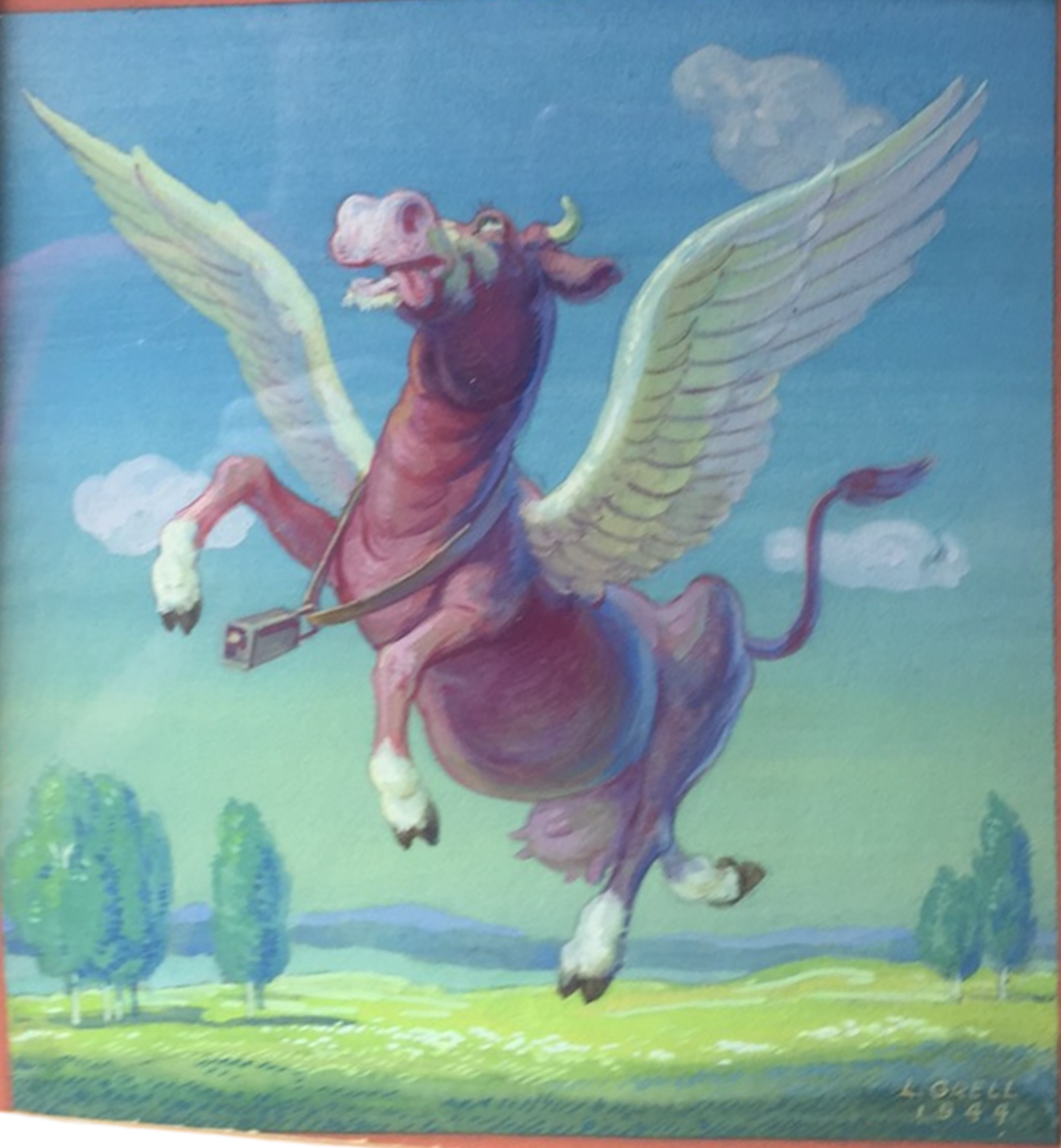
below – a signed Louis Grell watercolor (PEGASUS) installed in the Hotel Raleigh, Waco, TX in 1944
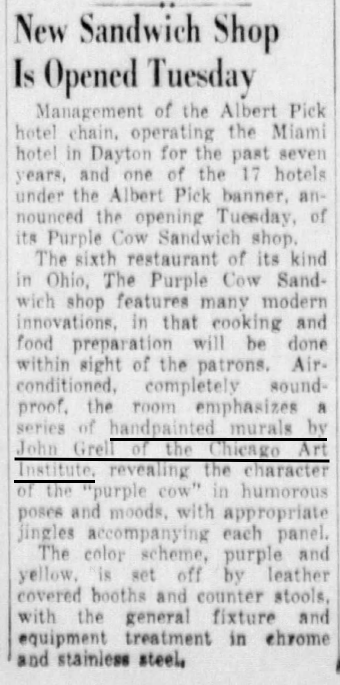
Above – Dayton Daily News article credits a “John” Grell from the Chicago Art Institute as the muralist. Getting Grell’s first name wrong was understandable since he didn’t sign the Purple Cow murals and he likely never visited this hotel (June 4, 1940 page 4).
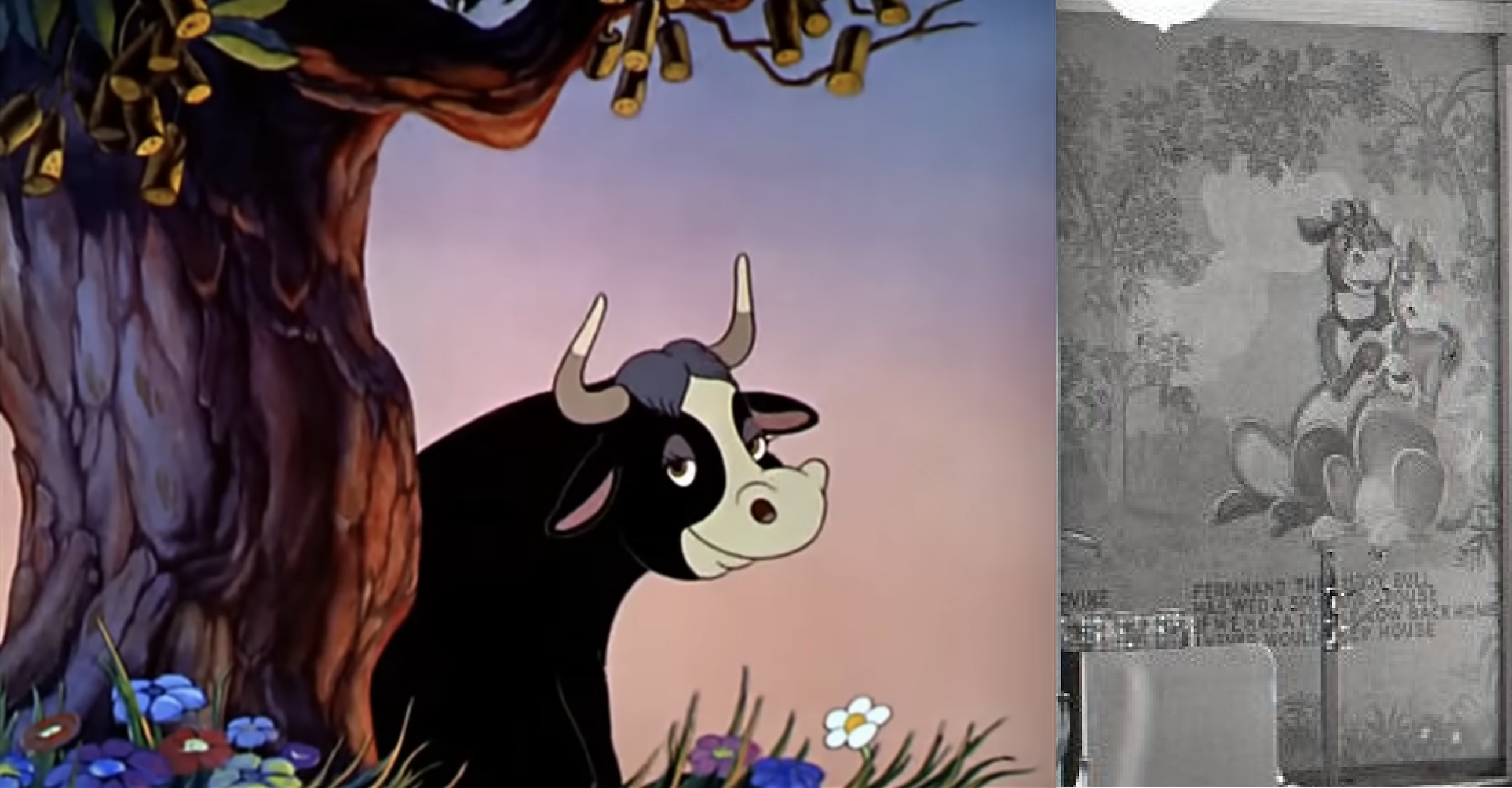
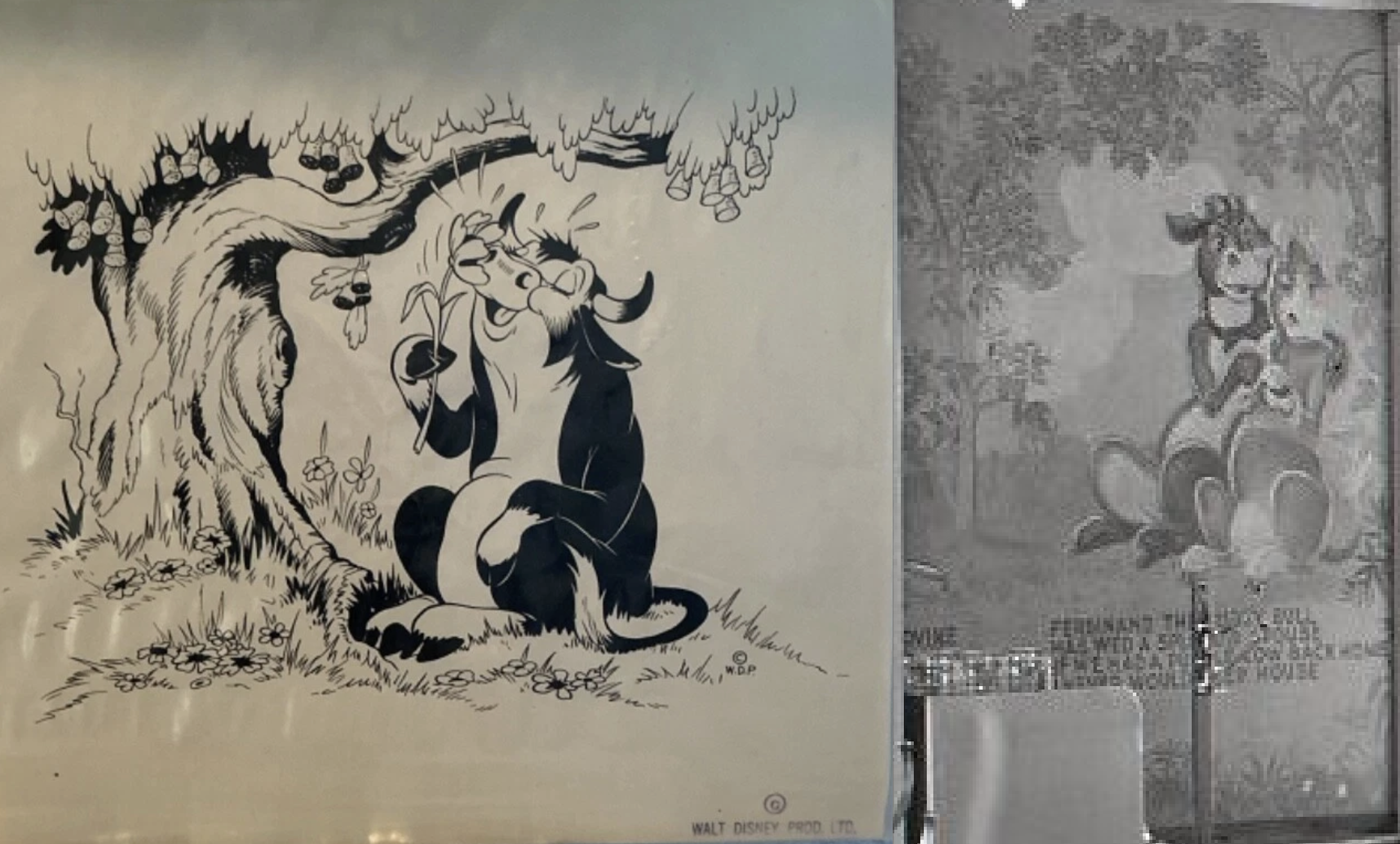
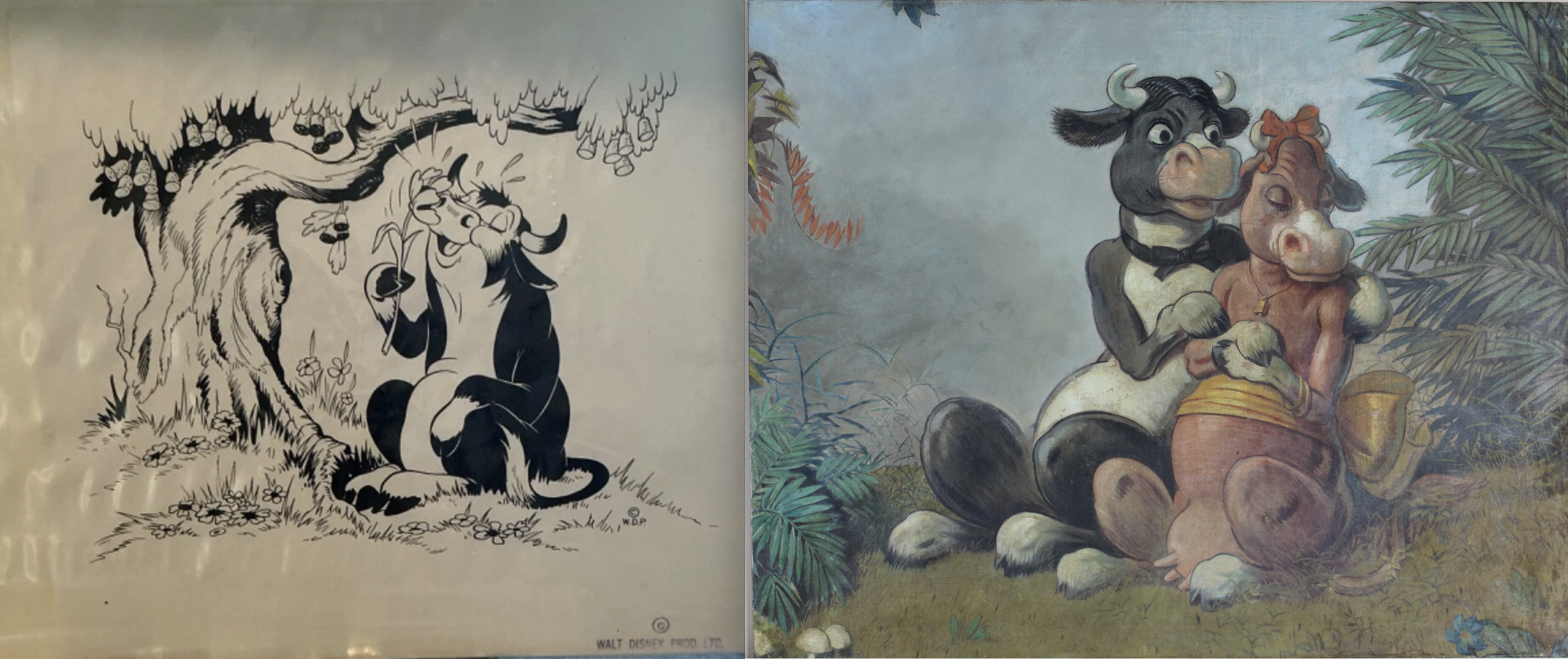
The above left image is a production sketch for the FERDINAND movie from Walt Disney Productions.
Disney’s FERDINAND was “very happy” underneath the ‘cork tree’ and loved sniffing flowers. Grell’s FERDINAND and other Purple Cow murals were typically pictured under odd trees, often with human food hanging from them while surrounded by flowers and many daisies.
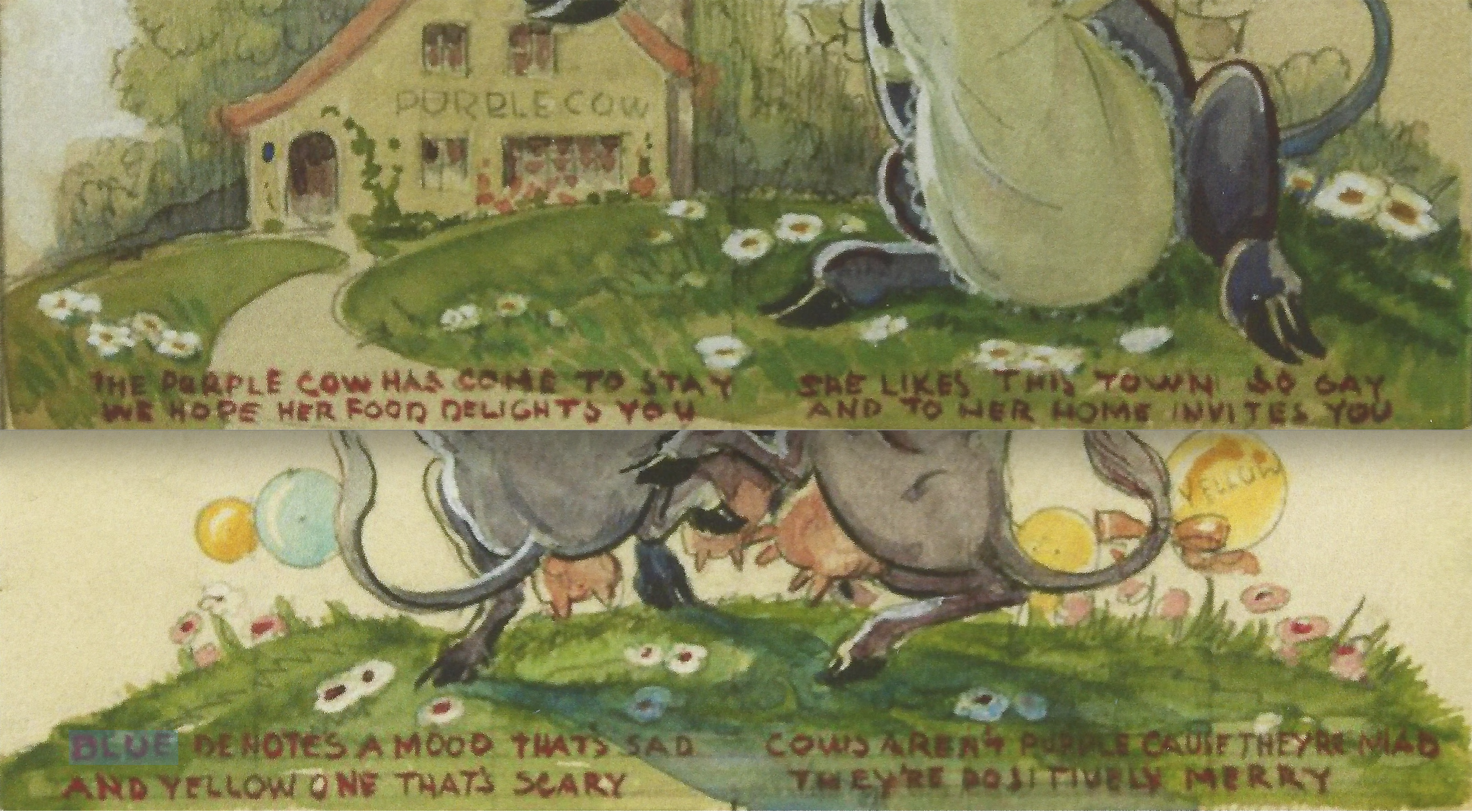
Above – Two Grell watercolors partial views of the many flowers and daisies. Below – Grell’s SHE DOOD IT mural formerly inside the Pick-Ohio, Youngstown.
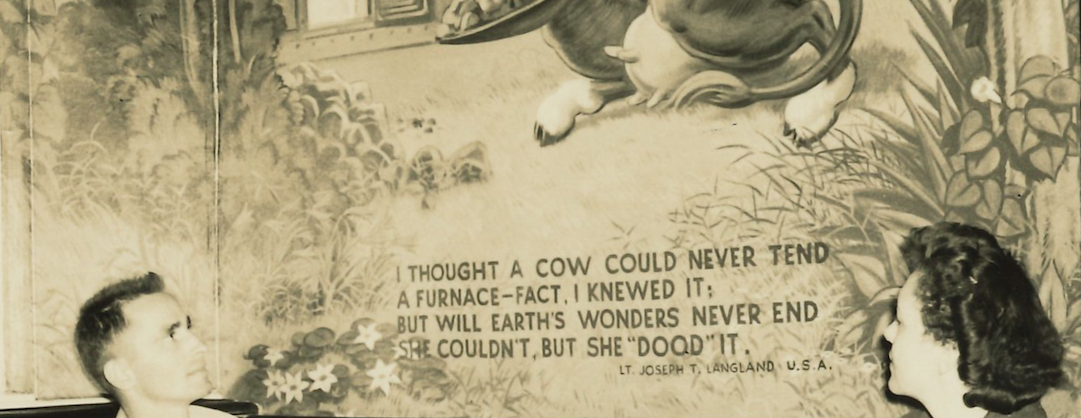
The above three shots depict the amount of daisies Grell incorporated into many of Grell’s Purple Cow murals; FERDINAND’s obsession.
Research Philosophy
The Louis Grell Digital Archive is committed to presenting documentary evidence as accurately as possible. New discoveries are evaluated using primary sources whenever available, and interpretations are revised as additional evidence emerges. Where questions remain unresolved, they are identified as subjects for continued research rather than presented as established fact.
