
Louis Grell’s Award-Winning Purple Cow Mural at the Hotel Roosevelt, Pittsburgh, 1948
Louis Grell Digital Archive — Research / Recent Discoveries
A PITTSBURGH MURAL WITH A PITTSBURGH STORY
When the Pick Hotels Corporation opened its new Purple Cow restaurant in Pittsburgh’s Hotel Roosevelt in January 1948, Chicago artist Louis Grell (1887–1960) filled its walls with an extraordinary cycle of humorous Purple Cow paintings.
One mural was different.
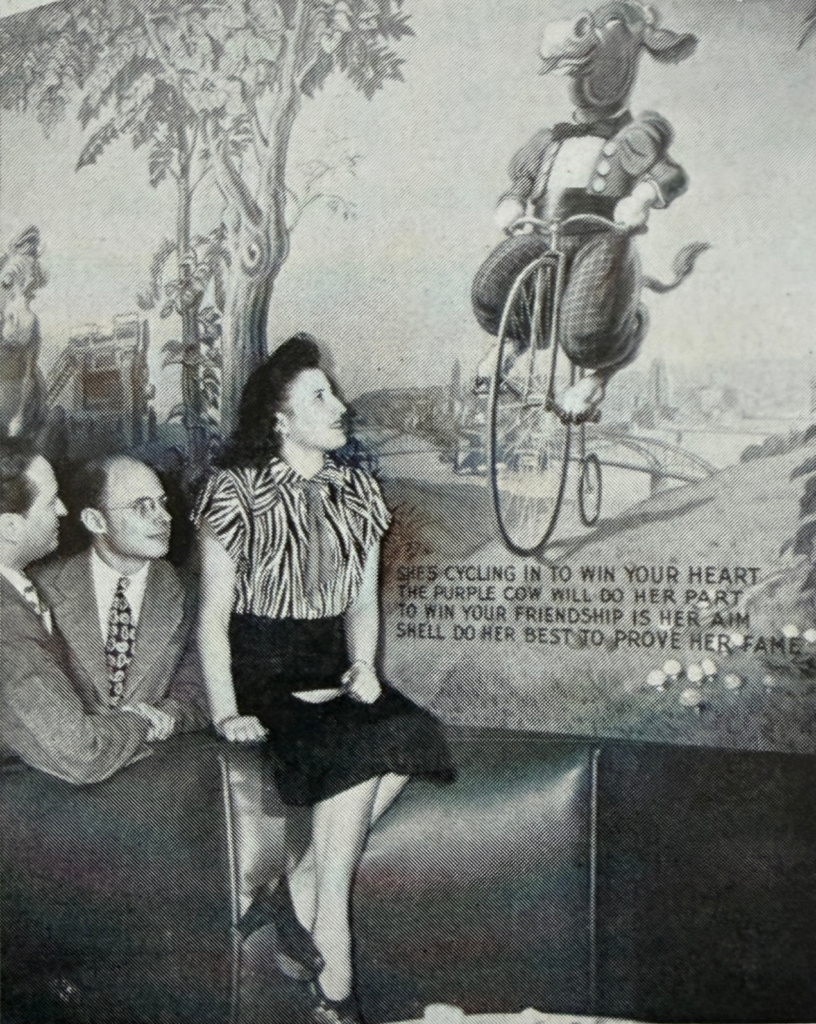
Against a recognizable Pittsburgh setting, Grell placed his Purple Cow high atop an old-fashioned high-wheel bicycle. Dressed in an exaggerated period cycling costume, the cow pedals through a landscape dominated in the distance by Pittsburgh’s celebrated Golden Triangle.
The painting was not merely another comic episode in the Purple Cow series. Pick Hotels’ own publication, Topicks, singled it out, reporting that the mural had “won first prize in a local contest.”
It subsequently became the centerpiece of another competition—one in which Pittsburgh residents were invited to complete Grell’s picture with a four-line jingle.
The result was:
SHE’S CYCLING IN TO WIN YOUR HEART
THE PURPLE COW WILL DO HER PART.
TO WIN YOUR FRIENDSHIP IS HER AIM;
SHE’LL DO HER BEST TO PROVE HER FAME.
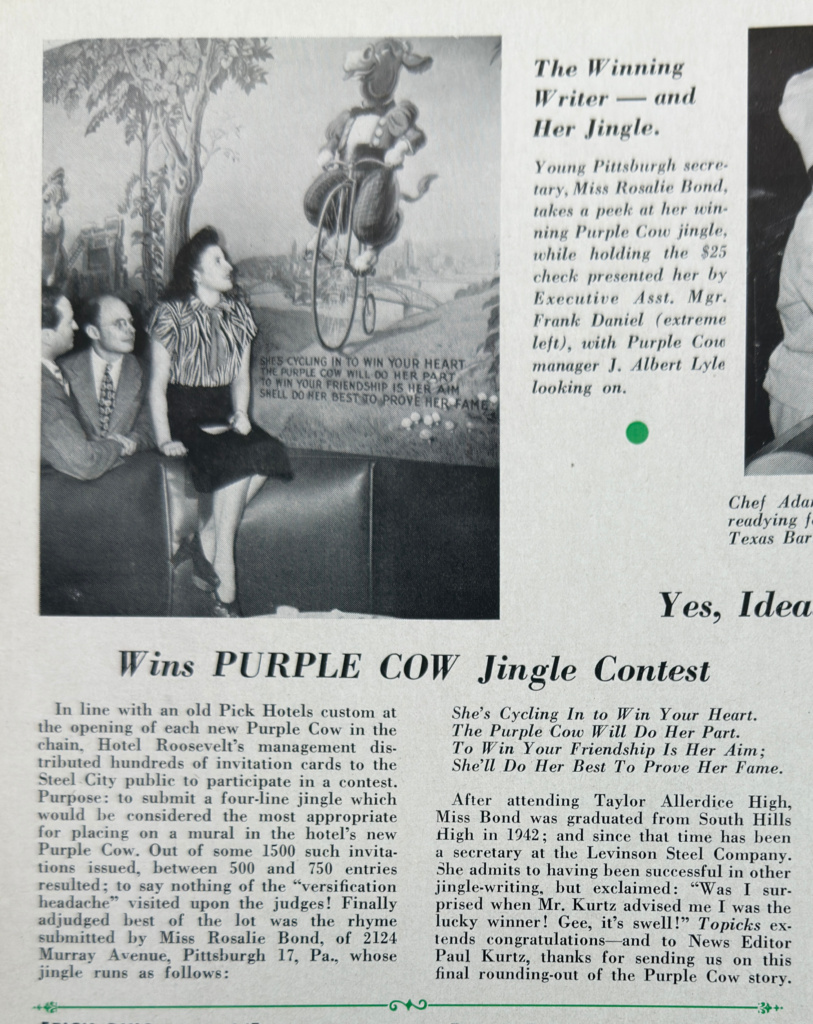
The winning writer was Pittsburgh secretary Rosalie Bond.
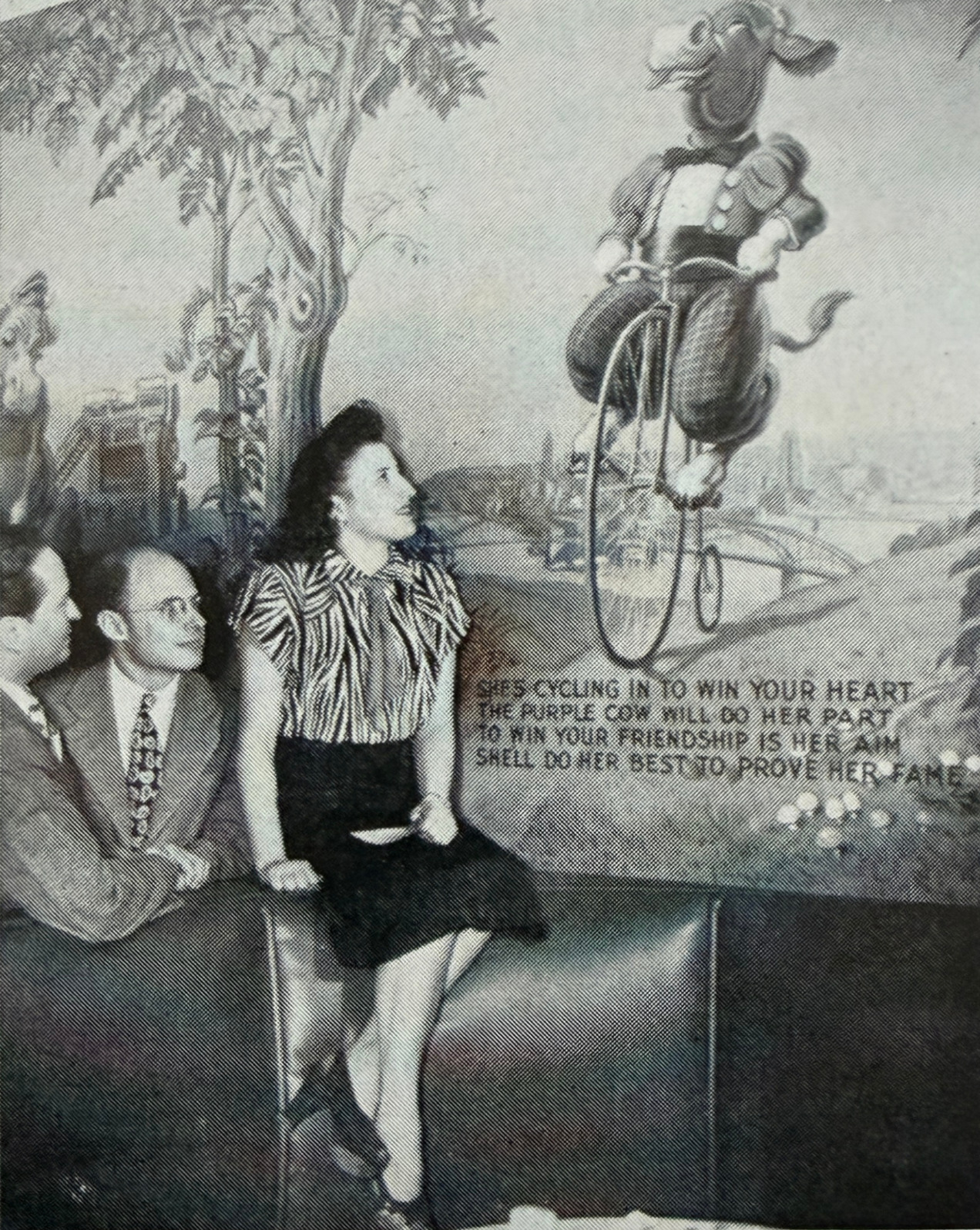
SHE’S CYCLING IN TO WIN YOUR HEART.
Louis Grell’s locally themed Purple Cow mural created for the Hotel Roosevelt, Pittsburgh, 1948. Pittsburgh secretary Rosalie Bond, winner of the hotel’s Purple Cow jingle contest, is photographed beside the mural with hotel representatives. The composition places Grell’s high-wheel bicyclist against Pittsburgh’s Golden Triangle. Pick Topicks, 1948. Chicago History Museum. Notice the partial mural visible to the left. Miss Bond is holding the check in her hand.
MORE THAN 600 FEET OF GRELL MURALS
The significance of She’s Cycling In becomes clearer when placed within the enormous decorative program Grell created for the Roosevelt.
The March 1948 issue of Topicks introduced the restaurant as the Hotel Roosevelt’s new Purple Cow. Describing the murals covering its walls, the Pick Hotels publication made an unusually explicit statement about both their scale and their authorship:
“No less than 600 feet of them here…”
The magazine identified their creator as the “famous Chicago mural artist, Louis Grell,” adding that Grell’s work “also adorns every other PC in the chain.”
Those few sentences are among the most important surviving documentary statements concerning Grell’s Purple Cow work. They establish that the Roosevelt paintings were not an isolated commission. Pick Hotels itself described Grell’s work as extending throughout the Purple Cow restaurant chain.
Surviving Roosevelt photographs examined by the Louis Grell Family Archive document approximately fifteen separate mural compositions within this restaurant alone. That figure represents murals visible in surviving photographs—not necessarily the complete number originally installed.
The Roosevelt’s reported 600-plus feet of murals therefore provides a striking measure of the physical scale of Grell’s work.
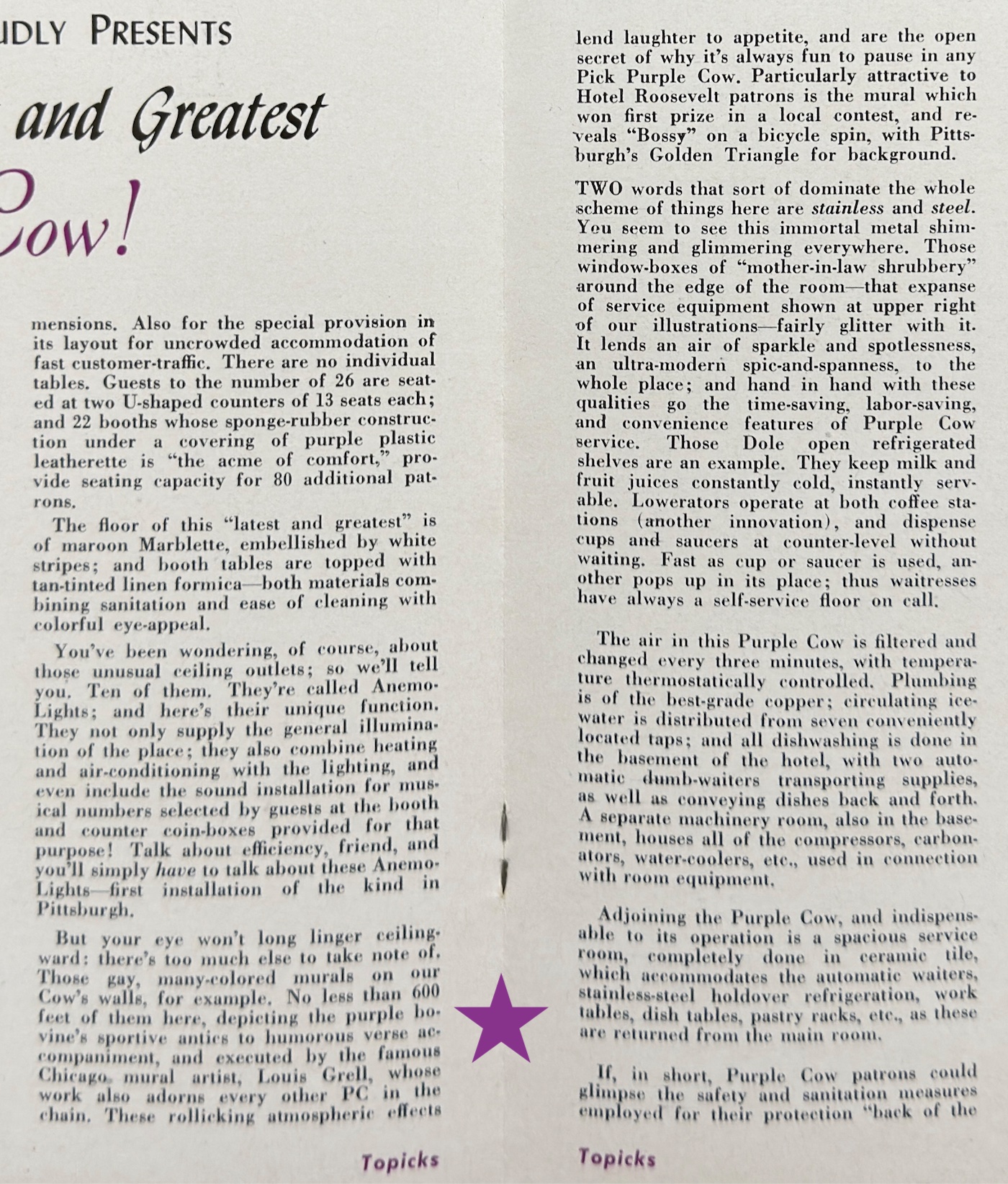
NO LESS THAN 600 FEET
Hotel Roosevelt proudly presents “The Chain’s Latest and Greatest Purple Cow,” Pittsburgh, 1948. This Topicks article reports “no less than 600 feet” of Purple Cow murals at the Roosevelt, identifies Louis Grell as their artist, and states that his work also adorned every other Purple Cow in the Pick Hotels chain. Pick Topicks, March 1948. Chicago History Museum.
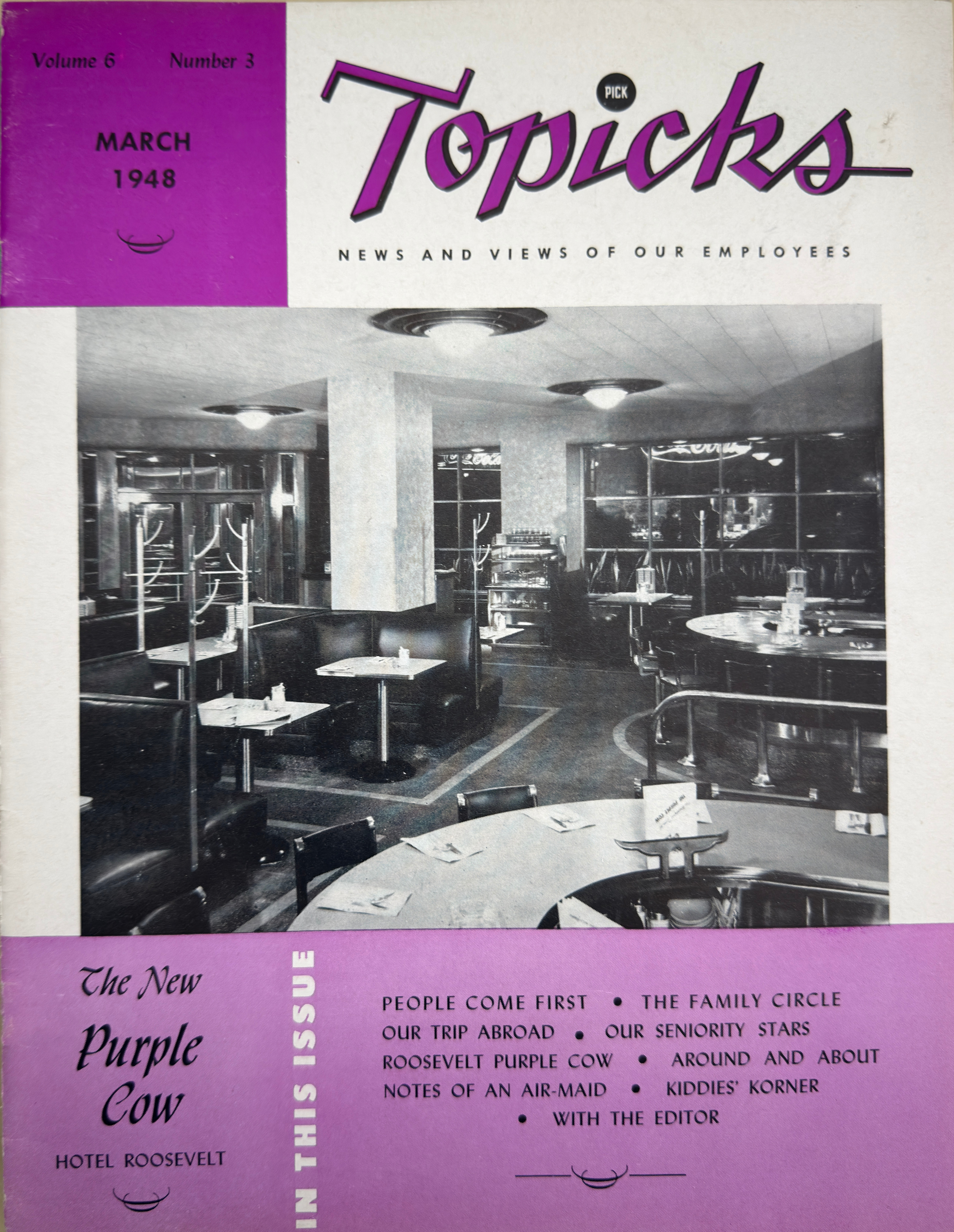
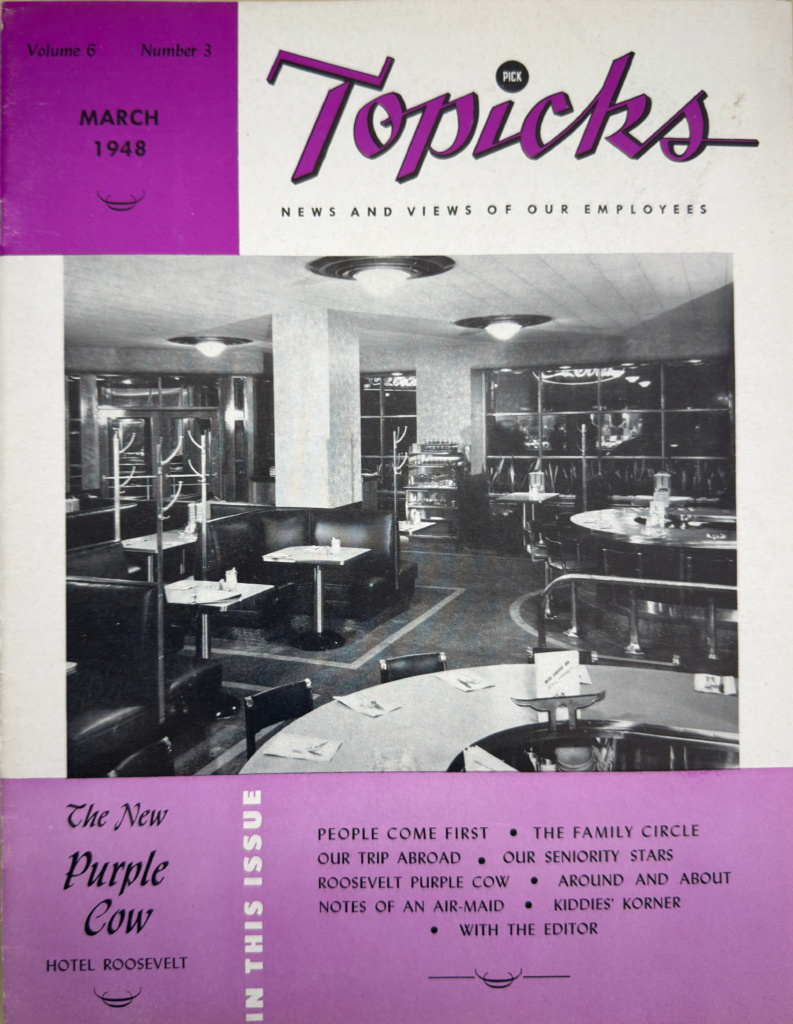
The New Purple Cow
Cover of Pick Topicks, March 1948, devoted prominently to “The New Purple Cow — Hotel Roosevelt.” The opening of the Pittsburgh restaurant received extensive photographic coverage in the Pick Hotels corporate publication. Chicago History Museum..
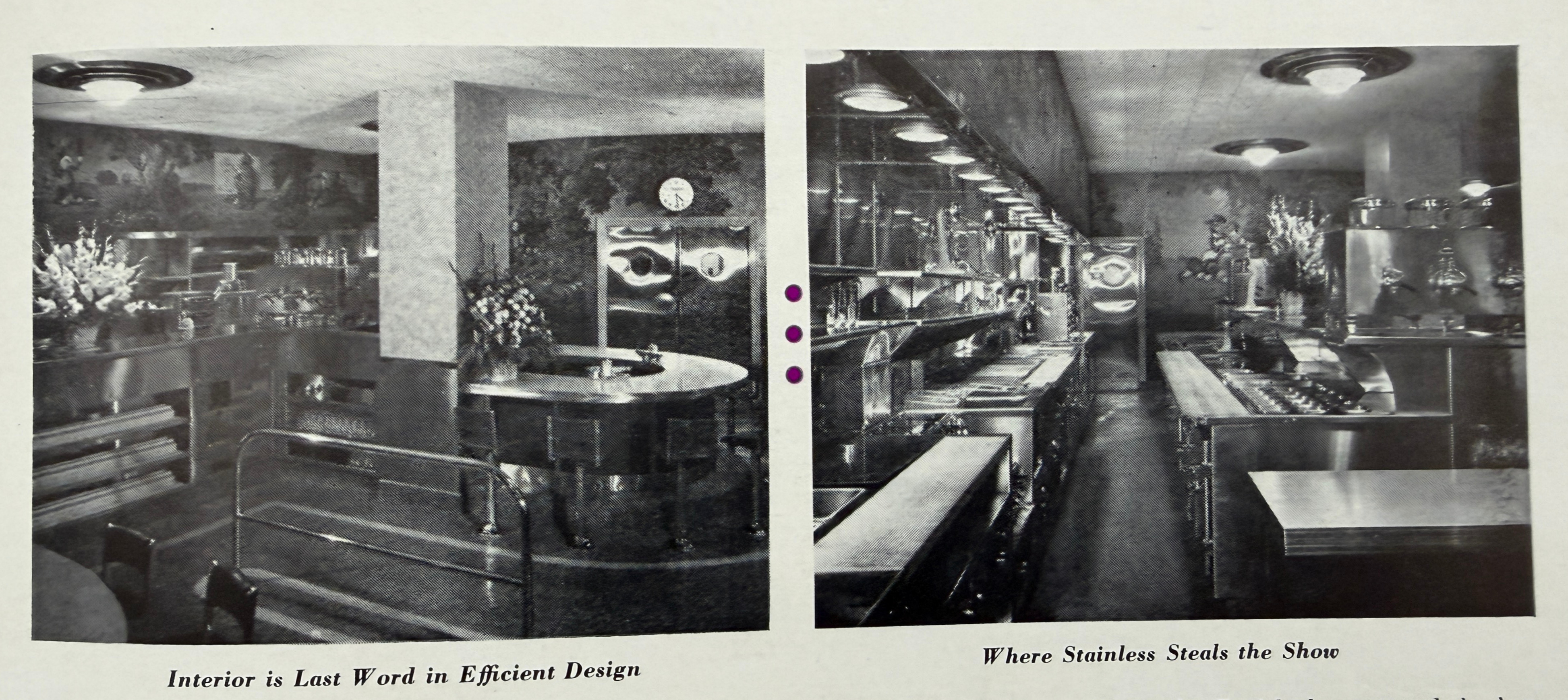
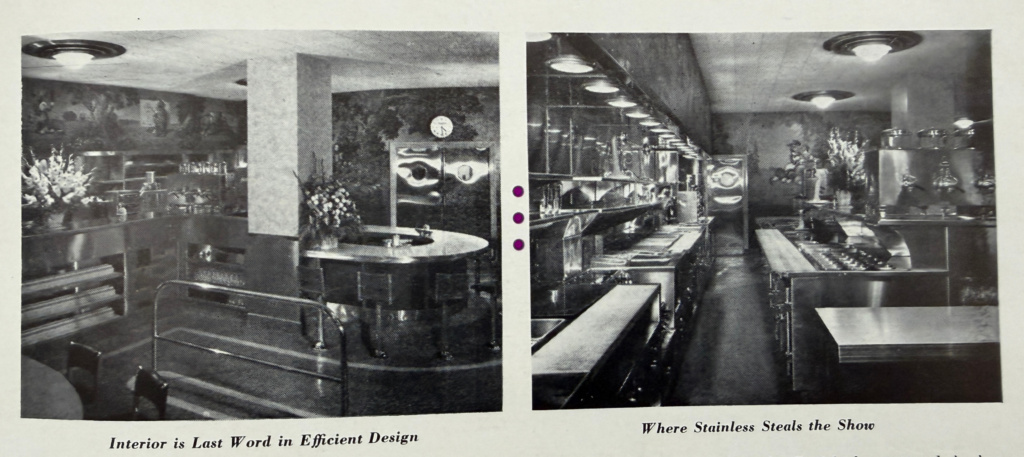
ROOSEVELT INTERIOR
Interior views of the Hotel Roosevelt Purple Cow, Pittsburgh, 1948. Surviving photographs reveal Grell murals extending around the restaurant walls. Approximately fifteen individual mural compositions can presently be identified in the photographic record, while Topicks reported that the complete installation comprised more than 600 feet of murals. Chicago History Museum.
ONE MURAL WAS PITTSBURGH’S OWN
The Roosevelt coverage makes another important distinction.
Among the many comic Purple Cow adventures covering the restaurant walls, Topicks called particular attention to the bicycle composition, describing the mural as having won first prize in a local contest and identifying its subject as “Bossy” on a bicycle spin, with Pittsburgh’s Golden Triangle for background.
That description confirms something visible in the photograph: Grell was deliberately localizing the Purple Cow.
The basic Purple Cow character could travel from hotel to hotel, but Grell changed her surroundings and circumstances. Favorite figures and situations could reappear, while individual compositions were adapted or newly constructed for their locations.
At Pittsburgh, the Purple Cow became a Pittsburgher.
The industrial skyline and Golden Triangle transformed a whimsical bicycle ride into a piece of local visual storytelling.
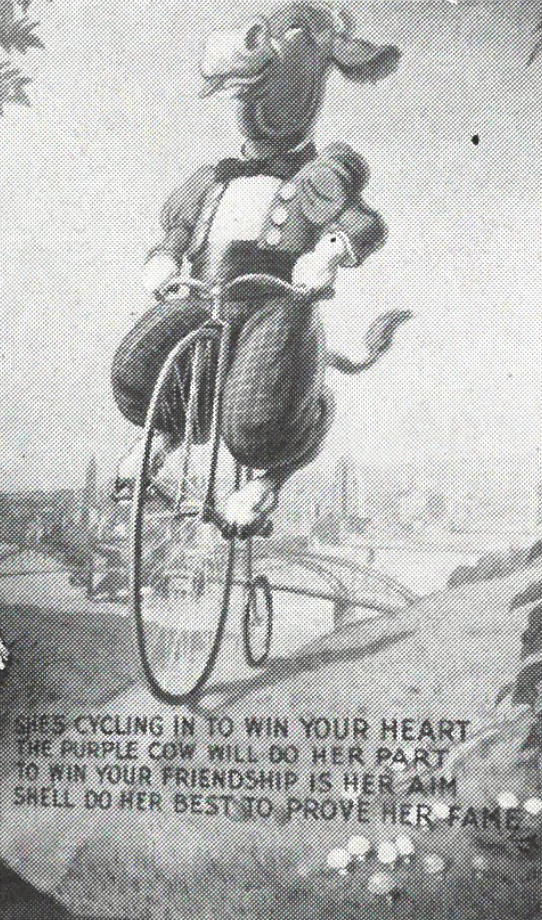
ONE LOCALLY THEMED MURAL
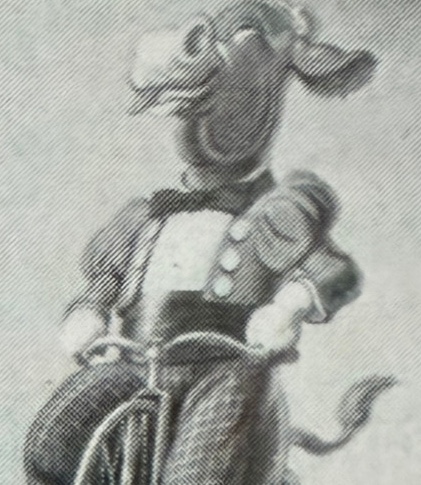
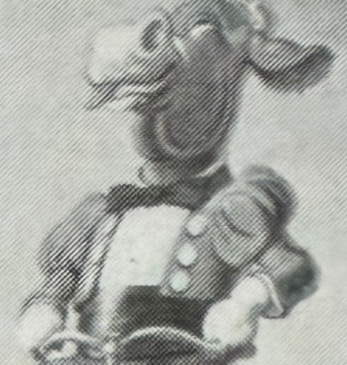
Detail of Grell’s Pittsburgh Purple Cow. The high-wheel bicycle, period costume and Golden Triangle background distinguish the composition as a locally themed Roosevelt mural rather than a generic Purple Cow scene. Pick Topicks, 1948. Chicago History Museum.
THE HIGH-WHEEL BICYCLE AND PITTSBURGH
Grell’s decision to put his Pittsburgh cow on a high-wheel bicycle is particularly intriguing when considered against the city’s cycling history.
Pittsburgh had possessed a vigorous cycling culture during the great bicycle era of the late nineteenth century. Among its best-known wheelmen was Frank Lenz, who became a prominent member of the Allegheny Cyclers.
Lenz purchased a Columbia high-wheeler in the 1880s and rode thousands of miles over the difficult roads surrounding Pittsburgh. He raced competitively and became one of the city’s prominent wheelmen before turning increasingly to long-distance cycling and photography.
In 1892, Lenz departed Pittsburgh on an ambitious attempt to circle the world by bicycle. He crossed the United States and traveled through Asia before disappearing in 1894 near Erzurum in the Ottoman Empire. His life and disappearance subsequently became part of American cycling history.
There is presently no documentary evidence that Grell intended the Purple Cow to represent Frank Lenz, and the Louis Grell Digital Archive does not make that attribution.
The history nevertheless provides valuable context. A high-wheel bicycle was not an image foreign to Pittsburgh’s past. The city had possessed organized cycling clubs and nationally notable riders during the high-wheel era. Lenz himself had ridden precisely this type of machine before changing to a safety bicycle for his later world journey.
Seen against that history, Grell’s antique cyclist was an especially appropriate comic vehicle for a mural consciously designed around Pittsburgh.
STEEL CITY — AND A STEEL BICYCLE
There may be another layer to Grell’s choice of a high-wheel bicycle for his Pittsburgh mural.
The Purple Cow was riding through the Steel City on a machine whose development was itself closely tied to steel.
High-wheel bicycles—known in their own era as “ordinaries” and today commonly called penny-farthings—were among the technological products made possible by advances in metalworking during the nineteenth century. Early cycles employed solid iron or steel members, while by about 1880 manufacturers were using weldless steel tubing for the backbone and fork of the ordinary bicycle.
That connection has particular resonance in Pittsburgh.
By the period when high-wheel cycling flourished in the 1870s and 1880s, Pittsburgh was already one of America’s great centers of iron and steel production. The city’s relationship with bicycles was not merely recreational, either. Pittsburgh cycling history records that Jones & Laughlin advertised its “American Special Cold Rolled Steel for Bicycle Parts.”
The region would subsequently become an enormous producer of steel tubing as well. National Tube’s McKeesport operations became a leading American producer of steel tubing and eventually part of U.S. Steel.
There is presently no evidence that Grell intended his bicycle as a reference to a particular Pittsburgh steel manufacturer, nor can the steel used in any specific nineteenth-century high wheel be traced to Pittsburgh without evidence for that particular bicycle.
But the historical associations surrounding Grell’s image are striking.
His locally themed Purple Cow rides an unmistakably steel-age machine through the Golden Triangle of America’s Steel City—a city that had possessed an active nineteenth-century cycling culture and whose own steel manufacturers later advertised material specifically for bicycle parts.
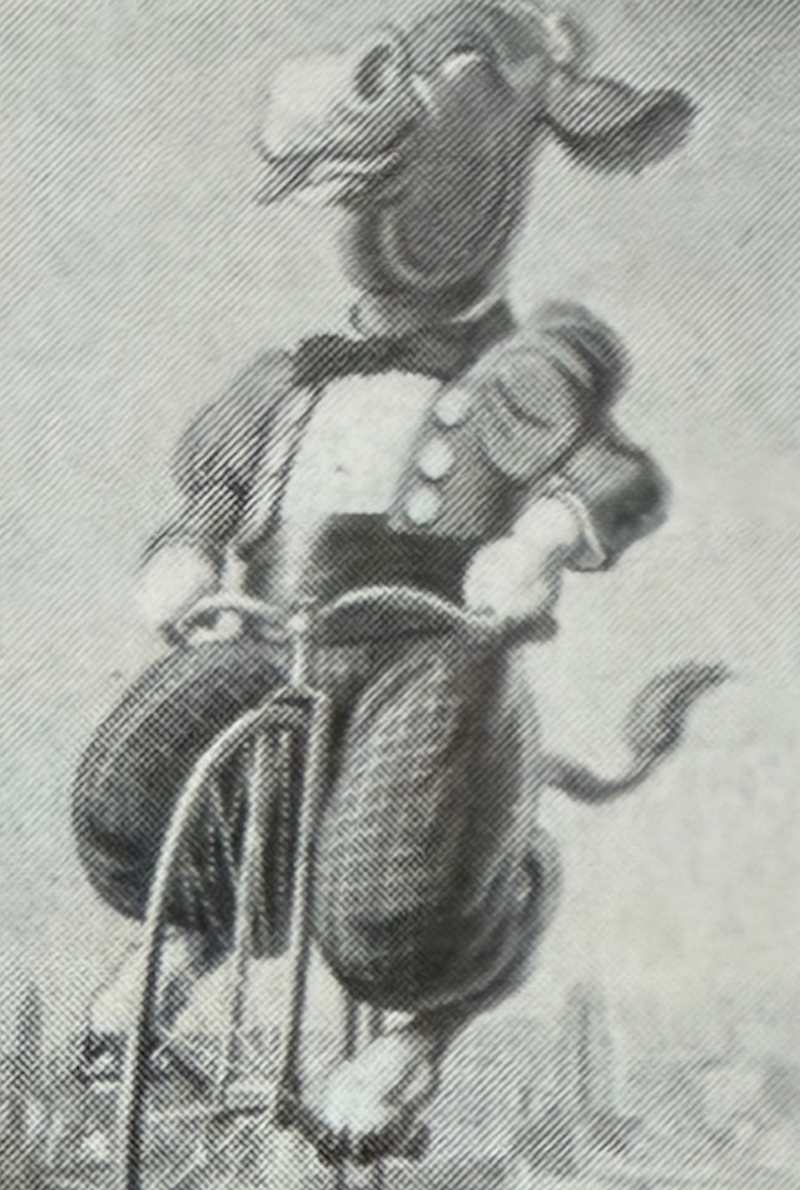
STEEL CITY ON TWO WHEELS.
Detail of Louis Grell’s locally themed She’s Cycling In mural, Hotel Roosevelt, Pittsburgh, 1948. Grell placed his Purple Cow on a nineteenth-century high-wheel bicycle against Pittsburgh’s Golden Triangle. High wheels relied increasingly on steel construction during their heyday, while Pittsburgh’s Jones & Laughlin later advertised cold-rolled steel specifically for bicycle parts. No evidence presently establishes that Grell intended a reference to a particular Pittsburgh manufacturer; the industrial connection is presented as historical context. Chicago History Museum.
EVEN THE COSTUME HELPS TELL THE STORY
Grell carried the historical joke beyond the bicycle.
His Purple Cow wears an elaborate old-fashioned outfit: puffed sleeves, a fitted upper garment, voluminous knee-length trousers or bloomers, stockings and shoes. The costume visually belongs to the world Grell was parodying rather than to 1948.
This is characteristic of his Purple Cow imagery. Grell did not simply paint cows performing human activities. He constructed miniature narratives through clothing, props, landscape and exaggerated human behavior.
The absurdity comes from the completeness of the transformation.
This cow is not merely sitting on a bicycle.
She has dressed for the occasion.
THE PUBLIC WAS ASKED TO FINISH GRELL’S STORY
The Roosevelt documentation also helps explain a remarkable Pick Hotels promotional tradition.
At the opening of a new Purple Cow, one locally themed Grell mural could be deliberately presented without its final jingle. The picture supplied the story; the public was then invited to supply the missing verse.
This distinction is important.
The public did not write the Purple Cow murals or their jingles generally. Rather, the documented contests centered upon a selected local mural whose accompanying four-line verse remained to be supplied.
At Pittsburgh, Pick Hotels distributed hundreds of invitation cards throughout the Steel City soliciting entries for the Roosevelt’s new Purple Cow.
The response was extraordinary.
According to Topicks, approximately 1,500 invitations produced between 500 and 750 entries.
Rosalie Bond’s four-line verse was selected as the winner.
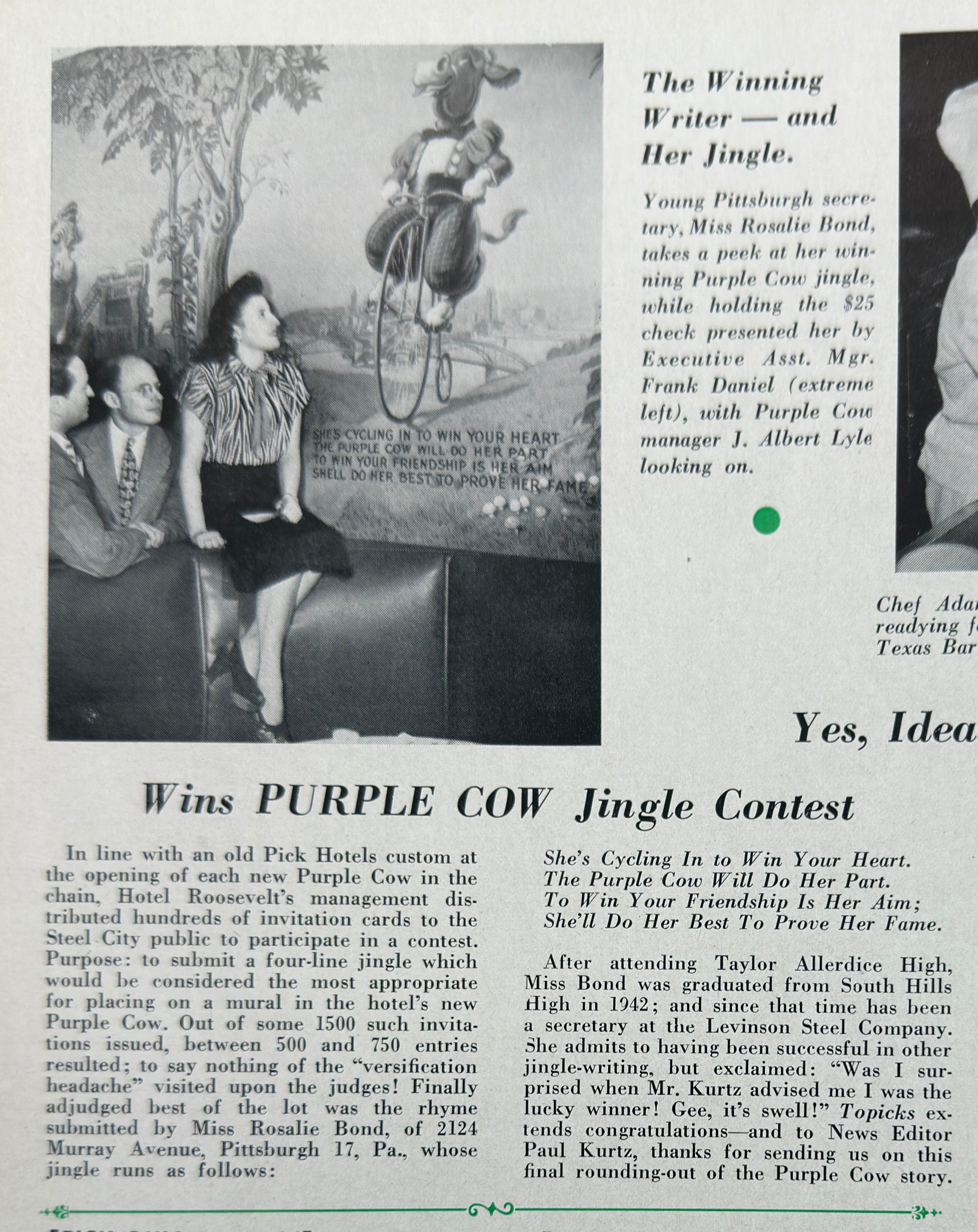
WINNING JINGLE
“Wins PURPLE COW Jingle Contest.” Pittsburgh secretary Rosalie Bond poses with the completed Grell bicycle mural and the $25 prize awarded for her winning four-line verse. Topicks explains that the contest accompanied the opening of the new Hotel Roosevelt Purple Cow and attracted hundreds of entries. Chicago History Museum.
NOT AN ISOLATED CONTEST
The Pittsburgh discovery becomes more significant when compared with evidence from other Pick Hotels.
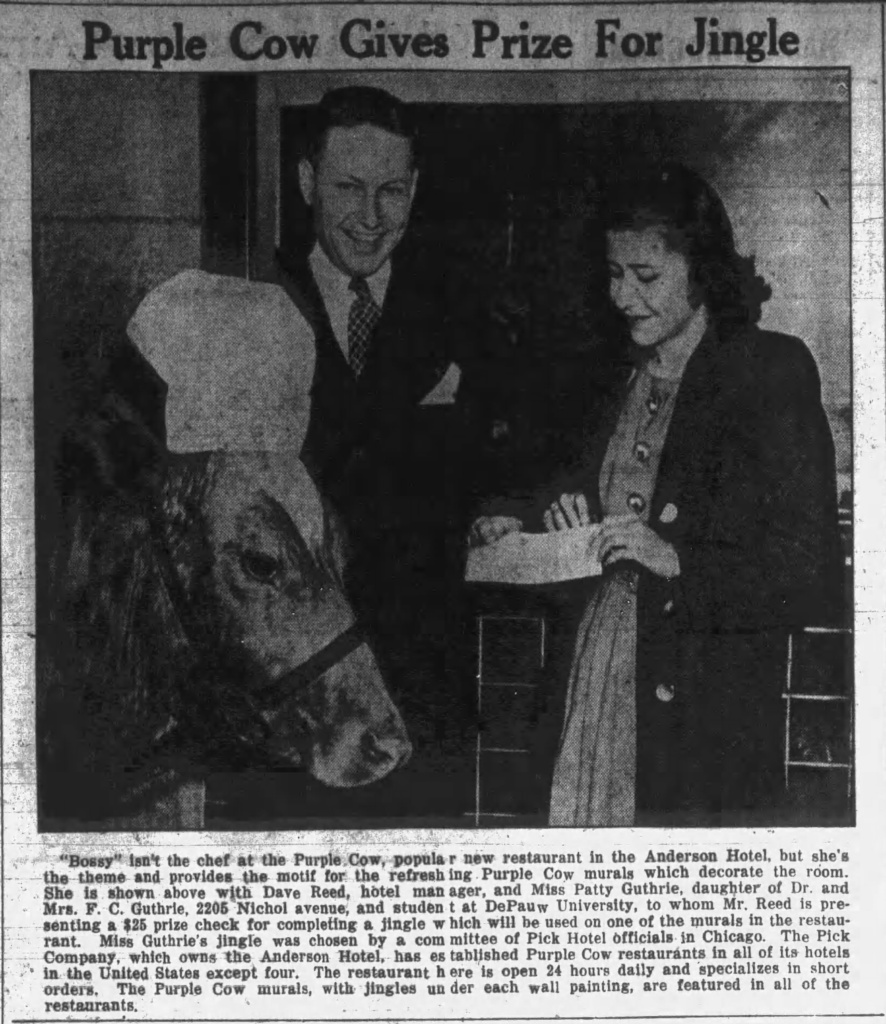
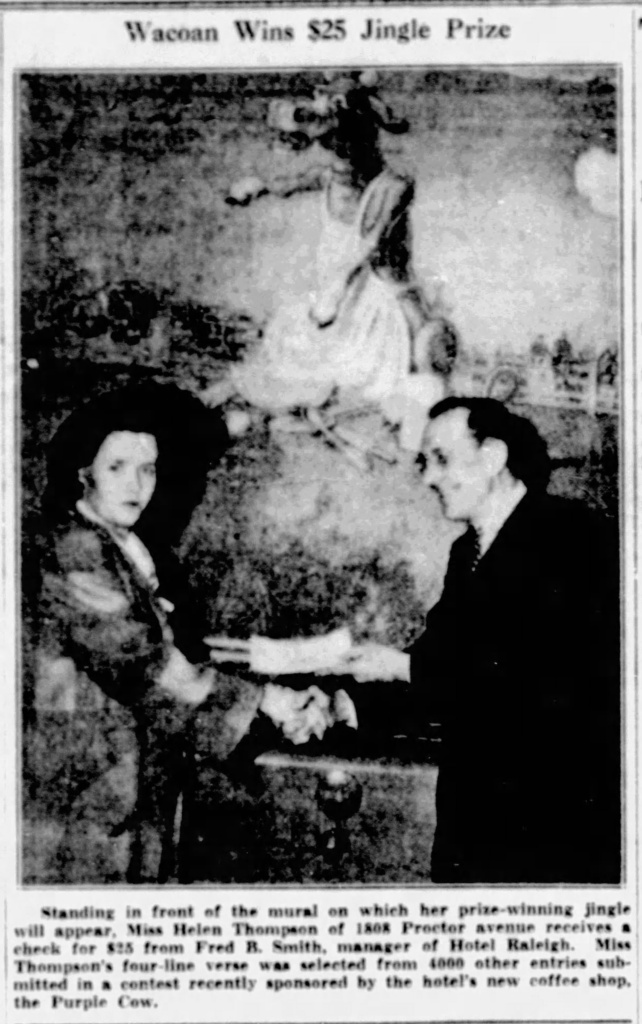
Three Purple Cow jingle contests are presently documented in the Louis Grell Family Archive: Pittsburgh, Pennsylvania; Raleigh, North Carolina; and Anderson, Indiana.
At Raleigh, approximately 4,000 entries reportedly competed for a $25 prize.
At Anderson, surviving newspaper coverage explicitly states that the winning jingle would be “used on one of the murals in the restaurant.”
Taken together, these records reveal a repeatable promotional system: Grell’s imagery, a locally themed mural, public participation, selection of a winning verse, and incorporation of that verse into the restaurant’s decorative program.
The contest was therefore more than advertising.
For a brief period, the residents of each city were invited to participate in completing one small part of the Purple Cow’s painted world.
FROM BLANK MURAL TO FINISHED MURAL
The significance of this practice is demonstrated particularly well by another surviving example from the Hotel Durant in Flint, Michigan.
A 1941 opening-day photograph shows Grell’s locally themed G.M. Tech mural without its eventual jingle. The mural depicts a professor-like Purple Cow standing before a board listing A.C. Spark Plug, Fisher Bodies, Chevrolet and Buick—companies associated with General Motors and especially appropriate to Flint.
A modern photograph taken at Kettering University in 2022 records the surviving mural with its four-line verse in place.
Together, the two images provide rare before-and-after evidence for the relationship between Grell’s locally themed paintings and their accompanying jingles.
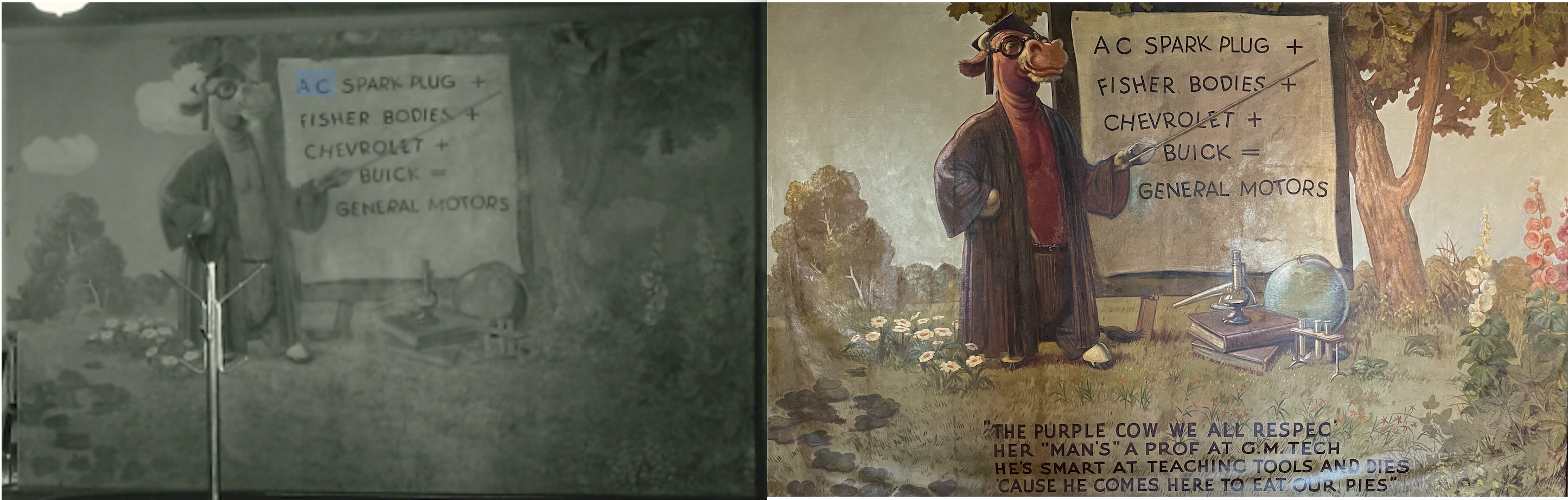
FLINT GM TECH
Grell’s G.M. Tech Purple Cow mural, Hotel Durant, Flint, Michigan. Left: the mural photographed at the restaurant’s 1941 opening before a jingle appears beneath the composition. Right: the surviving mural photographed at Kettering University in 2022 with its four-line verse in place. The comparison helps document how a locally themed Purple Cow composition could exist first as an image and subsequently acquire its accompanying jingle. MLive, Flint, MI & Kettering University, color photo by Richard Grell, 2022).
THE ROOSEVELT IN THE LARGER PURPLE COW RECORD
The Pittsburgh material now forms part of a much larger body of evidence assembled by the Louis Grell Family Archive.
The current catalogue contains 94 documented images of Purple Cow murals associated with multiple Pick Hotels locations.
That number is deliberately conservative.
It counts documented mural images—not every textual reference to murals and not every hotel known through other records to have possessed a Purple Cow installation.
The distinction matters.
The Hotel Roosevelt alone was reported to contain more than 600 feet of Grell murals. Pick Hotels stated that Grell’s work adorned every other Purple Cow in the chain. Other locations are documented textually even though photographs of their murals have not yet been located.
The surviving 94 images therefore represent evidence of the larger program, not a count of Grell’s total Purple Cow production.
A PAINTED WORLD, BUILT ONE CITY AT A TIME
She’s Cycling In to Win Your Heart captures something fundamental about Louis Grell’s Purple Cow project.
The Purple Cow was simultaneously a recognizable Pick Hotels character and a traveler.
Grell could repeat favorite characters and visual ideas, but he placed them into newly constructed surroundings. The murals were consequently related without simply being duplicates. No two documented compositions need be identical for the viewer to recognize that they inhabit the same imaginative world.
At Pittsburgh, that world encompassed more than 600 feet of painted walls.
And within that enormous installation, one cow climbed onto a high-wheel bicycle, dressed herself for an earlier age, and rode through Pittsburgh’s Golden Triangle.
Then Pick Hotels asked Pittsburgh to give her something Grell deliberately had not:
the words to complete her story.
Rosalie Bond supplied them.
More than seventy-five years later, the photographs, corporate publication and surviving archival evidence allow the story to be reconstructed again.
DOCUMENTARY SOURCES
The Albert Pick collection, Chicago History Museum Pick Topicks, March and April 1948, MLive & Kettering University, Flint, MI. Hotel Roosevelt/Purple Cow coverage; Richard Grell Archives photographic and documentary holdings; and the comparative Purple Cow jingle-contest documentation from Raleigh and Anderson. For the contextual section on Pittsburgh cycling and Frank Lenz, Pittsburgh historical sources document Lenz’s high-wheel career, membership in the Allegheny Cyclers and subsequent world-tour attempt.
Research Philosophy
The Louis Grell Digital Archive is committed to presenting documentary evidence as accurately as possible. New discoveries are evaluated using primary sources whenever available, and interpretations are revised as additional evidence emerges. Where questions remain unresolved, they are identified as subjects for continued research rather than presented as established fact.
